
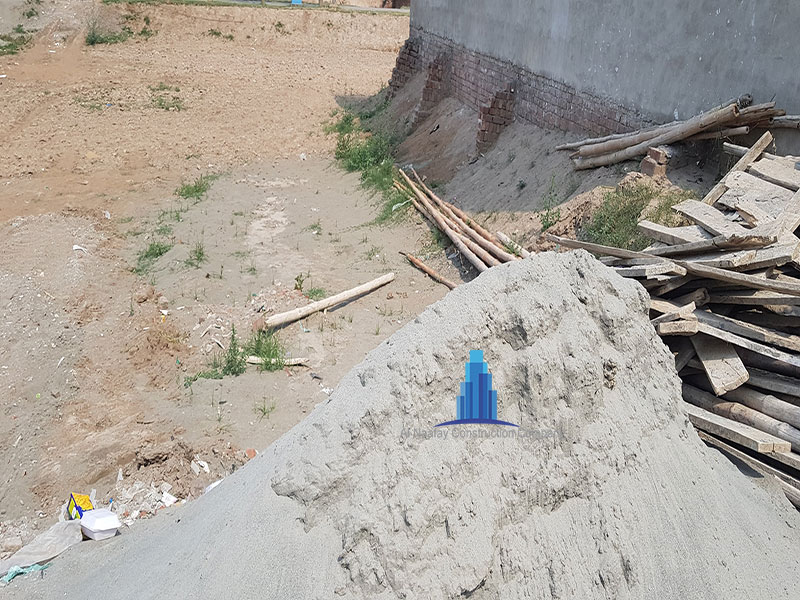
how to check sand quality
Check the colour
Good quality sand should be light brown or reddish-brown in colour. If the sand is grey, black, or white, it may contain impurities that could affect its quality.
Check the grain size
Good quality sand should have uniform grain size, meaning that all grains should be approximately the same size. If the sand contains large or small grains or has an uneven texture, it may not be suitable for use in construction.
Check for cohesion
Take a handful of sand and squeeze it tightly in your hand. Good quality sand should easily crumble and fall apart when released. If the sand sticks together or forms a ball, it may contain too much clay or silt, which can affect its strength and stability.
Perform a sedimentation test
Fill a clear jar with water and add a handful of sand to it. Shake the jar vigorously and then let it settle for several hours. Good quality sand will settle quickly and evenly, with no cloudiness or sediment at the bottom of the jar. If the sand takes a long time to settle or if it forms layers in the jar, it may not be suitable for use in construction. how to check sand quality
Check for contaminants
Look for any foreign objects or debris in the sand, such as shells, rocks, or sticks. These contaminants can weaken the sand and make it unsuitable for use in construction. You should also check for any foul odours or other signs of contamination, which could indicate that chemicals or pollutants have contaminated the sand. how to check sand quality best solutions
Sand Usage
Building foundations:
Sand is often used as a base material for building foundations because it provides a stable and level surface. It is typically compacted to create a firm, solid base for constructing walls, floors, and other structures. The sand used for this purpose is usually coarse and granular.
Concrete production:
Sand is a key ingredient in concrete, which is used in the construction of buildings, roads, bridges, and other structures. The sand used in concrete production is usually fine-grained and contains a low percentage of silt and clay. It is mixed with cement, water, and other aggregates to create a strong, durable material that can withstand heavy loads and harsh weather conditions.
Landscaping:
Sand is often used for landscaping purposes, such as filling in low spots, creating pathways, and creating sandboxes. The type of sand used for landscaping depends on the specific application. For example, coarse sand is often used for filling in low spots, while fine sand is used for creating smooth and level pathways.
Asphalt production:
Sand is used as a component of asphalt, which is used to pave roads, parking lots, and other surfaces. The sand used in asphalt production is typically fine-grained and contains a low percentage of silt and clay. It is mixed with asphalt cement, aggregates, and other materials to create a durable and long-lasting surface.
Glass production:
Sand is the primary raw material used in the production of glass. It is melted at high temperatures to create molten glass, which can then be moulded and shaped into a variety of products. The quality of the sand used in glass production is critical, as impurities can cause defects and imperfections in the final product. how to check sand quality
Sports fields:
Sand is often used as a component in the construction of sports fields, such as golf courses and soccer fields, to provide a stable and even surface. The type of sand used for this purpose is typically fine-grained and contains a low percentage of silt and clay.
Filtration:
Sand is used as a filtering material in water treatment plants and swimming pools, to remove impurities and particles from the water. The sand used for this purpose is usually coarse and granular, and may be treated with chemicals to enhance its filtration capabilities.
Foundry casting: Sand is used as a moulding material in the production of metal castings. The sand is mixed with a binder and compacted around a pattern to create a mold, which is then used to cast the metal part. The sand used for this purpose is typically a specialized type of sand called foundry sand, which has specific properties that make it suitable for use in this application.
Quick Links
Social Icons
Contact Us Information
443 J3 Johar Town Lahore near Expo Center Lahore
