
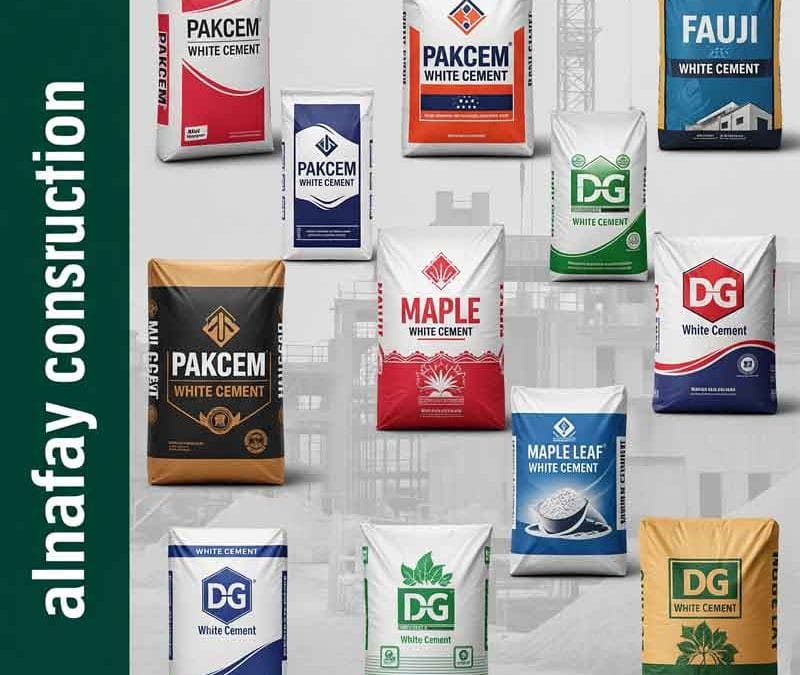
White Cement
Introduction
Cement is one of the most important materials used in the construction industry. When we think about cement, most people imagine the common grey cement. But there is another type of cement that is very special and useful in different ways – it is called White Cement.
White Cement is a special type of cement that looks completely white in color instead of grey. It is made in a similar way as Ordinary Portland Cement (OPC), but the raw materials used are different. These materials have very low iron oxide and manganese oxide content, which gives the cement its pure white color. Because of its brightness, strength, and smooth finish, White Cement is used in modern architecture, interior design, and decorative construction.
In this blog, we will understand what is White Cement, how it is made, its properties, uses, advantages, and differences from grey cement.
What is White Cement?
White Cement is a type of Ordinary Portland Cement but with a pure white color. The whiteness is achieved by reducing the amount of iron oxide and other coloring oxides in the raw material. It is made from raw materials like pure limestone, clay with low iron content, kaolin, and gypsum.
The main purpose of White Cement is not only strength but also aesthetic beauty. It is used where the appearance of the surface matters, such as in flooring, decorative finishes, facades, and artistic works.
Manufacturing of White Cement
The manufacturing process of White Cement is almost the same as grey cement, but it requires more care and purity.
Raw Materials Selection
Pure limestone
China clay or kaolin
Sand (with low iron content)
Gypsum
These materials are selected carefully so that they do not contain iron oxide and manganese, which are responsible for the grey color.
Clinker Formation
The raw materials are heated in a kiln at around 1400–1500 °C to form clinker. For White Cement, the fuel used in the kiln must also be free from impurities. For example, oil or natural gas is preferred instead of coal to avoid contamination.Cooling and Grinding
The clinker is cooled very quickly to preserve the white color, then ground with gypsum to form fine white cement.Quality Check
The cement is tested for whiteness, strength, and smoothness before it is packed.
Properties of White Cement
White Cement has some unique properties that make it different from grey cement:
Color – Pure white in appearance, very bright and clean look.
Strength – Comparable to Ordinary Portland Cement.
Fineness – White Cement is usually finer than grey cement.
Setting Time – Almost the same as OPC (initial setting around 30 minutes).
Whiteness Index – Good quality White Cement has a whiteness index of above 85%.
Smooth Finish – Gives a shiny and elegant surface.
Uses of White Cement
White Cement is not generally used for heavy structural work like bridges or foundations. Instead, it is mainly used for decorative and architectural purposes. Some of the major uses are:
Flooring
Used for marble-like floors and terrazzo flooring.
Creates smooth and glossy surfaces.
Wall Finishes
Used in wall putty and paints.
Provides a bright, clean background that enhances paint colors.
Decorative Works
Making artistic designs, precast items, and sculptures.
Used in garden ornaments, tiles, and false ceilings.
Exterior Designs
For facades of buildings.
Creates a modern and attractive look.
Tile Grouting and Fixing
White Cement is used in fixing tiles because of its smooth bonding property.
Architectural Buildings
Hotels, shopping malls, and showrooms often use White Cement to give a luxurious look.
Advantages of White Cement
Provides a bright and elegant finish.
Increases the beauty of surfaces.
Can be mixed with pigments to create colored cement.
High reflective property – keeps buildings cooler.
Very smooth, which reduces paint consumption.
Disadvantages of White Cement
More expensive compared to grey cement.
Limited use in heavy construction.
Needs high-quality raw materials, so availability can be limited.
Difference Between White Cement and Grey Cement
| Feature | White Cement | Grey Cement |
|---|---|---|
| Color | Pure White | Grey |
| Cost | More expensive | Cheaper |
| Main Use | Decorative & Aesthetic | Structural work |
| Raw Materials | Low iron & manganese | Contains iron oxides |
| Fineness | Finer | Normal |
| Strength | Similar to OPC | Standard strength |
Popular Brands of White Cement in Pakistan
Maple Leaf White Cement
Bestway White Cement
Kohat White Cement
Cherat White Cement
These brands are commonly used for flooring, wall finishes, and decorative projects.
Quick Links
Social Icons
Contact Us Information
443 J3 Johar Town Lahore near Expo Center Lahore
