
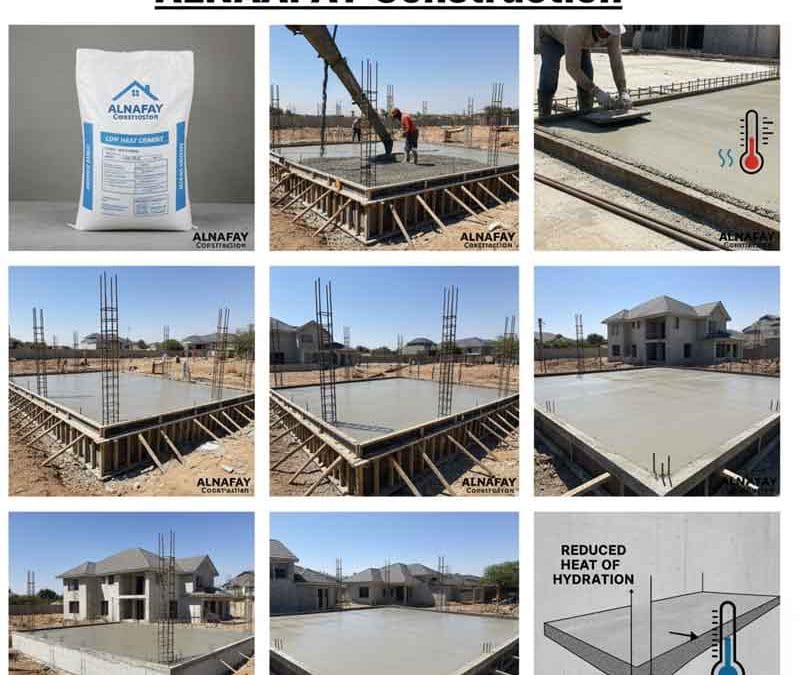
Low Heat Cement for House Construction
1. What Is Low Heat Cement?
Low Heat Cement (LHC) is a type of cement that releases less heat during the chemical reaction of setting and hardening. It is used in construction where temperature control inside concrete is important — especially in hot climates or large concrete sections.
In simple words:
It helps you build strong concrete without it getting too hot from inside. Low Heat Cement for House Construction
That “heat” is called heat of hydration, and when cement gets too hot while setting, it causes cracks, internal stress, and even structure failure. Low Heat Cement makes sure this doesn’t happen.
2. Why Is Low Heat Cement Important in House Construction?
In house building:
- You cast roofs, beams, footings, and columns.
- If you live in a hot or dry area, cement can get very hot during hardening.
- That heat can cause concrete to crack from inside.
- Cracks reduce strength, life, and safety of your building.
- Low Heat Cement minimizes this risk.
It is especially helpful for:
- Homes in places like Sindh, Southern Punjab, or Balochistan
- Large foundations (1 kanal or bigger houses)
- RCC slabs cast in summer
- Water tanks and basements
3. How Does Low Heat Cement Actually Work?
Normal Cement = High C3S (Tricalcium Silicate)
LHC = Low C3S + High C2S (Dicalcium Silicate)
Why does that matter?
- C3S = Early strength but high heat
- C2S = Slow strength build-up but low heat
When water is mixed with LHC, it generates less temperature rise, which:
- Reduces thermal cracks
- Allows concrete to set evenly
- Boosts long-term strength
In simple terms:
Low Heat Cement sets slowly, but lasts longer without cracking.Low Heat Cement for House Construction
4. Real-Life Case Study – A 10 Marla House in Multan
In 2022, a family in Multan constructed their 10 marla home using Low Heat Cement, especially for the foundation and first-floor RCC slab.
Their engineer warned that:
- High summer temps (above 40°C)
- Plus fast-setting cement
- Equals cracks in columns and roof
They switched to LHC for footings and slab work.Low Heat Cement for House Construction
Results:
- Less surface cracking
- Slab cured better
- Internal temperature 4°C cooler
- No premature concrete failure
Till now (2 years later), they’ve seen no structural issues.
5. Key Properties of Low Heat Cement That Make It Unique
| Property | Detail |
|---|---|
| Low Heat of Hydration | Less internal temperature rise |
| Slow but steady strength gain | Improved durability |
| Fineness | Medium – not as fine as Rapid cement |
| Cement color | Light grey |
| Chemical resistance | Good |
| Environmental temperature suitable | 25°C–45°C ideal |
6. Comparison: Low Heat Cement vs Ordinary Portland Cement
| Feature | Ordinary Cement (OPC) | Low Heat Cement (LHC) |
|---|---|---|
| Heat during setting | High | Low |
| Initial Strength | Faster | Slower |
| Workability | Easier to mix | Slightly stiff |
| Price | Generally lower | Slightly higher |
| Cracking Risk in hot weather | Higher | Much lower |
| Best for | Fast builds | Durable builds in heat |
So, if you want long-term stability, especially in hot zones, Low Heat Cement is a winner.
7. Ideal Locations and Conditions for Using Low Heat Cement
Use LHC if:
- You are building in temperatures above 35°C
- Your slab is larger than 600 square feet
- You are casting mat foundations (house base)
- You are working in sunlight with slow curing ability
- Basement walls are more than 12 inches thick
It’s not limited to big projects. Smart homeowners even use it for overhead water tanks, because they store water better with no internal cracks.
8. How to Mix and Apply Low Heat Cement in Construction
To get best results, follow this guide:
- Use clean, cool water
- Maintain water-to-cement ratio = 0.45 to 0.50
- Mix the batch within 20–30 mins
- Place the concrete quickly
- Vibrate with needle for compaction
- Protect slab from direct sunlight during curing
- Keep structure wet for at least 7–14 days
If followed well, the concrete will harden without surface cracks or heat damage, especially in larger slab or roof casting.
9. Benefits of Using Low Heat Cement in House Construction
| Benefit | Why It Matters |
|---|---|
| Lower cracking risk | Safer structure |
| Greater long-term strength | More durable home |
| Works better in heat | Perfect for southern Pakistan |
| Better curing performance | Good surface finish |
| Fewer repair costs later | Saves future money |
| Less chance of sudden failure | Improves safety |
Less heat = less stress = more peace of mind.
10. Limitations You Should Know
No product is perfect. Here’s what to remember:
- It gives early strength slowly
- Not ideal where very fast results are needed
- Slightly more expensive than OPC (ordinary cement)
- Needs careful curing — cannot be left open to dry
- Mixing must be proper — poor batching causes bleeding
But, with expert planning, these issues are easy to manage.
11. Current Cost of Low Heat Cement in Pakistan (2024–2025)
| Brand | Bag Price (PKR/50kg) |
|---|---|
| DG Khan Cement – Low Heat | Rs. 1,350 – Rs. 1,450 |
| Maple Leaf Low Heat | Rs. 1,400 – Rs. 1,500 |
| Bestway Special LHC | Rs. 1,300 – Rs. 1,450 |
| Lucky Cement – LHC | Rs. 1,350 – Rs. 1,470 |
| Kohat Low Heat | Rs. 1,400 – Rs. 1,550 |
Note:
- Prices vary slightly by city
- Buy only from authorized dealers
- Check freshness (cement age under 3 months)
12. Top Cement Companies Offering Low Heat Cement in Pakistan
- Maple Leaf Cement
- Lucky Cement
- DG Khan Cement
- Cherat Cement
- Flying Cement (Low Heat Premium)
- Kohat Cement
These companies offer stronger formulas made specifically for hot weather and slower set demand.
13. How It Supports Environment & Sustainability
Low Heat Cement:
- Requires less cooling labor
- Reduces early-stage failures (so less rebuilding)
- Produces lower greenhouse emissions
- Less cracking means buildings survive longer
This makes it a climate-smart choice for eco-conscious builders and sustainable homes.
14. LHC vs Sulphate-Resistant Cement – Not the Same!
People often mix these two:
| Feature | LHC | Sulphate Resistant (SRC) |
|---|---|---|
| Designed for | Controlling temperature | Resisting salty water |
| Best for | Roofs/slabs | Foundations in coastal or saline soil |
| Common use | Domestic slabs | Dams, sea tunnels |
In short: Use LHC for heat, SRC for saline areas.
15. Best Places to Use Low Heat Cement in Houses
- RCC Roof slabs
- Deep beam casting
- Water tank slab/floor/walls
- Porch and garage flooring
- Big foundations (2 kanal plots)
- Column merging points
- Boundary walls exposed to sunlight
- Sun-facing walls
16. Low Heat Cement in Footings, Columns and RCC Slabs
In structures holding weight:
- High hydration always causes delay or expansion
- But LHC controls unwanted reactions
- RCC becomes more stable over time
- Helps avoid column-face cracks and slab sagging
If your house has solar panels, water tanks, or heavy load — this helps a lot.
17. Best Curing Practices for LHC Structures
- Start curing within 4–5 hours of casting
- Don’t let water flow — gentle spray preferred
- Use wet gunny bags in hot regions
- Curing should be twice daily for at least 7 days
- Check surface temperature to stay under 35°C if possible
Curing helps bring out the real strength of LHC concrete.
18. Storage, Transport and Bag Protection
- Store in dry, shaded rooms
- Don’t stack more than 12 bags high
- Follow first-in-first-out rule
- Use pallets to keep bags off ground
- Ensure proper ventilation
Don’t let moisture enter – it can ruin the quality quickly.
19. What Civil Engineers and Contractors Say
“I no longer use OPC for summer slabs — LHC takes that fear away.” – Engr. Faisal, Lahore
“Low Heat Cement helped us save a floor from cracking completely during record heat in Nawabshah.” – Engr. Talha, Site Engineer
“It helps reduce early stress problem during curing phases. Good for dense foundations too.” – Ar. Nabeel, Architect
Engineers suggest to always match LHC with proper structure type and project timeline.
Quick Links
Social Icons
Contact Us Information
443 J3 Johar Town Lahore near Expo Center Lahore
