
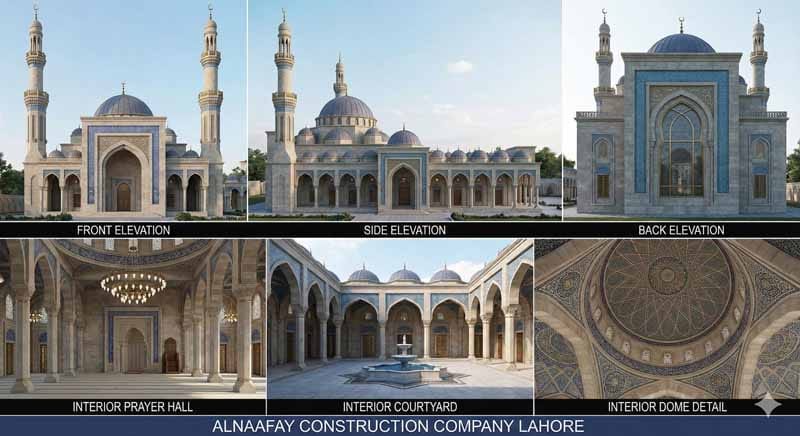
Islamic Mosque Design: Important Notes for Beauty, Faith, and Function
Have you ever stood in a mosque so peaceful that your heart felt calm without a word being said? Perhaps you saw the rising dome, the shining minaret, the smooth prayer hall, or the calligraphy on the wall. A mosque is more than a building. It is a space made for connection—between people and their Creator.
In this blog, we’ll walk gently through the Islamic Mosque Design: Important Notes that every student, architect, and believer should know. From shapes and colors to symbolism and spiritual need, we will explore what makes mosque design so respectful, beautiful, and full of meaning.
Even young readers will be able to understand this guide—because at the heart of mosque design is simplicity, clarity, and love for faith.
What Is Islamic Mosque Architecture?
The word “mosque” comes from the Arabic word “Masjid,” which means “a place for prostration.” It is where Muslims gather to offer salah (prayer).
Over the past 1400+ years, the design of mosques has changed according to the region, the culture, and available materials. Yet, the purpose and key elements remain mostly the same.
So, what does Islamic Mosque Design: Important Notes mean?
It means understanding:
- What goes into building a mosque?
- Which elements must be included?
- What materials and shapes should be used?
- How do beauty and function come together?
- Why does each part have meaning?
Let’s find out together.
Why Mosque Design Matters in Islam
Islam teaches balance between deen (faith) and dunya (worldly life). Mosque design is a great example of how this balance happens in real spaces.
Here’s why the design of a mosque is important:
1. A Place for Worship Must Feel Pure
The design of a mosque must invite peace, not noise or distraction. Muslims come to cleanse their hearts in prayer. Architecture should reflect that.
2. Every Element Has Spiritual Meaning
From domes to doors, from carpets to corridors—there is wisdom in every detail. Using Islamic history and values in construction brings barakah (blessing).
3. Beauty is Part of Faith
As the Prophet Muhammad (peace be upon him) said:
“Allah is beautiful and loves beauty.”
This means that making a mosque look good is not show-off—it is a form of respect to the One it is built for.
Islamic Mosque Design: Which Countries Use It Most?
Islamic mosque architecture is found around the world, especially in these regions:
🇸🇦 Saudi Arabia & The Gulf:
- Very large mosques with simple white domes
- Use of calligraphy and geometric patterns
- Focus on wide open spaces
🇹🇷 Turkey:
- Ottoman mosque designs
- Big central domes with supporting half-domes
- Beautiful stained-glass windows
🇪🇬 Egypt & North Africa:
- Use of mashrabiya (carved wooden screens)
- Tall thin minarets
- Clay and brickwork in older mosques
🇮🇳 India / Pakistan / Bangladesh:
- Mughal influence (red sandstone, tile work)
- Multiple small domes
- Minarets with arches and floral carvings
🇮🇩 Indonesia / Malaysia:
- Mosques made of timber
- Roofs shaped like pyramids
- Local tropical materials used
Although each region builds in a different way, the core elements of Islamic Mosque Design are respected in all.
Elements of Islamic Mosque Design: Important Notes by Feature
Let’s now break down every part of a mosque, so we truly understand what matters and why it matters.
1. The Mihrab – Direction of Faith
The mihrab is a small niche in the wall that shows the Qibla—the direction of prayer toward Makkah.
- Must be placed at the front wall of the prayer hall
- Most mihrabs are shaped like an arch
- Some are decorated with tiles or calligraphy
- It is not a sound speaker—but a place of focus
It helps worshippers know where to stand—and reminds them to align their hearts.
2. The Minaret – Call to Prayer’s Home
A minaret is a tall and slender tower that rises from the corner of the mosque.
- Traditionally used by the muezzin (the person calling to prayer)
- Symbolic of reaching high toward Heaven
- Some mosques have 1, others 2 or 4
- Minarets are slim with balconies or open rooves
Even though speakers are used today, the spiritual and visual role of the minaret is still respected.
3. The Prayer Hall – Heart of the Muslim Community
This is the largest room in a mosque—where prayers happen in rows.
Important guidelines:
- Should face the qibla wall
- Carpet with straight lines makes prayer easier
- No furniture except for the imam’s stand (minbar)
- Open space allows movement and reflects equality
The hall should feel bright, calm, and holy—a space where voices lower and hearts rise.
4. The Dome – Symbol of Unity and Heaven
Most mosques have at least one dome, right above the prayer hall.
Why a dome?
- It reflects harmony and unity
- Represents the sky and spiritual openness
- Makes the voice of the imam echo softly during prayer
- Allows hot air to rise, keeping the hall cool
While domes are stunning, their job is not just beauty—it’s function and faith.
5. The Ablution Area – Preparing Inside and Out
Before Muslims pray, they do wudhu (ablution)—a cleaning ritual.
Therefore, mosques must have:
- A clean fountain, taps, or water system
- Proper drainage, so feet wash easily
- Seats or low benches for seniors or disabled worshippers
- Separate areas for men and women
Cleanliness is half of faith. The design of the wudhu area reminds people of that daily.
6. Doors and Entrances – Welcoming with Dignity
The entrance of the mosque should be:
- Wide enough to handle crowds
- Clearly divided for men and women
- Decorated with respectful Arabic script, not pictures
- Made of wood, brass, or stone—not glass
- Reflective of Islamic hospitality and shelter
A mosque invites people—not just for prayer but during sadness, joy, and learning.
7. Calligraphy and Decoration – Beauty without Idols
Islam does not allow living pictures inside mosques (e.g., faces of animals or humans).
Instead, mosque interiors are decorated with:
- Verses from the Qur’an in Arabic
- Geometric patterns and arabesque art
- Names of Allah and the Prophet Muhammad (SAW)
- Mosaics, carved wood, colored tiles
The idea is not to distract but to remind. Let the eyes rest—and the heart remember God.
Islamic Mosque Design Materials: What to Use and Why
Mosques can be made from many things. However, some materials serve better, both for care and for faith.
Common elements include:
✅ Stone and Brickwork
Used in historic mosques like Masjid Al-Aqsa and Sultan Hassan mosque in Egypt. Strong, earthy, and long-lasting.
✅ Tile Work
Common in Iran, Pakistan, and India. Adds color and feeling through simple natural materials.
✅ Marble
Popular for floors due to its cooling effect. Almost all mosques in Saudi Arabia and Major Middle Eastern cities use it.
✅ Wood
Used on windows, doors, and screens. Adds softness and texture. Many Turkish mosques master this.
✅ Gold and Brass (in small amounts)
Sometimes used on domes or minbars for decoration. Should not be the focus.
Overall, the design must be clean, practical, and timeless.
Lighting in Mosque Design: Both Day and Night
Often, people forget how much lighting matters.
For daytime, skylights and windows help keep the hall bright without needing too many bulbs.
For night:
- Use soft yellow lighting, not sharp white
- Hang lanterns or Arabic lamps, if possible
- Stay away from blinking, moving lights that feel distracting
- Place spotlights softly on the mihrab and minbar
A mosque should feel alive, not loud.
Can Children Be Part of Mosque Design?
Yes! In fact, they should be.
Here’s how:
- Add a children’s room with books and cushions
- Put low hooks in the wudhu area for small towels
- Place Qur’an shelves at safe heights
- Design signs with Arabic in both big and small fonts
- Keep a separate family prayer area so mothers can pray with kids
When the mosque makes space for children, they grow up loving it—not fearing silence or scolding.
What is the Role of Education in Mosque Architecture?
The Prophet’s mosque in Madinah was also a school, court, shelter, and meeting space.
Modern mosques should offer:
- A maktab or madrasah for children
- A small Islamic library
- Lectures or classes for adults
- Wall space for duas and Qur’an verses
- A noticeboard to inform of prayer times or community news
By bringing knowledge into architecture, mosques can guide hearts without always saying a word.
Final Wisdom: Islamic Mosque Design Important Notes in Summary
Here’s a gentle recap of all we learned:
| Mosque Feature | Islamic Purpose |
|---|---|
| Mihrab | Shows direction of prayer (Qibla) |
| Minaret | Call to prayer, Islamic symbol |
| Prayer Hall | Open space, focuses the soul |
| Dome | Unity, acoustic echo, beauty |
| Wudhu Area | Cleansing before worship |
| Calligraphy | Reminder of Qur’an and names of Allah |
| Decoration | Geometry over pictures, calm visuals |
| Education Rooms | Promotes learning and sharing knowledge |
Quick Links
Social Icons
Contact Us Information
443 J3 Johar Town Lahore near Expo Center Lahore
