
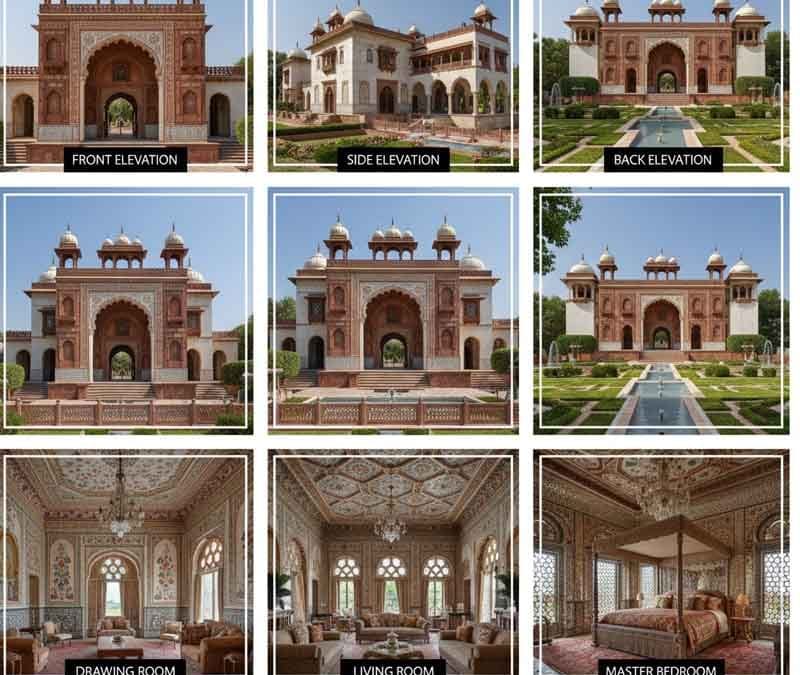
Mughal Architecture Design Home – A Royal Style for Modern Living
Close your eyes for a moment and imagine a place built long ago. There is a grand entrance, a garden filled with fountains, floral walls, and ceiling patterns that look like stars. You’re not inside a palace or a museum. This dream is part of Mughal Architecture Design Home—a design style that blends the beauty of the past with the comfort of the present.
In this blog, we’ll walk together through the history, structure, colors, materials, and layout of Mughal-inspired homes. Each section is written using simple English, making it easy for everyone—including children and first-time readers—to enjoy.
Let us begin this calm journey through domes, arches, and timeless design.
Where Is Mughal Architecture Famous Today?
The Mughal emperors ruled large parts of South Asia from the 16th to 18th century. They brought with them a rich blend of Persian, Islamic, Turkic, and Indian styles.
Today, Mughal Architecture Design Home is most commonly found in these countries:
- India – Homes, tombs, and forts still stand proud
- Pakistan – Lahore, Multan, and Islamabad show Mughal influence in buildings
- Bangladesh – Dhaka has many historical Mughal structures
- Afghanistan – Early phases of this style began here
- UK, USA, UAE – Through cultural appreciation and modern adaptations
While it began as royal architecture long ago, today people adapt it into modern homes wherever they want a touch of history and beauty at once.
History Behind Mughal Architecture: Simple Facts
Understanding a design becomes easier when we know where it comes from.
The Mughal Empire was started by Babur in 1526. Later emperors like Akbar, Shah Jahan, and Aurangzeb built many famous monuments, including the Taj Mahal, Red Fort, and Badshahi Mosque.
Key Mughal design elements include:
- Huge domes
- Pointed arches
- Geometric and floral patterns
- Symmetry in layout
- Marble and sandstone
- Fountains and gardens
In the past, these styles were used in palaces, mosques, tombs, and sometimes in the homes of nobles. Now, they’re recreated in smaller, modern homes to bring that royal energy back to life.
Why Choose Mughal Architecture Design Home Today?
People still choose this style not because it’s fancy, but because it holds emotion, history, and comfort together.
Here’s why Mughal home design remains popular:
1. Connection with Culture
If you’re from South Asia or appreciate Islamic history, building a Mughal-style home connects you to your roots in a deep, beautiful manner.
2. Natural Cooling
Many features in Mughal homes—arched windows, high ceilings, thick walls—help in keeping rooms cool naturally. Especially in warm countries like Pakistan and India, this is a smart choice.
3. Visual Beauty
The blend of symmetrical design, color, light, and shape makes the house feel softer and more welcoming.
4. Timelessness
Just like the forts and palaces that have lasted for centuries, Mughal style doesn’t go out of fashion. It’s always charming.
5. Mix of Simplicity and Luxury
You can choose to keep it minimal with only a few arches and patterns, or go full traditional with domes, marble, and calligraphy. Both choices work.
Main Elements Found in a Mughal Architecture Design Home
Let’s now explore all the important features you might want to include if you plan to design or even just understand a Mughal-style home.
1. Domes – Symbol of Majesty
Even though large domes were once built only on monuments, smaller versions are now used in home entrances or ceiling corners for that soft, royal feel.
Features:
- Usually rounded or onion-shaped
- Often painted with stars, tiles, or floral motifs
- Gives the structure a strong, symbolic centerpiece
2. Arches – Graceful Gateway Design
Arches are curves above doors or windows. They reduce sharpness and welcome movement expertly.
Types include:
- Pointed arches (commonly seen in mosques)
- Multifoil arches (multiple curves for delicate look)
- Keystone arches (with a central stone in the middle)
Use them at entrances, balconies, prayer rooms, or corridor edges to add grace.
3. Jaalis (Latticed Screens) – Beauty in Patterns
These are stone or wooden screens with holes in them carved in beautiful patterns.
Benefits:
- Create gentle airflow
- Offer privacy while letting in light
- Cast stunning shadows during daytime
You can use jaalis on windows, between living spaces, or as wall features.
4. Frescoes and Pietra Dura
Frescoes are hand-painted designs on walls or ceilings, while pietra dura means inlaying different colored stones into marble.
These were once done in mausoleums, but now you can:
- Paint floral borders around rooms
- Inlay colored marble or tiles in entrance floors
- Frame Qur’anic verses in similar patterns
5. Geometric Patterns and Calligraphy
Calligraphy is a sacred art in Islam. Usually, Ayahs (verses) from the Qur’an are designed in Arabic and placed tastefully around the house.
Common spots:
- On entrance walls
- In the prayer room or study
- Around lighting fixtures or domes
Geometric tile patterns enhance the overall design further—without relying on pictures or human forms.
6. Gardens and Courtyards – A Tranquil Open Space
The Charbagh (four-garden layout) in Mughal traditions was a symbol of paradise.
Modern adaptation includes:
- Having a square backyard split by water paths or stone walkways
- One central fountain or water body
- Use of symmetrical greenery: neem, jasmine, or roses
Even a small courtyard in the center of your home can serve as a peace corner.
Interior Layout of a Mughal Design Home (Modern Version)
Today, nobody wants 100 rooms. However, you can still apply the Mughal layout feeling wisely into a cozy 10-marla or 1-kanal home.
Bedrooms:
- High ceiling with exposed wooden beams
- Bed in the center with carved wooden headboards
- Painted floral designs across a single wall
- Long curtains in royal fabric like silk or cotton jamawar
Drawing/Living Room:
- Dark wood furniture with hand-carved sides
- Solid rug with traditional motifs
- A central chandelier covered by a mock-dome or arch feature
Instead of lots of décor, rely on color, shape, and soft lighting.
Dining Area:
- Wooden dining table with carved legs
- Plates or pots made of brass or copper placed for decoration
- Arabian-style hanging lamps above
- A tiled JAALI panel along one wall
Prayer Room (If Space Allows):
- Mihrab-shaped painted wall
- Calligraphy circle on the ceiling
- Low shelf for Qur’an, sajdah (prayer mats), and tasbeehs
- Stone or wooden flooring with soft carpet
Lighting Tips for Mughal Homes
Use diffused, soft lighting at night and natural daylight during the day.
Here are some ideas:
- Lanterns with colored glass (green, red, amber)
- Small lamps bouncing off white walls
- Candlestick designs near staircases or corners
- Skylight or chhajja (roof overhangs) for natural shade
Remember, light in a Mughal home isn’t just for brightness. It’s for ambiance and emotion.
Modern Materials for Mughal Design (Affordable Options)
Not everyone can buy real white marble or sandalwood. But today, many modern materials give the same look for less.
Use:
- Ceramic tiles designed like pietra dura or Mughal prints
- Laminated wood to copy old textures
- Gypsum or POP to create arches and domed ceilings
- Stone-textured paint or wall stickers with floral edges
With careful planning, you save cost but not beauty.
Who Will Enjoy Living in a Mughal Architecture Design Home?
This beautiful style fits the hearts of:
- Elderly family members who cherish memories and cultural designs
- Artists, poets, and thinkers who enjoy soul-centered surroundings
- Modern families that want both tradition and comfort
- Children, because the arches, shadows, and colors feel like fairy tale homes
Tips to Build or Renovate Mughal Style into Your Home
Even if your current house is modern, here’s how to add Mughal touches:
✅ Add a single arch doorway at your entry
✅ Use printed tiles on staircase walls
✅ Commission a small dome above your porch
✅ Use wooden screens or create false “jaali” partitions
✅ Paint floral motifs around chandeliers or light points
You don’t need to rebuild. Just adjust and blend.
Final Summary: Mughal Architecture Design Home at a Glance
| Feature | Symbolism / Purpose |
|---|---|
| Domes | Central focus, reflects heaven |
| Arches | Gentle pathways, visual elegance |
| Gardens | Harmony with nature, styled landscape |
| Jaali / Screens | Privacy with airflow |
| Calligraphy & Patterns | Faith-based beauty |
| Natural Materials | Earth-rooted, spiritual, and lasting |
Quick Links
Social Icons
Contact Us Information
443 J3 Johar Town Lahore near Expo Center Lahore
