
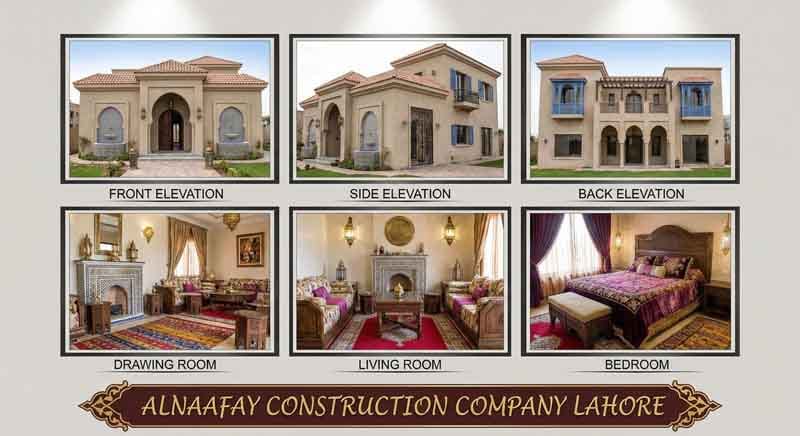
Moroccan House Style Design – Simple, Complete Guide in Easy English
Moroccan House Style Design looks rich, colorful, and a little bit magical. Many people imagine bright tiles, carved doors, and courtyards with fountains. Some think such homes only exist in movies or in very rich families. In reality, the main ideas behind Moroccan houses are simple and smart, and they can be used in normal homes too.
This long guide will explain Moroccan House Style Design in very easy English. Ideas will be broken into small parts so that even school students can understand. Hard words will be explained. Sentences will be kept clear, and examples will be given again and again so that you do not get confused.
You will learn:
- What Moroccan style really is
- Where Moroccan houses come from and how they developed
- Which shapes, colors, and materials Moroccan homes use
- How Moroccan rooms are planned inside
- How to decorate using Moroccan House Style Design
- How to apply this style in small houses or apartments
- In which country this design is most famous
- What advantages and problems this style can have
- A step‑by‑step way to bring this style into your own home
All of this will be done without using any harmful or rude phrases. Instead of saying something like “to go crazy”, which can hurt feelings, softer and kinder words will be used.
1. Introduction to Moroccan House Style Design
Before going deep into details, it helps to understand the basic idea. Once the big picture is clear, it becomes easier to remember the small parts.
1.1 Where Does Moroccan Style Come From?
As the name shows, Moroccan House Style Design comes from the country of Morocco. This country is in North Africa, near the Atlantic Ocean and the Mediterranean Sea. It is close to Spain and also not very far from the Sahara Desert.
Over many centuries, different people and cultures lived in or passed through Morocco:
- Amazigh (Berber) people – the original people of the land
- Arabs – who brought the Arabic language and Islam
- Andalusian Muslims and Jews – who came from Spain long ago
- French and Spanish – who were there during colonial times
Because of all these influences, Moroccan houses mix African, Arab, Mediterranean, and Islamic designs. That mix makes Moroccan House Style Design very rich and special.
1.2 What Is Special about Moroccan House Style Design?
Several things stand out when you see a Moroccan house:
- Bright and deep colors, often with strong contrast
- Beautiful, detailed tiles called zellige
- Arches and curved shapes over doors and windows
- Inner courtyards with plants and sometimes fountains
- Carved wood and plaster with delicate patterns
- Soft seating with many cushions
Even so, under all this decoration, Moroccan homes are also very practical. They try to:
- Keep the inside cool in hot weather
- Protect family privacy
- Create peaceful, shady places to rest
- Use air, light, and water in clever ways
Because of these points, Moroccan House Style Design is not just “fancy”. It is also smart and comfortable.
1.3 Why People Around the World Love Moroccan Style
People from many countries now like Moroccan style because:
- It feels warm and welcoming, not cold or stiff.
- Colors and patterns can bring strong character into a simple room.
- Courtyards and patios feel like holiday spaces.
- Traditional crafts make the home feel handmade and human.
In addition, Moroccan style can be used in many levels. Someone may design a full Moroccan house, or they may only add Moroccan tiles in one bathroom. Another person might just use Moroccan lanterns and cushions in a modern living room. All of these are valid uses of the Moroccan House Style Design idea.
2. Origins and History of Moroccan House Style
Understanding the history of a style helps you use it in a better, more respectful way.
2.1 Old Medina Houses and Riads
Many famous Moroccan houses are found inside medinas. A medina is the old part of a city, often with:
- Narrow streets
- High walls
- Small shops
- Old mosques and fountains
Inside the medina, you often find a special type of house called a riad. A riad is:
- A house built around a central courtyard
- Usually with two or three floors
- With rooms facing the courtyard, not the street
From outside, riads can look plain, with just a door and a few small windows. Inside, they can be extremely beautiful, with:
- Tile walls
- Arched galleries
- Plants and orange trees
- A small fountain in the middle
These riads are one of the strongest examples of Moroccan House Style Design.
2.2 Climate and Moroccan House Style Design
Morocco has different climates, but many areas are:
- Hot and dry in summer
- Cool or cold in winter nights
- Sunny for most of the year
Because of this, Moroccan houses needed to:
- Stay cool during the day
- Keep warm air inside at night in winter
- Block strong sun, but let in soft light
- Protect people from dust and wind
Courtyards, thick walls, small outside windows, and shaded galleries all developed to answer these needs. Therefore, the Moroccan House Style Design is not random; it is a careful answer to local climate.
2.3 Cultural and Religious Influences
Islam plays a big role in Morocco. That religion and culture influence how houses are shaped:
- Privacy, especially for women, is important.
- Family life should be protected from street view.
- Decoration often avoids images of people and animals.
- Beautiful patterns and calligraphy are used instead.
Because of that, a typical Moroccan house:
- Opens inward toward a private courtyard
- Uses screens and small outside windows for privacy
- Shows geometric and plant patterns as its main art
All these points join together to form the Moroccan House Style Design that people admire today.
3. Main Principles of Moroccan House Style Design
Rather than just copying details, it is better to understand the main principles. Those principles can then be used in different ways in large or small homes.
3.1 Inward-Facing Design
Moroccan houses often turn their face inward, not outward. Instead of large windows to the street, they focus on:
- Courtyards
- Inner gardens
- Private terraces
This design:
- Protects privacy
- Reduces street noise
- Keeps the house cooler
A modern house that follows Moroccan House Style Design might not fully close to the street, yet it can still:
- Use high boundary walls
- Put big windows facing a private yard
- Keep living spaces away from direct road view
3.2 Balance between Shadow and Light
Too much direct sun can make rooms hot and uncomfortable. Too little light makes them dark and sad. Moroccan style tries to balance both.
Ways this is done:
- Arched openings that allow light but also shade edges
- Deep window recesses that protect from strong sun
- Screens and lattice work that break harsh light into soft patterns
Because of this, interiors in the Moroccan House Style Design often feel:
- Bright but not blinding
- Cool but not gloomy
- Alive with changing shadows during the day
3.3 Rich Decoration on Simple Shapes
If you study Moroccan buildings carefully, you may notice something interesting. Basic forms (walls, doors, roofs) are usually quite simple and strong. Decoration then sits on top of these simple shapes.
Typical pattern:
- Straight walls in strong, clear lines
- Simple arches in repeated rhythm
- Flat or gently sloped roofs
- Decoration applied through tiles, carvings, and paint
This method keeps the building stable and practical while still allowing the Moroccan House Style Design to look artistic and detailed.
3.4 Use of Natural and Local Materials
Traditional Moroccan houses use materials that come from nearby areas:
- Stone
- Earth and plaster
- Wood
- Clay tiles
Using local materials:
- Reduces cost
- Feels natural and warm
- Ages nicely over time
Modern versions may also include concrete and steel for structure. Yet, visible surfaces usually still try to look natural or traditional, even if hidden parts are modern.
4. Outside Look: Moroccan House Facades and Courtyards
Now that main principles are clear, we can walk from outside to inside and see how Moroccan House Style Design looks and works.
4.1 Traditional Riads in Moroccan House Style Design
A riad is the classic Moroccan house type. Many old riads have now become hotels or guest houses.
Common features:
- Door directly from narrow street into a small entry hall
- Turn from entry into a large courtyard
- Rooms opening around the four sides of that courtyard
- Floors above with galleries and balconies
In the middle of the courtyard, you often see:
- A small fountain or water basin
- Trees like orange or lemon
- Plants and sometimes benches
Even in a small modern house, the Moroccan House Style Design idea of a central open space can be used. For instance, a tiny light well or an open-to-sky patio can repeat this riad feeling in simple form.
4.2 Arches and Doorways in Moroccan House Style Design
Arches are one of the most loved parts of Moroccan style. These are curved shapes above openings.
Common Moroccan arch types:
- Horseshoe arch – slightly wider than a half-circle
- Pointed arch – comes to a soft point at the top
- Keyhole or Moorish arch – more decorative and complex in outline
Doorways may be:
- Plain wooden doors inside an arched frame
- Doors with carved surfaces and metal studs
- Open arches used as passageways, without actual doors
Even one arch at an entrance or in a corridor can give a strong Moroccan House Style Design feeling to an otherwise simple home.
4.3 Colors and Materials on Moroccan House Exteriors
On the outside, Moroccan houses often use:
- Light colors like white, cream, and soft beige in hot areas
- Earth tones like terracotta and sandy browns in older medina streets
- Bright, contrasting doors and shutters in blues, greens, or reds in some cities
Walls may be:
- Smooth plaster, sometimes with a slightly rough, hand-made texture
- Stone in mountain regions
- Painted surfaces that can be easily refreshed
Because strong sun can damage paint quickly, many traditional homes choose colors that fade gracefully. As a result, even slightly worn Moroccan houses can look charming rather than ugly.
4.4 Roofs, Terraces, and Boundary Walls in Moroccan Style
Roofs in Moroccan towns are often flat, which allows:
- Roof terraces for sitting and drying clothes
- Placement of water tanks and solar panels in modern times
Terraces sometimes act as extra living spaces, especially in evenings.
Boundary walls and street façades typically:
- Appear high and somewhat closed
- Include only the main door and a few small windows
- Are painted in the same tone as the house
This plain outside hides the rich, private world inside, which is a key part of Moroccan House Style Design.
5. Inside a Moroccan House: Layout and Rooms
Once you step through the simple outer door, Moroccan houses often surprise you. Interior life usually feels very different from what you saw on the street.
5.1 Entry and Central Courtyard
After the front door, there is often a small bent hallway. This space:
- Blocks direct view from the street into the courtyard
- Reduces dust and noise entering the house
- Creates a feeling of “arrival” and respect
Right after this, you may suddenly stand inside the courtyard.
Courtyard roles:
- Works like a private outdoor living room
- Gives light and air to surrounding rooms
- Acts as center point for the whole house
In a modern Moroccan House Style Design, even a modest courtyard with potted plants and some tiles can provide similar benefits.
5.2 Moroccan Salon / Living Room Design
The salon (or sitting room) is an important part of Moroccan homes. It is used for:
- Receiving guests
- Family gatherings
- Celebrations during holidays and events
Typical Moroccan salon features:
- Built-in or long sofas around the walls, often known as “banquettes”
- Many cushions along the back and sides
- Low central tables for tea, coffee, and snacks
- Carpets or rugs covering most of the floor
- Rich fabrics, patterns, and sometimes a chandelier
Walls may include:
- Decorative plasterwork
- Painted patterns
- Arched niches with decor items
A modern living room can borrow this style by:
- Placing sofas against walls instead of floating in the middle
- Using plenty of cushions
- Adding a patterned rug and Moroccan-style tables
Through these steps, it can begin to follow the Moroccan House Style Design feeling.
5.3 Bedrooms and Privacy in Moroccan House Style
Bedrooms in Moroccan houses usually:
- Remain more private than the salon or courtyard
- Use calmer colors than main sitting areas
- Include wooden or iron headboards and wardrobe doors
Decor can still be rich, but comfort is the main goal. In many cases:
- A few key items like a beautiful lamp, a carved mirror, or a patterned rug create the style
- Rest of the room stays simple to support good sleep
Windows may face the courtyard or a small garden, giving fresh air and a sense of safety.
5.4 Moroccan-Style Bathrooms and the Hammam Feel
Bathing is special in Moroccan culture. People often visit a hammam (public bath house) for deep cleaning and relaxation.
At home, bathrooms inspired by Moroccan House Style Design may include:
- Colorful or patterned tiles on walls or floors
- Niches in the wall for soaps and bottles
- Curved or arched shower entrances
- Copper or brass taps and bowls
Lighting is usually soft, not too bright, to create a relaxing feeling. Even in a small bathroom, a few Moroccan tiles and a lantern can give a light hammam-like mood.
5.5 Kitchen and Dining in Moroccan House Style Design
Food is very important in Moroccan life, and homes reflect that.
Kitchen features:
- Practical work surfaces
- Open shelves with clay pots, tajines, and jars
- Tiled backsplashes with colorful patterns
- Wooden cabinet doors in warm tones
Dining areas may be:
- Part of the courtyard under a covered gallery
- In a separate room with a round or rectangular table
- Inside the salon during special meals
Adding patterned tableware, woven mats, and metal trays can help bring the Moroccan House Style Design spirit to the dining table.
6. Interior Decoration in Moroccan House Style Design
Decoration is where Moroccan style truly shines. Nevertheless, it is helpful to move slowly and understand each part instead of trying everything at once.
6.1 Color Palettes in Moroccan Interiors
Moroccan style uses both:
- Soft, natural colors
- Bright, jewel-like tones
Common natural colors:
- Sand beige
- Clay terracotta
- Olive green
- Ocean blue
- Stone grey
Common strong accents:
- Deep cobalt blue
- Turquoise
- Ruby red
- Saffron yellow
- Emerald green
One room might mix a warm neutral base (such as beige walls) with bold cushions and tiles. Another room could use cooler whites and greys with blue accents. Overall balance is important so that the room does not feel out of control.
6.2 Tiles, Mosaics, and Patterns in Moroccan House Style Design
Tiles are perhaps the most famous part of Moroccan House Style Design. Traditional handmade tiles are called zellige. These:
- Are small pieces, cut by hand
- Form complex geometric patterns
- Come in many colors
- Are often shiny
Tiles may appear:
- On floors
- On lower half of walls
- Around doors and windows
- On stair risers
- Around fountains and sinks
Patterns are usually:
- Geometric stars, polygons, and crosses
- Repeated plant-like forms
- Sometimes calligraphy or simple borders
If real zellige is too expensive, printed or machine-made tiles can still give a similar look. Even a small area, such as behind a sink or on a table top, can bring a strong Moroccan touch.
6.3 Furniture and Seating in Moroccan Style Homes
Furniture in Moroccan houses tends to:
- Stay low to medium in height
- Use wood or metal frames
- Have carved or inlaid details
Types of furniture:
- Benches and banquettes along the walls
- Small round or hexagonal tables
- Wooden chests with metal corners
- Poufs (round or square floor seats)
In modern homes, you can:
- Use your normal sofa but add Moroccan cushions and throws
- Bring in one or two small Moroccan tables
- Place a pouf or low stool near the coffee table
That way, your home slowly moves toward Moroccan House Style Design without changing everything at once.
6.4 Fabrics, Rugs, and Cushions in Moroccan Interiors
Textiles play a giant role in Moroccan decor.
Common items:
- Kilims and rugs with geometric patterns
- Beni Ourain rugs – fluffy, cream rugs with black lines
- Cushion covers in bright or deep colors
- Curtains and drapes in rich fabrics like cotton, linen, or silk mixes
Patterns may be:
- Simple diamonds and stripes
- Complex traditional motifs
Layering of fabrics is key. For example:
- A rug on the floor
- Cushions on the sofa
- Throws or blankets over side chairs
Together they make the room feel warm, soft, and lived in.
6.5 Lighting: Lanterns and Lamps in Moroccan House Style Design
Light in Moroccan homes is often seen through something, not just from a bare bulb.
Famous lighting forms:
- Moroccan lanterns – metal or brass frames with colored or clear glass pieces
- Pierced metal lamps – small holes create dotted patterns of light on walls and ceilings
- Wall sconces – lamps attached to walls, sometimes with Arabesque designs
Using only one large light on the ceiling can feel too sharp. Instead, a mix of:
- Ceiling lights
- Table lamps
- Floor lamps
- Wall lights
creates soft layers of light that match the Moroccan House Style Design mood.
7. Modern Moroccan House Style Design in Small Homes and Apartments
Traditional riads can be quite large. Still, the same style ideas can be used in small city homes, even apartments.
7.1 Adapting Moroccan House Style Design to a Small House
In a small house, space is precious. Therefore, it becomes helpful to choose carefully which Moroccan elements to use.
Possible steps:
- Make one room (often the living room) the main Moroccan-style zone.
- Use a strong rug, cushions, and one or two accent walls with Moroccan tiles or paint.
- Add arches only where they really add value, such as at the entrance to living room or over a niche.
- Keep other rooms simpler, using just a few shared colors or materials.
Through this method, the Moroccan House Style Design remains present but the house does not feel crowded.
7.2 Moroccan-Inspired Apartment Interiors
Apartments often have fixed walls and small balconies. Even then, you can add Moroccan flavor.
Ideas include:
- Placing a low seating area with cushions by a window
- Creating a reading corner with a Moroccan lantern and small table
- Using Moroccan tiles on the balcony floor or wall
- Hanging a carved mirror or wall panel with geometric design
Kitchen and bathroom can also receive:
- Moroccan backsplash tiles
- Brass or bronze-colored taps
- Patterned hand towels and soap dishes
Bit by bit, the apartment turns into a modern version of Moroccan House Style Design.
7.3 Blending Moroccan House Style Design with Modern Minimalism
Some people like both Moroccan richness and modern minimal style. These can be combined if done carefully.
Basic idea:
- Keep main shapes of furniture simple and clean.
- Choose a neutral base palette (white, grey, beige).
- Add Moroccan elements in a limited but clear way:
- One patterned rug
- A few bright cushions
- One tiled area
- One or two lanterns
By not overloading the space, you can enjoy both the calm of minimalism and the warmth of Moroccan patterns. In this way, Moroccan House Style Design and modern life can fit together.
8. Where Is Moroccan House Style Design Most Famous?
You asked clearly: “Yeh design kis country main zyada famous hai?”
Answering this is easy for this style.
8.1 Morocco as the Heart of Moroccan House Style Design
As the name tells us, Moroccan House Style Design is most famous in Morocco itself. Cities like:
- Marrakesh
- Fez
- Chefchaouen
- Rabat
- Casablanca
have countless examples of Moroccan houses, riads, and palaces. Tourists from all over the world travel there to see and stay in these traditional homes.
8.2 North Africa and the Middle East
Beyond Morocco, similar house styles appear in nearby regions:
- Algeria and Tunisia – share many features like courtyards, arches, and tiles
- Other Arab countries – use related Islamic and Middle Eastern design elements
Even though each country has its own look, many share the base ideas found in Moroccan style, such as geometric patterns and inner courtyards.
8.3 Moroccan Style Spread to Other Continents
Today, Moroccan House Style Design is also popular in:
- Europe – especially France and Spain, because of historical links
- North America – many homes in the USA and Canada use Moroccan interiors
- The Gulf (UAE, Qatar, etc.) – luxury villas sometimes include Moroccan rooms and decor
Interior designers and magazines worldwide show Moroccan-style rooms. As a result, this style has become international, even though its home and strongest identity remain in Morocco.
9. Pros and Cons of Choosing Moroccan House Style Design
Every style has strong points and weak points. Choosing wisely means knowing both.
9.1 Advantages of Moroccan House Style Design
Firstly, there are many good sides:
Strong personality
Rooms look unique and memorable. Guests often remember them clearly.Warm and welcoming feeling
Cushions, rugs, and lanterns make spaces feel cosy.Flexible level of use
You can choose a full Moroccan look or just a few elements.Good for indoor-outdoor living
Courtyards and terraces become special living areas.Timeless beauty
Traditional patterns and natural materials age well and do not quickly go out of fashion.
9.2 Challenges and Mistakes to Avoid in Moroccan Style Homes
On the other hand, some difficulties can appear:
Over-decoration
If every wall, floor, and ceiling has strong patterns, the eye can feel tired. Rooms might start to feel too busy.Better approach: Choose a few focus areas for heavy pattern, such as one wall or floor, and keep the rest quieter.
Cost of handmade materials
Real zellige tiles or hand-carved wood can be expensive.Possible solution: Use a mix of real and simpler materials. For example, real tile in a small area and more affordable tiles elsewhere.
Cleaning and maintenance
Many carvings and deep textures can collect dust. Multiple small items may make cleaning harder.You can manage this by using smoother surfaces in some places and planning regular gentle cleaning.
Darkness in some layouts
If the house closes too much to the outside and the courtyard is small, light might not reach every corner well.To avoid this, design must include enough windows and light wells according to local climate.
Copying without adapting
Taking a design from old Marrakesh and placing it directly in a very cold or very rainy city may cause technical problems.Adaptation to local weather, building rules, and daily habits is always necessary.
10. Step-by-Step Guide to Create a Moroccan House Style Home
If you like this style and want to use it, a step-by-step path will help.
10.1 Step 1 – Understand Your Needs and Budget
Start by answering some questions:
- How many rooms do you need?
- Do you want a separate guest sitting room?
- How important is outdoor space for you?
- What is your total budget?
- Do you prefer full Moroccan style or just a light touch?
Write these things down. This list is your guiding light while you plan a Moroccan House Style Design.
10.2 Step 2 – Study Reference Images and Real Examples
Secondly, collect examples:
- Look at pictures of riads, Moroccan hotels, and homes.
- Notice which parts you love the most (tiles, arches, colors, etc.).
- Visit any local place that uses Moroccan style, if possible.
These references will help you explain your dream clearly to your architect or interior designer.
10.3 Step 3 – Plan the Layout with Moroccan Ideas
Next, work on the floor plan.
Try to include:
- A main living space that can act like a Moroccan salon.
- If space allows, a small courtyard or patio as a center or side garden.
- Good connection between kitchen, dining, and courtyard, for family meals.
- Clear separation between guest area and private bedrooms if your lifestyle needs that.
You do not have to copy riads exactly. However, using at least one Moroccan House Style Design idea such as an inward-facing garden or central focus can be very powerful.
10.4 Step 4 – Choose Exterior Style and Materials
After layout, decide the outer look:
- Do you want a light, sand-colored façade or a white one?
- Where will arches appear – at the main entrance, windows, or inside only?
- Which parts may get tiles on the outside – maybe around main door or on stairs?
Also, think about:
- Boundary wall and gate style
- Balcony and terrace railings
- Exterior lighting (lanterns, wall lights)
All these should speak the same Moroccan House Style Design language.
10.5 Step 5 – Select Interior Colors and Major Finishes
Now move indoors.
Decisions include:
- Floor materials (tiles, stone, or another surface)
- Wall paints and where to use patterned tiles
- Ceiling design – simple or with beams and coves
For a strong Moroccan feel:
- Choose warm neutrals plus clear accent colors.
- Use patterned tiles on one or two main surfaces.
- Keep some walls plain to give the eye rest.
Planning these together avoids clashes later.
10.6 Step 6 – Plan Lighting with Moroccan Mood
Light can change everything.
While planning:
- Decide spots for Moroccan lanterns or pendant lights.
- Add wall lights in hallways and near arches.
- Use warm-colored bulbs instead of very cold, bluish ones.
Testing light positions early prevents you from feeling aggravated later because a beautiful tile wall stays hidden in darkness.
10.7 Step 7 – Add Furniture and Textiles
Once structure and finishes are almost ready, begin thinking about furniture.
Steps:
- Buy main items first: sofa, chairs, dining table, beds, wardrobes.
- Add Moroccan flavor through:
- Rugs and carpets
- Cushions and throws
- Side tables and poufs
Trying to buy all decor at once can be hard. Instead, start with a few key pieces such as one large rug and a matching set of cushions. Over time, you can slowly grow your Moroccan House Style Design collection.
10.8 Step 8 – Final Touches and Personal Items
Finally, fill the home with life.
Consider adding:
- Plants in pots or garden beds
- Mirrors with Moroccan or Arabesque frames
- Artworks and family photos in simple or decorative frames
- Traditional items like metal trays, clay pots, or handmade baskets
These touches make the house feel like your own, not just a picture from the internet.
11. Frequently Asked Questions about Moroccan House Style Design
To close the guide, here are some short answers to common questions.
11.1 What Is Moroccan House Style Design in One Simple Sentence?
You can say:
“Moroccan House Style Design is a way of building and decorating homes that comes from Morocco, using courtyards, arches, colorful tiles, rich patterns, and warm materials to create a cosy, private, and beautiful space.”
This sentence covers the heart of the idea.
11.2 In Which Country Is Moroccan House Style Design Most Famous?
This design is most famous in Morocco. That country is the home of riads, medinas, and many traditional houses that show this style in full form. Other North African and Arab countries also use related ideas, but Morocco is the strongest example and the name source.
11.3 Is Moroccan House Style Only for Big Homes?
No, it is not. Even a small home or apartment can use parts of this style.
For example, you can:
- Put a Moroccan rug and lantern in a small living room.
- Use Moroccan tiles on one kitchen wall.
- Make a balcony into a tiny Moroccan corner with cushions and plants.
The concept is flexible. You can choose how much or how little to use.
11.4 Does Moroccan House Style Design Always Cost a Lot?
Real handmade tiles and carvings can be costly. However, there are many ways to control cost:
- Use expensive materials only in small areas.
- Choose printed tiles instead of hand-cut ones when needed.
- Focus on paint and fabrics, which can also give strong style.
Therefore, Moroccan House Style Design can fit both medium and higher budgets, depending on your choices.
11.5 Is This Style Easy to Maintain?
Maintenance level depends on details:
- Smooth tiles and plaster walls are easy to clean.
- Very deep carvings and many small decor items can collect dust.
To reduce work:
- Keep some surfaces simple.
- Plan storage so items can be put away when not needed.
With smart planning, Moroccan style can stay beautiful without making cleaning feel out of control.
11.6 Can Moroccan Style Work in Cold or Very Rainy Places?
It can, but designers must adapt it.
They should:
- Use stronger waterproofing on flat roofs or choose sloped roofs.
- Make sure rooms get enough light in short winter days.
- Use insulation and heating systems to keep houses warm.
Main ideas like arches, patterns, and indoor courtyards can still be used, but technical parts must respect the local weather.
Quick Links
Social Icons
Contact Us Information
443 J3 Johar Town Lahore near Expo Center Lahore
