
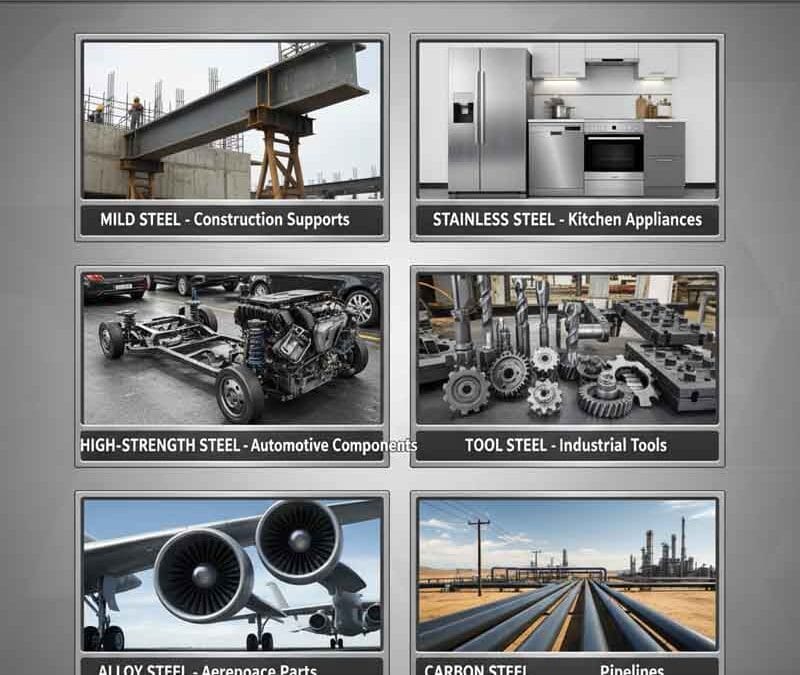
Steel Grades and Their Uses
Steel shapes almost every aspect of modern life, supporting everything from giant skyscrapers to intricate surgical tools. However, not all steel is created equal. Different elements change steel’s properties, resulting in many steel grades and their uses. Therefore, it becomes crucial for engineers, manufacturers, and designers to know these grades so they can pick the right material for any task. This guide will help you confidently navigate the complex world of steel, explaining its classifications, properties, and practical applications.
What Are Steel Grades? A Fundamental Introduction
Steel always starts as a mix of iron and carbon. Yet, the specific amount of carbon and the addition of other elements cause each grade to exhibit unique qualities. As a result, industry grading systems, such as those from the American Iron and Steel Institute (AISI) and Society of Automotive Engineers (SAE), ensure consistent expectations for performance, durability, and quality. Because of this, understanding steel grades and their uses lays a strong foundation for almost every industry.
Most often, experts divide steel into four main groups: Carbon Steel, Alloy Steel, Stainless Steel, and Tool Steel. Each group consists of multiple sub-grades, designed with a specific job in mind. While some steels sacrifice flexibility for strength, others focus on corrosion resistance or extreme hardness. With so many possible combinations, you can usually find an ideal steel for virtually any engineering problem.
Why You Need to Understand Steel Grades
Making poor choices in steel selection may lead to disaster. Imagine building in a freezing climate using a grade that turns brittle in the cold—breakage could follow. Conversely, choosing an advanced but unnecessary grade could waste money. Therefore, learning about steel grades and their uses isn’t simply helpful; it’s essential for responsible design and solid manufacturing. Moreover, with this knowledge, teams can innovate, building better products at lower costs.
The Four Main Types of Steel
To truly understand how to use steel, you need a grasp of its four biggest categories. Each section offers a high-level snapshot before we dive deeper into specific steel grades and their uses.
1. Carbon Steel: The Industry Workhorse
Carbon steel dominates the steel world, making up nearly 90% of production. Its carbon content determines both strength and hardness. While more carbon boosts both, it also creates tradeoffs—less flexibility and tougher welding.
Low-Carbon Steel (Mild Steel)
Low-carbon steel contains no more than 0.3% carbon and serves as the most popular choice for forming, welding, and general work. Thanks to its softness and adaptability, you’ll find it everywhere—from car frames to beams, pipes, and food cans.
Medium-Carbon Steel
Medium-carbon grades contain between 0.3% and 0.6% carbon. Because of this, they offer a sweet spot between toughness and flexibility, though they’re harder to work with than mild steel. Most often, manufacturers use them in axles, gears, and railway tracks where durability is essential.
High-Carbon Steel
High-carbon steel pushes carbon content above 0.6%. That extra carbon makes parts much harder and stronger—ideal for springs, cutting tools, or anything demanding maximum wear resistance. However, these grades can become brittle, so you have to account for that during design.
2. Alloy Steel: Tailored for Performance
Alloy steels gain extra qualities through the addition of manganese, chromium, molybdenum, nickel, boron, or vanadium. Because these elements react with iron, the possibilities seem endless—they might boost strength, toughness, corrosion resistance, or formability. As a result, manufacturers select precise formulas to achieve specific results. For example, chromium can improve hardness, while nickel helps with toughness. Consequently, you’ll find alloy steels in components ranging from automotive parts to demanding aerospace systems and everything between.
3. Stainless Steel: Leading in Corrosion Resistance
When you need a material that survives moisture, salt, and chemicals, stainless steel is usually the first pick. Its resistance to rust comes from the addition of chromium—typically more than 10.5%. With chromium in play, the steel forms an invisible protective layer against corrosion.
Stainless steel offers many families, so you can nearly always find the right fit:
- Austenitic: Grades like 304 and 316 are not magnetic and resist corrosion, so they’re found in sinks, food equipment, and building facades.
- Ferritic: This magnetic option mixes formability and resistance at a moderate strength, making it suitable for automotive parts.
- Martensitic: Hard, tough, and magnetic, these grades serve in knives, turbines, and medical tools.
- Duplex: These combine austenitic and ferritic traits, providing incredible strength and corrosion resistance, so engineers choose them for chemical plants and marine uses.
4. Tool Steel: Made for Demanding Tasks
When a job calls for maximum toughness, tool steel steps in. By carefully blending elements and applying advanced heating and cooling steps, you can tailor tool steel to maintain shape, cut, or resist extreme wear.
Tool steel grades suit particular tasks:
- Water-hardening (W-grade): Quick to harden in water but sometimes prone to brittleness.
- Air-hardening (A-grade): Cools in air to lock in hardness while limiting distortion.
- High-speed steel (T-grade and M-grade): Keeps its edge under friction and heat, so it’s perfect for drill bits and industrial blades.
Exploring Specific Steel Grades and Their Uses
Manufacturers sort steel into grades to make choosing the right type easier. As you shop for steel, you’ll often encounter alphanumeric codes from the AISI or SAE. Below, we’ll summarize some major options to help you master steel grades and their uses.
Common Carbon Steel Grades
- 1018 Steel: Known for a mix of strength and ductility, 1018 is simple to weld and machine. Therefore, you’ll find it in fasteners, pins, and shafts.
- 1045 Steel: This medium-carbon steel delivers added hardness and wear resistance. Many companies pick it for manufacturing gears, bolts, and axles.
- A36 Steel: As a structural low-carbon grade, A36 often appears in bridges, buildings, and beams, celebrated for its strength and reliability.
Common Alloy Steel Grades
- 4140 Steel: This blend of chromium and molybdenum creates outstanding toughness and wear resistance, making it the go-to for tool parts and crankshafts.
- 4340 Steel: With nickel, chromium, and molybdenum, 4340 goes further, offering elite strength for challenging uses such as aircraft landing gear.
Popular Stainless Steel Grades
- 304 Stainless Steel: If you seek versatility and easy fabrication, 304 stands as the top choice. It resists rust and supports projects from kitchen wares to buildings.
- 316 Stainless Steel: By adding molybdenum, 316 delivers outstanding resistance to chlorides, so marine projects, surgical devices, and chemical plants often use it.
- 410 Stainless Steel: Perfect for harder applications, this martensitic stainless steel becomes even tougher after heat-treating, working well in knives and valve parts.
Global Leadership and Design in Steel
Steel’s impact is worldwide, but a few regions lead in design and innovation, showing the practical side of steel grades and their uses in real-world settings.
Germany: A Steel Technology Trailblazer
Few nations rival Germany’s record in metalworking. Through decades of focused development, German scientists invented many advanced steels that changed manufacturing globally. Moreover, German companies remain at the forefront of alloy research and precision applications, so they set the standard for quality and reliable performance. You’ll spot German steel solutions across buildings, autos, and even complex machines, making the country famous for mastering steel grades and their uses in high-demand environments.
Lahore: Pakistan’s Hub of Steel Construction
Pakistan’s urban growth depends on steel’s adaptability, especially in Lahore. New construction projects in neighborhoods like DHA, Bahria Town, Lake City, and Valencia rely on reinforced concrete, which steel strengthens. Meanwhile, Model Town, Gulberg, Askari, Cantt, Wapda Town, and Johar Town showcase how builders use steel for both commercial and private development.
The hot Lahore weather might make some worry about metal fatigue, yet with correct design and insulation, steel easily handles these challenges. Moreover, steel allows for broad spaces and striking designs that concrete alone can’t achieve. As a result, steel remains the foundation of modern Lahore construction.
Practical Guide to Working with Steel
Choosing a grade only starts your journey. Every project needs careful planning, thoughtful execution, and attentive maintenance to maximize value from steel grades and their uses.
Avoiding Common Mistakes with Steel Grades
Mistakes arise when you rush grading decisions. For example, picking a cheap, low-grade steel in a high-stress situation could cost more later. Overshooting with advanced grades risks overspending. Consider the environment before placing your order—coastal or humid locations demand corrosion resistance, while frigid regions need ductility to avoid brittleness. Likewise, neglecting proper heat treatment or incorrect installation leads to premature failures. Always match steel grade to use case.
Budgeting Tips for Steel Projects
Budgeting isn’t just about the upfront price. Instead, think about total lifecycle costs. Basic carbon steels are affordable but may require upkeep. Meanwhile, premium alloys and stainless steels demand more at first but might save thousands if they fend off maintenance or early replacement. Consider buying standard sizes or commonly used lengths for extra savings. Moreover, consult your suppliers for bulk rates and alternatives—sometimes switching to a locally available grade brings down costs.
Maintenance Strategies for Steel Components
Maintenance keeps steel strong over time. For carbon steel, be sure to paint, galvanize, or coat surfaces. Regular inspections and touch-ups prevent rust from getting a foothold. For stainless steel, normal soap and water keep parts sparkling, but skip harsh abrasives to avoid scratching the protective surface. In applications using alloy steels, check if a protective layer or lubricant best prevents wear or rust. If repairs become frequent, review the material choice and consider upgrades.
With patient planning, respect for local climate and codes, and good teamwork with experts, your steel project can stand strong for decades. Careful preparation and wise execution transform steel grades and their uses into lasting results.
Frequently Asked Questions (FAQs) About Steel Grades
Q: What is the main difference between steel and iron?
Steel always contains iron and carbon, which combine to create extra strength and hardness compared to pure iron. Because of their different properties, steel serves in many more structural roles.
Q: Can you weld every kind of steel?
Most low-carbon steels weld easily. However, higher carbon and alloy types sometimes call for special preparation, such as pre-heating, to reduce the risks of cracking.
Q: Do all stainless steels attract magnets?
No, the austenitic types like 304 and 316 aren’t magnetic, unlike ferritic and martensitic grades. If you need a magnetic application, check the type carefully.
Q: How does heat treatment change steel?
Heat treatment alters steel’s structure, boosting hardness, toughness, or flexibility for different uses. For instance, quenching and tempering can strengthen tool steel or help parts hold an edge.
Q: What’s the best way to select a steel grade?
First, figure out your needs—strength, hardness, corrosion, temperature, and cost. Then, review options and consult with material specialists to match the grade to your project goals.
Quick Links
Social Icons
Contact Us Information
443 J3 Johar Town Lahore near Expo Center Lahore
