Fast-Track Construction Methods
Introduction
In the construction industry, time is the most valuable currency. Every day a project sits unfinished, it costs money in loans, labor, and lost opportunity. Consequently, owners and developers are constantly looking for ways to speed up the process. This is where fast-track construction methods come into play. This approach is not about cutting corners or sacrificing safety. Instead, it is about overlapping phases of the project to finish sooner.
Traditionally, construction follows a linear path: design, bid, then build. However, fast-tracking changes this rule. It allows construction to begin before the design is 100% complete. For example, you might pour the foundation while the architects are still designing the interior finishes. This method requires intense coordination, but the rewards are massive. In this guide, we will explore the rules you must follow to succeed. We will also discuss the benefits, the best materials to use, and how different climates affect speed. Finally, we will look at which country is the global leader in rapid construction and what we can learn from them.
The Must-Follow Rules of Accelerated Building
To successfully implement fast-track construction methods, you need discipline. This is a high-stakes game. Therefore, you must follow specific rules to avoid chaos.
Rule 1: The Integrated Team Approach
You cannot work in silos. In a traditional project, the architect finishes their job and hands it to the builder. In a fast-track project, the builder, architect, and engineer must work together from day one. This is often called “Integrated Project Delivery” (IPD).
- The Logic: If the builder is involved early, they can order long-lead materials like steel or elevators before the design is finalized.
- The Result: This prevents the common problem of designing something that takes 20 weeks to arrive when you only have 10 weeks.
Rule 2: Decisive Decision Making
Indecision is the enemy of speed. Owners must make decisions quickly and stick to them.
- The Risk: If you change your mind about the wall layout after the plumbing is already installed, you destroy the schedule.
- The Rule: Establish a “freeze date” for design changes. After this date, no changes are allowed unless they are critical for safety. This rule is essential for maintaining the pace of fast-track construction methods.
Rule 3: Procurement Before Design
Usually, you buy materials after the design is done. In fast-tracking, you buy them based on estimates.
- Strategy: You might order the HVAC units based on rough load calculations, even if the ductwork layout isn’t finished.
- Benefit: The equipment arrives on site exactly when you need it, rather than months later.
Major Benefits of Rapid Project Delivery
Why would anyone choose a method that requires so much coordination? The answer lies in the significant benefits that fast-track construction methods offer.
Reduced Interest Costs and Inflation
Construction loans are expensive. The longer you borrow money, the more interest you pay. By shaving months off the schedule, you save a fortune in financing costs. Furthermore, material prices tend to rise over time due to inflation. Buying materials early locks in today’s prices, protecting your budget from future hikes.
Faster Return on Investment (ROI)
For commercial projects, a finished building generates revenue. A hotel can book guests, and a factory can produce goods.
- Example: If a retail store opens three months early, that is three extra months of sales.
- Impact: This early revenue often outweighs the extra cost of overtime labor or expedited shipping.
Competitive Advantage
In a crowded market, being first matters. If two developers are building apartments in the same neighborhood, the one who finishes first captures the tenants. Therefore, using fast-track construction methods gives you a strategic edge over competitors who use slower, traditional methods.
Essential Material Options for Speed
The materials you choose dictate how fast you can build. Some materials require long curing times, while others are ready instantly.
Structural Steel vs. Cast-in-Place Concrete
Concrete takes time to dry and cure. You often have to wait days before you can build the next floor.
- Steel: It arrives ready to install. You can bolt it together immediately.
- Benefit: Steel framing allows you to erect the skeleton of a building much faster than pouring concrete on site.
- Trade-off: Steel requires a longer lead time for fabrication, so it must be ordered early.
Precast Concrete Panels
If you prefer the durability of concrete, use precast panels. These are walls made in a factory and trucked to the site.
- Speed: A crane lifts them into place, and the wall is finished in minutes.
- Quality: Because they are made indoors, the quality is consistent, regardless of the weather.
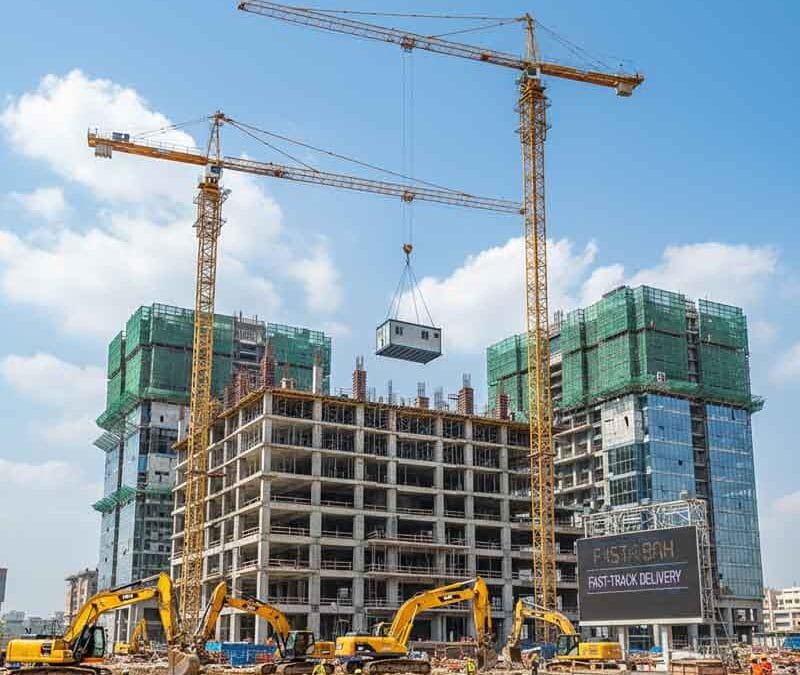
- Connection: This is a staple of fast-track construction methods for warehouses and large commercial buildings.
Drywall Alternatives
Hanging, taping, mudding, and sanding drywall is a slow, messy process. It requires multiple days for drying between coats.
- Option: Modular wall systems or pre-finished panels.
- Benefit: These systems clip together and require no painting or sanding. You can finish a room in hours instead of days.
Climate Suitability for Quick Construction
Your location affects your ability to build fast. Different climates present different hurdles for fast-track construction methods.
Wet and Tropical Regions
Rain is the biggest delay factor. You cannot weld steel or pour concrete in a downpour.
- Solution: Use “Top-Down” construction. Build the roof first (supported by temporary or permanent columns) and then work underneath it.
- Suitability: This method is perfect for rainy climates because it creates a dry work environment immediately.
Cold and Freezing Zones
Winter slows everything down. Machines don’t start, and workers move slower in bulky clothes.
- Solution: Maximize off-site prefabrication. Build as much as possible in a heated factory and simply assemble it on site.
- Suitability: This approach minimizes the time workers spend exposed to the cold, keeping the project moving despite the temperature.
Hot and Arid Environments
Extreme heat can damage materials and endanger workers.
- Solution: Schedule heavy work for the night.
- Suitability: Fast-track construction methods in hot climates often rely on 24-hour shifts. One crew works the day, and another works the night. This effectively doubles the speed of construction.
Global Leader: China and “China Speed”
When the world talks about building fast, one country stands alone: China.
Why China is Famous for Speed
China has gained global fame for its ability to build skyscrapers in weeks and hospitals in days. The term “China Speed” refers to their incredible efficiency in infrastructure and building projects. A famous example is the Mini Sky City in Changsha, a 57-story building erected in just 19 days.
The Secret Sauce: Modular Construction
China’s secret is not just hard work; it is technology. They have mastered modular construction.
- The Method: They build 90% of the building in a factory. They create entire rooms, complete with plumbing, wiring, and flooring, as separate modules.
- On-Site: These modules are stacked like LEGO bricks. They only need to connect the pipes and wires.
- Result: This drastically reduces on-site work, noise, and waste.
Lessons for Western Builders
Western contractors can learn from this industrial approach. By treating a building like a product on an assembly line rather than a unique art piece, you can achieve incredible speed. China proves that fast-track construction methods are most effective when combined with manufacturing principles.
Implementing the Critical Path Method (CPM)
To go fast, you need a map. The Critical Path Method (CPM) is the standard tool for managing complex schedules.
Identifying the Longest Path
The critical path is the sequence of tasks that determines the project’s end date. If a task on this path is delayed, the whole project is delayed.
- Action: You must identify these tasks early. Is it the steel delivery? The elevator installation?
- Focus: Put all your energy into managing these critical tasks. Non-critical tasks can slip without hurting the final deadline.
Crashing the Schedule
“Crashing” means adding resources to shorten a task’s duration.
- Example: If framing is on the critical path, you can “crash” it by hiring a second framing crew.
- Cost: This costs money, but in fast-track construction methods, the time saved is often worth the expense.
Overlapping Phases
This is the heart of fast-tracking.
- Traditional: Design -> Foundation -> Structure -> Skin -> Interior.
- Fast-Track: Design (Partial) -> Foundation -> Design (Finish) -> Structure -> Skin + Interior (Simultaneous).
- Benefit: By doing the interior work while the exterior skin is still being finished, you can save months.
Advanced Strategies: BIM and Lean Construction
Technology is the accelerator for modern construction. Building Information Modeling (BIM) is essential.
4D Scheduling with BIM
BIM creates a 3D model of the building. 4D BIM adds the element of time.
- Visualization: You can watch a video of the building being built before you start.
- Clash Detection: The software will tell you if the plumber and the electrician are trying to install pipes in the same spot at the same time.
- Result: This prevents conflicts on the job site, which is a major source of delays in fast-track construction methods.
Lean Construction Principles
Lean construction focuses on eliminating waste.
- Concept: “Just-in-Time” delivery. Do not stockpile materials on site where they can get damaged or moved twice.
- Action: Have the drywall delivered the exact morning the hangers arrive.
- Outcome: A clean, organized site allows workers to move faster and safer.
The Risks of Rushing and How to Mitigate Them
Speed has risks. If you go too fast, you might crash.
The “Rework” Trap
If you build the foundation before the final load calculations are done, you might find out later that the foundation is too weak.
- Consequence: You have to jackhammer it out and start over. This is slower and more expensive than traditional building.
- Mitigation: Use conservative estimates. Over-engineer the foundation slightly to account for potential design changes.
Burnout and Safety
Working 12-hour days, six days a week, leads to tired workers.
- Risk: Tired workers make mistakes and get hurt.
- Mitigation: Rotate crews. Do not rely on the same people to work overtime every week. Bring in fresh teams to maintain high energy and safety standards.
Quality Control Challenges
When you are rushing, it is easy to miss small details.
- Risk: Leaky windows or crooked tiles.
- Mitigation: Increase the number of inspections. Do not wait until the end to check quality. Check it every day. This rigorous inspection is vital for successful fast-track construction methods.
Contractual Frameworks for Speed
You cannot use a standard contract for a fast-track job. The legal framework must support the speed.
Design-Build Contracts
In a traditional “Design-Bid-Build” contract, the owner holds separate contracts with the architect and builder. This creates conflict.
- Design-Build: The owner signs one contract with a single entity that does both design and construction.
- Benefit: This unifies the team. If there is a design error, the builder fixes it internally rather than suing the architect.
Guaranteed Maximum Price (GMP)
Owners worry that fast-tracking will lead to runaway costs.
- GMP: The builder guarantees the project will not cost more than a set amount.
- Benefit: This gives the owner peace of mind while allowing the builder the flexibility to move fast. It is a common structure for projects using fast-track construction methods.
Incentive Clauses
Money motivates. Put a bonus in the contract for finishing early.
- Structure: “For every day the project is finished early, the builder gets a $5,000 bonus.”
- Result: This aligns the builder’s goals with the owner’s goals. Everyone wants to finish early.
The Role of Subcontractors
You are only as fast as your slowest subcontractor. Selecting the right partners is critical.
Pre-qualification
Do not just hire the cheapest electrician. Hire the one with the biggest crew and the best track record.
- Question: Ask them, “Have you done fast-track work before?”
- Requirement: They must have the financial stability to buy materials upfront and pay their workers on time.
Early Involvement
Bring key subs, like mechanical and electrical, into the design meetings.
- Input: They can suggest ways to route pipes and wires that are faster to install.
- Benefit: Their practical experience can save weeks of installation time, reinforcing the efficiency of fast-track construction methods.
Detailed Breakdown: Site Preparation
The first phase sets the tone. You need to hit the ground running.
Aggressive Permitting
You cannot start without a permit.
- Strategy: Apply for a foundation-only permit. This allows you to start digging while the city reviews the rest of the plans.
- Relationship: innovative builders meet with city officials early to explain the schedule and ask for expedited reviews.
Site Logistics Plan
Where will the cranes go? Where will the trucks unload?
- Plan: Map this out in detail. A traffic jam at the gate can stop work for hours.
- Action: Create separate gates for deliveries and workers. Use a “just-in-time” delivery schedule to prevent overcrowding.
Detailed Breakdown: The Structure
The skeleton of the building must go up fast.
Flying Forms
For concrete buildings, use “flying forms.” These are large table-like molds for the floor slabs.
- Process: Pour the concrete, let it set, and then a crane pulls the entire form out and flies it up to the next floor.
- Speed: This is much faster than disassembling and rebuilding the formwork for every floor.
Steel Erection Sequencing
Divide the building into zones.
- Process: Erect steel in Zone A. While the steel crew moves to Zone B, the concrete crew pours the floors in Zone A.
- Benefit: This vertical integration allows multiple trades to work on the structure at the same time, a hallmark of fast-track construction methods.
Detailed Breakdown: The Enclosure
Getting the building watertight is the most critical milestone.
Panelized Facades
Do not lay brick by brick. Use large panels that look like brick but install in huge sections.
- Speed: You can enclose a floor in a day.
- Benefit: Once the glass and panels are on, you can turn on the temporary heat and start the interior finishes, regardless of the weather outside.
Temporary Roofs
If the permanent roof takes too long, install a temporary waterproof layer.
- Action: This allows interior work to proceed while the complex final roof details are being finished.
Detailed Breakdown: Interior Fit-Out
This is where the most trades are working at once. It can be a crowded mess or a symphony.
Pull Planning
“Pull Planning” works backward from the deadline.
- Meeting: Stick notes on a wall. “To paint on Friday, we need drywall done on Wednesday. To do drywall on Wednesday, we need insulation on Tuesday.”
- Commitment: The trades make promises to each other in front of the group. Peer pressure is a powerful motivator.
Prefabricated MEP Racks
Mechanical, Electrical, and Plumbing (MEP) systems are complex.
- Solution: Build racks of pipes and ducts in a warehouse. Lift the rack into the ceiling and connect the ends.
- Benefit: This replaces hundreds of hours of overhead welding and cutting with a simple installation process. This technique is revolutionizing fast-track construction methods.
Detailed Breakdown: Commissioning and Closeout
The end of the project can drag on forever if not managed.
Rolling Punch Lists
Do not wait until the end to make a “punch list” of repairs.
- Strategy: As soon as a room is done, inspect it and fix it.
- Benefit: This prevents a mountain of small problems from piling up at the very end.
Early Testing
Test the air conditioning and fire alarms as soon as possible.
- Risk: If you wait until the last week and the system fails, you will miss your opening date.
- Action: Test systems by zone or by floor as they are completed.
Conclusion
Building at breakneck speed is not for the faint of heart. It requires a different mindset, a different contract, and a different level of teamwork. However, the rewards are undeniable. Fast-track construction methods allow owners to generate revenue sooner and avoid the crushing costs of inflation and interest.
To succeed, you must integrate your team early. You must make decisions and stick to them. You must leverage technology like BIM and prefabrication. Look to the examples set by countries like China, where modular construction has redefined what is possible. Use steel and precast concrete to shave weeks off the schedule.
Remember, fast-tracking is a management strategy, not a magic trick. It works because you plan the work and work the plan. It turns the chaotic process of construction into a streamlined production line. If you are willing to embrace the discipline it requires, you can achieve results that traditional builders would call impossible. The future of construction is fast, efficient, and integrated. By adopting these methods today, you position yourself at the forefront of that future. Start your next project with speed in mind, and watch your efficiency soar.
Quick Links
Social Icons
Contact Us Information
443 J3 Johar Town Lahore near Expo Center Lahore
