
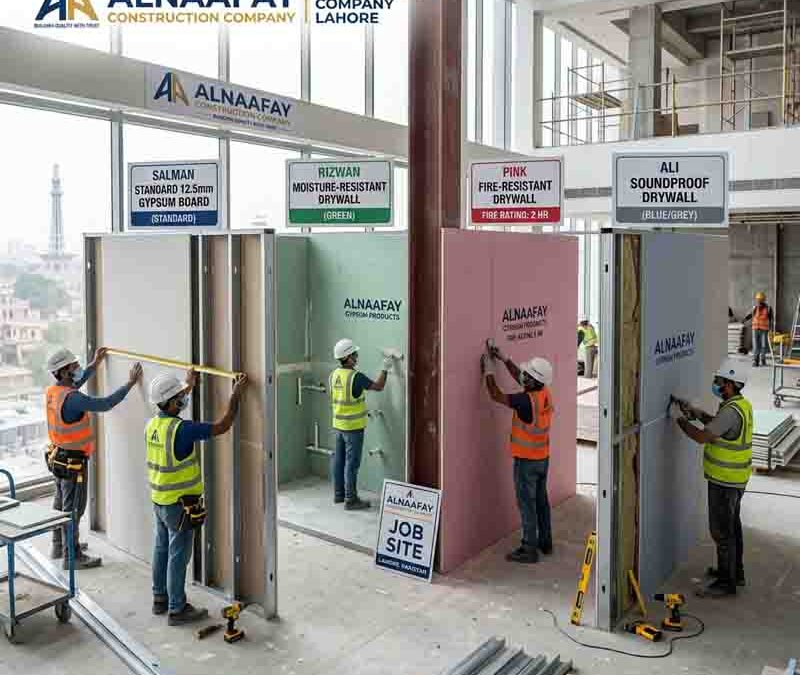
Drywall Types and When to Use Each One
Picking the wrong drywall is one of the most common — and costly — mistakes in construction. Use standard drywall in a bathroom and you will have mold within months. Skip fire-resistant drywall in a garage and you may not meet local building codes. The right choice protects your walls, your budget, and your building for years to come.
This guide covers everything you need to know about drywall types — what each one is made of, where it performs best, what it costs, and how to choose the right option for your specific project. Whether you are a homeowner taking on a renovation or a builder planning a commercial fit-out, the information here will help you make a confident, informed decision.
Table of Contents
- What Is Drywall?
- Types of Drywall
- Standard Drywall
- Moisture-Resistant Drywall
- Fire-Resistant Drywall
- Soundproof Drywall
- Mold-Resistant Drywall
- Lightweight Drywall
- Abuse-Resistant Drywall
- How to Choose the Right Drywall Type
- Drywall and Construction Company Lahore
- FAQs
- Conclusion
1. What Is Drywall?
Drywall — also called gypsum board, plasterboard, or sheetrock — is a panel made from gypsum plaster pressed between two thick sheets of paper. It is the standard material used to finish interior walls and ceilings in residential and commercial construction across most of the world.
Before drywall became widely available after World War II, builders used plaster applied over wooden lath — a time-consuming and labor-intensive process. Drywall changed all of that. Panels could be installed quickly, finished with joint compound and paint, and provide a smooth, durable surface in a fraction of the time. That efficiency made drywall the default wall-finishing material it remains today.
Standard drywall panels come in sheets that are typically 4 feet wide and either 8 or 12 feet long. Thickness ranges from 3/8 inch to 5/8 inch, with 1/2 inch being the most common for interior walls. However, thickness, facing material, and core composition vary significantly depending on the drywall type — and those differences determine where each product should and should not be used.
Understanding the different drywall types is not a matter of preference. It is a practical requirement. Local building codes in many jurisdictions mandate specific drywall types in certain areas of a building, particularly around fire-prone spaces and wet rooms. Using the wrong type can result in failed inspections, expensive rework, and long-term structural damage.
2. Types of Drywall
There are seven main drywall types used in construction today. Each is engineered to solve a specific problem — whether that is moisture infiltration, fire spread, noise transmission, surface damage, or the physical demands of carrying and installing heavy panels.
The seven types covered in this guide are:
- Standard Drywall
- Moisture-Resistant Drywall
- Fire-Resistant Drywall
- Soundproof Drywall
- Mold-Resistant Drywall
- Lightweight Drywall
- Abuse-Resistant Drywall
Each type has a distinct cost range, performance profile, and set of ideal use cases. The sections below cover all seven in detail.
3. Standard Drywall
Standard drywall is the most widely used of all drywall types. It consists of a gypsum core faced with white paper on one side and brown paper on the other — which is why it is sometimes called white board. Most interior walls and ceilings in homes and offices are finished with standard drywall, and for good reason: it is affordable, widely available, easy to cut and install, and takes paint and texture finishes without issue.
Specifications
Standard drywall panels are typically 4 feet by 8 feet, though 4-by-12 panels are also common for larger installations. Thickness ranges from 3/8 inch to 1 inch, but the 1/2-inch panel is the standard choice for most wall applications. At approximately $12 to $18 per 4-by-8-foot panel, standard drywall is the most cost-effective option available.
Best Uses
Standard drywall performs well in low-to-moderate activity areas with minimal moisture exposure. Suitable spaces include:
- Living rooms and dining rooms
- Bedrooms and closets
- Interior hallways
- Single-occupant offices and libraries
Where Not to Use It
Because standard drywall does not resist moisture, it should never be used in bathrooms, kitchens, laundry rooms, or basements. Water infiltration will cause the gypsum core to soften, the paper facing to separate, and mold to develop behind the wall surface. In those environments, a specialized drywall type is always the better choice.
4. Moisture-Resistant Drywall
Moisture-resistant drywall — commonly known as green board due to its distinctive green paper facing — is designed specifically for areas where humidity and incidental water exposure are a concern. While it is not waterproof, its treated facing and denser core significantly reduce the risk of moisture damage compared to standard drywall.
This drywall type is a step up from standard drywall in terms of durability and moisture performance. It is, however, frequently misunderstood. Many builders assume that green board is appropriate for direct water contact — for example, directly behind a shower surround. It is not. For direct water exposure, cement board is the correct choice. Moisture-resistant drywall is appropriate for areas that experience elevated humidity, not direct and repeated wetting.
Specifications
Moisture-resistant drywall panels are denser than standard drywall. They come in the same 4-by-8-foot format and are available in 1/2-inch and 5/8-inch thicknesses. Cost typically runs $14 to $18 per panel, which is modestly higher than standard drywall.
Best Uses
This drywall type is well-suited for:
- Bathroom walls (away from direct water contact)
- Kitchen walls near sinks and cooking areas
- Laundry rooms
- Utility rooms
- Basements with controlled humidity levels
Practical Tip
When installing moisture-resistant drywall, ensure that all cut edges are sealed with joint compound or a moisture-resistant sealant. Exposed gypsum at cut edges is vulnerable to moisture infiltration, which can undermine the panel's overall performance.
5. Fire-Resistant Drywall
Fire-resistant drywall — most commonly known as Type X — is engineered to slow the spread of fire through walls and ceilings. Its gypsum core is reinforced with fiberglass fibers, which hold the core together and maintain its integrity for a longer period when exposed to high heat. The standard 5/8-inch Type X panel provides a minimum one-hour fire rating, meaning a properly installed assembly will resist burn-through for at least 60 minutes in a standardized fire test.
Adding additional layers of fire-resistant drywall to a wall assembly can extend the fire rating further. However, it is worth noting that using this drywall type can increase project costs by up to 50 percent compared to standard drywall. In many cases, though, fire-resistant drywall is not a choice — it is a legal requirement.
Type C is a variation of fire-resistant drywall with an enhanced core that contains additional fiberglass and shrinkage-compensating additives. Consequently, Type C provides superior fire resistance compared to Type X and is typically specified for applications requiring two-hour or longer fire ratings.
Specifications
Fire-resistant drywall is standardly 5/8 inch thick, though some assemblies use 1/2-inch Type X panels. Panels measure 4 by 8 feet or 4 by 12 feet. Cost ranges from $20 to $30 per 4-by-8-foot panel.
Best Uses
Building codes in most jurisdictions require fire-resistant drywall in the following locations:
- Attached garages, particularly walls and ceilings shared with living spaces
- Furnace and mechanical rooms
- Stairwells and exit corridors in multi-family residential buildings
- Shared walls between apartment units
- Certain commercial spaces, particularly those with occupancy loads above defined thresholds
Practical Tip
Do not assume that thicker drywall is automatically fire-resistant. Fire resistance depends on core composition, not just thickness. Always verify the fire rating designation — Type X or Type C — before purchasing panels for fire-rated assemblies.
6. Soundproof Drywall
Soundproof drywall — also called acoustic drywall or sound-dampening drywall — is a multi-layer panel designed to reduce the transmission of sound between rooms. Unlike standard drywall, which is a single-layer gypsum panel, soundproof drywall is constructed from alternating layers of gypsum, viscoelastic polymers, and in some products, a thin embedded metal layer. These layers work together to absorb and dissipate sound energy before it can pass through the wall.
This drywall type is significantly more expensive than standard options, but its acoustic performance can be transformative in the right setting. Many installers pair soundproof drywall with fiberglass batt insulation within the wall cavity for enhanced results. The combination of dense panel layers and cavity insulation provides a meaningful reduction in sound transmission across wall assemblies.
Specifications
Soundproof drywall panels are typically 1/2 to 5/8 inch thick. They come in standard 4-by-8-foot sheets and cost approximately $40 to $55 per panel — making them the most expensive of the common drywall types for residential applications.
Best Uses
This drywall type is worth the cost in the following settings:
- Home theaters and media rooms
- Recording studios and music rooms
- Master bedrooms in multi-family buildings
- Shared walls between units in townhouses or condominiums
- Home offices where concentration and privacy are priorities
- Hotels and hospitality environments where guest comfort requires acoustic separation
Practical Tip
Soundproof drywall performs best when the entire wall assembly is treated as an acoustic system. Sealing all penetrations — electrical outlets, pipe openings, gaps at the top and bottom plates — with acoustic sealant is just as important as selecting the right panel. Sound transmission through small gaps can undermine even the best soundproofing drywall installation.
7. Mold-Resistant Drywall
Mold-resistant drywall goes a step further than standard moisture-resistant drywall. While green board provides resistance to moisture, mold-resistant drywall — often identified by its purple facing — is engineered to inhibit mold and mildew growth even under sustained humid conditions. It is, therefore, the more appropriate choice for high-humidity environments where moisture exposure is more significant or persistent.
The mold resistance comes from the treatment applied to the paper facing and, in some products, the incorporation of antimicrobial compounds into the gypsum core itself. Purple board, manufactured by National Gypsum Company, is one of the most widely recognized products in this category. Notably, some mold-resistant drywall products also offer improved resistance to dents and surface abrasion, making them a strong dual-purpose choice for high-traffic, high-humidity environments.
Homes that have previously experienced mold problems, buildings in humid climates, and spaces directly adjacent to water-intensive uses are all candidates for mold-resistant drywall over standard moisture-resistant options.
Specifications
Mold-resistant drywall panels typically come in 4-by-8-foot sheets and are available in 1/2-inch and 5/8-inch thicknesses. Cost ranges from $15 to $60 per panel depending on the product and level of mold resistance — a wide range that reflects the variation in performance between entry-level and premium products.
Best Uses
Mold-resistant drywall is appropriate in the following areas:
- Bathrooms, particularly in climates with high ambient humidity
- Basements, especially those with any history of moisture infiltration
- Laundry rooms and utility rooms
- Kitchens in high-volume cooking environments
- High-traffic residential areas where both moisture and surface durability are concerns
Practical Tip
Mold-resistant drywall slows and inhibits mold growth — it does not eliminate the possibility entirely. Effective moisture control at the building envelope level, including proper vapor barriers, adequate ventilation, and well-sealed windows and penetrations, remains essential. Mold-resistant drywall is one layer of protection in a broader moisture management strategy.
8. Lightweight Drywall
Lightweight drywall addresses a straightforward problem: standard drywall is heavy, and heavy materials are harder and more expensive to move, carry, and install. A conventional 1/2-inch sheet of 4-by-8-foot drywall weighs just over 51 pounds. A sheet of ultralight drywall in the same size and thickness weighs approximately 39 pounds — a reduction of 12 pounds per panel.
That weight difference becomes much more significant at scale. A stack of 25 conventional 1/2-inch panels weighs approximately 1,280 pounds. By contrast, a stack of 25 ultralight panels of the same size weighs around 980 pounds — a difference of nearly 300 pounds. For workers carrying, loading, and hanging drywall all day, that reduction has measurable effects on productivity and workplace injury risk.
Lightweight drywall is not a different drywall type in terms of application — it can be used in all the same locations as standard drywall. Rather, it is a reformulation of standard drywall that introduces a gaseous foaming agent into the gypsum slurry during manufacturing, creating more air pockets in the core and reducing overall density. USG, which manufactures the well-known Sheetrock UltraLight brand, notes that the product is "stronger pound for pound than standard 1/2-inch drywall" and offers "superior sag resistance" — an important quality for ceiling installations.
Specifications
Lightweight drywall is available in 1/2-inch and 5/8-inch thicknesses, though it is not currently available in a 1/4-inch format. Panels come in 4-by-8-foot and 4-by-12-foot sheets. Cost is approximately $16 per sheet for 1/2-inch ultralight panels — marginally higher than standard drywall at approximately 20 cents per square foot versus 18 cents for standard panels.
Advantages and Limitations
Advantages:
- Easier to carry, load, and position during installation
- Less dust generated when cutting
- Lower transportation costs due to reduced weight
- Better sag resistance for ceiling applications
Limitations:
- Marginally more brittle than conventional drywall, with a slightly higher susceptibility to edge breakage
- Not available in 1/4-inch thickness
- Provides slightly less soundproofing performance than standard drywall
- Minimal but measurable cost premium
Best Uses
Lightweight drywall is a practical choice for virtually any interior wall or ceiling application. It is particularly valuable in the following scenarios:
- Ceiling installations, where overhead work is physically demanding
- Projects handled by smaller crews or solo installers
- Large-scale commercial projects where cumulative weight savings translate into meaningful logistics advantages
9. Abuse-Resistant Drywall
Abuse-resistant drywall is a specialty gypsum panel designed to withstand the surface damage caused by high-traffic use. Unlike standard drywall, which is paper-faced and relatively susceptible to scuffs, dents, and scrapes, abuse-resistant drywall is manufactured with either an enhanced paper facer or a fiberglass mat facer. Both options provide greater resistance to surface abrasion, scratching, and low-energy impacts.
It is important to understand that abuse-resistant and impact-resistant drywall are not the same product, though they are often grouped together incorrectly. Abuse-resistant drywall addresses surface-level damage — scuffs from backpacks in a school hallway, scrapes from cart traffic in a hospital corridor. Impact-resistant drywall adds a layer of mesh within the panel to resist higher-energy impacts that could break through to the stud cavity, such as those that occur in recreation rooms, loading docks, and maintenance areas.
Both drywall types are tested per ASTM C1629, which classifies panels as Level I, II, or III across four distinct test methods: surface abrasion resistance, surface indentation resistance, soft body impact resistance, and hard body impact resistance. When specifying either type, reference the ASTM C1629 classification level rather than using generic descriptors — specifying "abuse- and impact-resistant" in the same line of a project document will create confusion and may result in the contractor selecting based on cost rather than performance.
Specifications
Abuse-resistant and impact-resistant drywall products are typically 5/8-inch Type X panels. They carry GREENGUARD Gold certification in most commercially available forms and meet mold resistance requirements per ASTM D3273. Installation is identical to standard drywall.
Best Uses
Abuse-resistant drywall is appropriate in:
- Residential laundry rooms, hallways, and stairwells
- School and university corridors, cafeterias, and dormitories
- Hospital observation rooms and outpatient areas
- Commercial lobbies, entries, and public corridors
- Warehouses and distribution centers
Impact-resistant drywall is appropriate in:
- Residential recreation rooms, garages, and mudrooms
- Multifamily corridors, stairwells, and maintenance rooms
- Gymnasiums and school workshops
- Mailrooms, loading areas, and high-traffic commercial corridors
- Stair and elevator shaft enclosures in high-rise buildings of Risk Category III or IV
Practical Tip
For walls that require abuse-resistant drywall on only the lower portion — where contact is more likely — there is no need to install a control joint between the abuse-resistant section and the standard drywall above it. The two products can be installed continuously, which simplifies finishing.
10. How to Choose the Right Drywall Type
Choosing correctly among the available drywall types comes down to four questions. Answer each one for every room or space in your project, and the right product will become clear.
Question 1: What is the moisture level in this space?
If the space experiences routine humidity — bathrooms, kitchens, laundry rooms, or basements — standard drywall is the wrong choice. Select moisture-resistant drywall (green board) for moderately humid environments, mold-resistant drywall (purple board) for persistently humid spaces or areas with prior moisture history, and cement board for areas with direct water contact such as shower surrounds.
Question 2: Does this space require fire resistance?
Review your local building code before selecting drywall for garages, mechanical rooms, stairwells, or shared walls in multi-family buildings. Many of these locations require Type X or Type C fire-resistant drywall by law. Installing standard drywall in a fire-rated assembly is a code violation that will result in a failed inspection.
Question 3: Is sound control a priority?
If the space is a home theater, recording studio, bedroom adjacent to a noisy area, or a shared wall between rental units, soundproof drywall is worth the premium. For moderate noise control needs, adding insulation to the wall cavity alongside standard drywall may be sufficient. For high-performance acoustic environments, soundproof drywall combined with cavity insulation and acoustic sealant delivers the best results.
Question 4: What level of traffic will the space experience?
For high-traffic commercial corridors, school hallways, hospital areas, and residential mudrooms or garages, abuse-resistant or impact-resistant drywall is the appropriate choice. Standard drywall will not hold up against sustained use in these environments, and the cost of replacing damaged panels over time will far exceed the modest premium of abuse-resistant products.
Quick Reference by Room
Room or Space | Recommended Drywall Type |
|---|---|
Living room, bedroom | Standard drywall |
Bathroom (non-wet areas) | Moisture-resistant or mold-resistant |
Shower surrounds, wet areas | Cement board |
Garage | Fire-resistant (Type X) |
Home theater | Soundproof drywall |
School corridor | Abuse-resistant drywall |
Gymnasium, loading dock | Impact-resistant drywall |
Ceiling installation | Lightweight drywall |
Basement | Mold-resistant drywall |
11. Drywall and Construction Company Lahore
The construction industry in Lahore is one of the most active in South Asia. With rapid urban expansion, a surge in commercial development, and growing demand for high-quality residential finishes, contractors and developers across the city face increasingly complex material specification decisions — and drywall types are at the center of many of them.
We understand that choosing the right drywall type in a Lahore project involves considerations that go beyond the product itself. Availability in local supply chains, compliance with applicable building standards, climate-specific performance requirements, and project budget all factor into the decision. Lahore's hot and humid summer climate, in particular, makes moisture and mold resistance important considerations that builders in drier climates may not need to prioritize as carefully.
Here is what construction professionals and project owners in Lahore should know about specifying and working with drywall types on local projects:
Moisture and mold resistance matter more here. Lahore's monsoon season creates extended periods of elevated ambient humidity. Consequently, moisture-resistant or mold-resistant drywall types should be specified not just in bathrooms and kitchens, but in any interior space that may be exposed to elevated humidity during construction or thereafter. Standard drywall installed in an unventilated space during monsoon season is a mold risk that can compromise an entire wall assembly before it is ever occupied.
Fire-resistant drywall is increasingly required. As Lahore's commercial building stock grows to include taller structures, mixed-use developments, and institutional facilities, the need for Type X fire-resistant drywall in specific assemblies becomes more relevant. Contractors working on multi-story commercial buildings, hotels, hospitals, or apartment buildings should review fire safety requirements carefully and specify fire-resistant drywall types wherever they apply.
Abuse-resistant drywall adds long-term value in commercial projects. High-traffic commercial buildings — shopping centers, office complexes, schools, and healthcare facilities — see a level of wall contact that standard drywall is not built to withstand. Specifying abuse-resistant drywall in corridors, lobbies, and public areas reduces ongoing maintenance costs and keeps interior finishes looking professional for longer.
Lightweight drywall improves installation efficiency. For large-scale projects where significant quantities of drywall are being moved and hung, the weight savings offered by lightweight panels translate directly into lower labor costs and faster installation timelines. On a project involving thousands of sheets, a reduction of 12 pounds per panel adds up to a substantial productivity gain.
We work with construction companies in Lahore to identify the right drywall types for each project environment, budget, and performance requirement. Whether the project is a single-family home, a commercial tower, or an institutional facility, selecting the correct drywall type from the start prevents costly rework and ensures long-term wall performance.
12. FAQs
What is the most common type of drywall?
Standard drywall — also called white board or regular gypsum board — is the most widely used of all drywall types. It is appropriate for most interior walls and ceilings in dry, low-traffic areas such as bedrooms, living rooms, and offices. It is available in 1/2-inch and 5/8-inch thicknesses and costs approximately $12 to $18 per 4-by-8-foot panel.
What type of drywall should I use in a bathroom?
For bathroom walls that do not receive direct water contact, moisture-resistant drywall (green board) or mold-resistant drywall (purple board) are both suitable choices. For surfaces that will be directly exposed to water — such as the walls of a shower enclosure — cement board is the correct material. Standard drywall should never be used in a bathroom.
Is fire-resistant drywall required by code?
In many jurisdictions, yes. Building codes in most of the United States and other countries require fire-resistant drywall (Type X or Type C) in attached garages, furnace rooms, stairwells, and shared walls between units in multi-family buildings. Before purchasing drywall for any of these spaces, review your local building code or consult with your building department to confirm which fire-rated assembly is required.
What is the difference between abuse-resistant and impact-resistant drywall?
Abuse-resistant drywall is designed to resist surface-level damage — scuffs, scratches, and minor dents caused by everyday high-traffic use. Impact-resistant drywall provides all of that, plus a layer of internal mesh that resists higher-energy impacts capable of breaking through to the stud cavity. The two drywall types should be specified separately in project documents and selected based on the intensity and type of use in a given space.
How much lighter is lightweight drywall compared to standard drywall?
A standard 1/2-inch, 4-by-8-foot drywall panel weighs approximately 51 pounds. By comparison, a lightweight drywall panel of the same dimensions weighs approximately 39 pounds — a reduction of 12 pounds per sheet. Over a stack of 25 sheets, that weight difference adds up to nearly 300 pounds, which has a meaningful impact on transportation logistics and installation labor.
Can I use mold-resistant drywall instead of moisture-resistant drywall?
Yes, and in most cases it is the better choice. Mold-resistant drywall offers superior performance compared to standard moisture-resistant drywall (green board), with greater resistance to both mold growth and surface damage. Consequently, mold-resistant drywall is worth specifying anywhere that moisture-resistant drywall would otherwise be used, particularly in climates with persistent humidity or in buildings with a history of moisture issues.
What is the cheapest type of drywall?
Standard drywall is the most affordable of all drywall types, at $12 to $18 per panel. Moisture-resistant drywall costs slightly more at $14 to $18 per panel. Fire-resistant drywall runs $20 to $30 per panel. Soundproof drywall is the most expensive common option, at $40 to $55 per panel. The most cost-effective approach is always to match the drywall type to the actual needs of the space — overspending on specialty drywall where it is not needed wastes budget that could be applied elsewhere.
How do I know which drywall type to use?
Evaluate each space based on four factors: moisture exposure, fire resistance requirements, acoustic performance needs, and traffic level. For dry, low-activity spaces, standard drywall is sufficient. For wet or humid areas, select moisture-resistant or mold-resistant drywall. For fire-rated assemblies, use Type X or Type C. For noisy environments, use soundproof drywall. For high-traffic commercial spaces, use abuse-resistant or impact-resistant drywall. The quick reference table in Section 10 provides room-by-room guidance.
13. Conclusion
Choosing the right drywall type is not a minor detail — it is a foundational decision that affects the durability, safety, and long-term performance of every room in a building. Standard drywall works well where conditions are dry and traffic is light. Beyond that, there is a specific drywall type engineered for every environment and use case: moisture, fire, sound, mold, impact, and physical installation demands all have purpose-built solutions.
The seven drywall types covered in this guide give you a complete picture of the options available, along with the specifications, cost ranges, and best-use cases that make each one the right choice in the right situation. Apply that information carefully — room by room, space by space — and your walls will perform exactly as intended for the life of the building.
If you are planning a construction or renovation project and want expert guidance on selecting and installing the correct drywall types for your specific conditions, contact our team. We specify and install the right product for every environment, and we stand behind every installation we complete.
