Concrete Types and Their Applications
Concrete stands as the most widely used artificial material on Earth. It serves as the literal foundation of modern civilization. Sidewalks, driveways, bridges, and dams all rely on its strength. However, “concrete” describes a vast family of materials, with each type offering unique properties and advantages. Understanding the different concrete types and their applications is critical for engineers, architects, builders, and homeowners. Doing so ensures the strength, durability, and success of any construction project. In this comprehensive guide, you’ll discover the many forms of concrete and find out how to choose the right one for any purpose.
What Exactly Is Concrete? A Foundational Overview
At its core, concrete is a composite material. It combines three key components: aggregate (such as sand, gravel, or crushed stone), cement (most often Portland cement), and water. Mixing these materials creates a paste that coats the aggregate evenly. Immediately, a chemical reaction called hydration begins, causing the mixture to harden and gain strength over time. As a result, the mix forms a rock-like mass with remarkable durability.
The Impact of Ingredient Adjustments
Changing the amount or type of aggregate, cement, or water can dramatically alter concrete characteristics. Moreover, introducing special additives adjusts workability, setting times, color, and durability. These modifications lead to a wide variety of concrete types and their applications, with each type tailored for specific performance needs. For instance, some concretes weigh less than others, while certain mixes provide ultra-high strength or rapid hardening. Therefore, you’ll find that this versatility is what makes concrete indispensable in construction.
Why Understanding Concrete Types Matters
Selecting the right concrete mix plays a vital role in the longevity and safety of any structure. The wrong choice can cause premature deterioration, structural failures, or costly repairs. For example, choosing standard concrete for a marine structure could result in rapid damage from water and chloride exposure. In contrast, paying extra for an overly specialized mix on a garden path may waste your budget. Therefore, a solid grasp of concrete types and their applications is essential for efficient, safe, and responsible building practices.
The Major Categories of Concrete
To effectively explore your options, it helps to first learn about broad concrete classifications. These categories group mixes based on their design, key properties, and primary ingredients.
1. Nominal and Ordinary Standard Concrete
Nominal and ordinary standard concrete remains the most familiar form, commonly used in general construction when strength requirements are not demanding. Mixes such as M15, M20, and M25 all fall into this group, where the ‘M’ denotes “mix” and the number indicates the compressive strength in megapascals (MPa) after 28 days. For example, M20 grade concrete achieves a standard compressive strength of 20 MPa.
These mixes use predefined proportions of cement, sand, and aggregate. Because they are simple and affordable, people often use them for smaller residential projects and non-structural components.
2. High-Strength Concrete
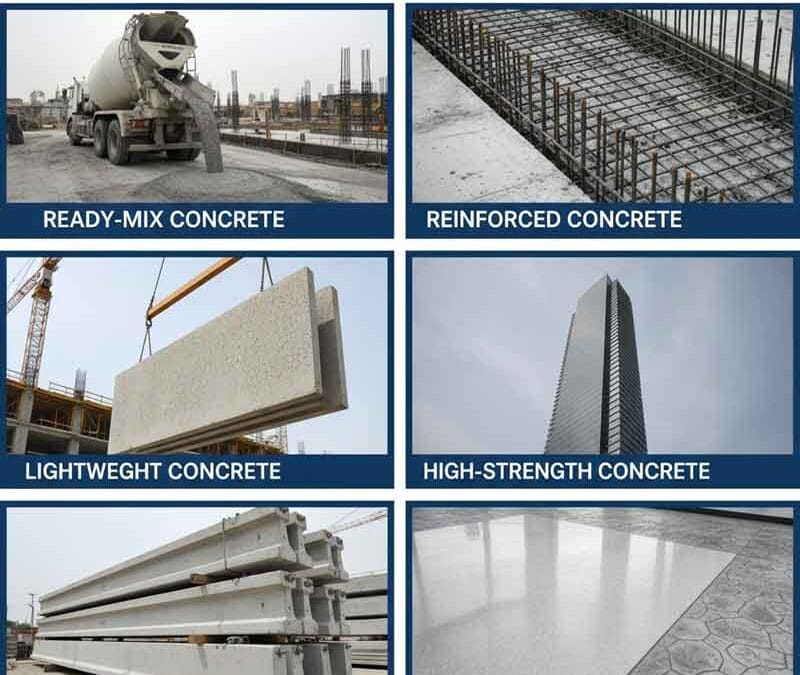
As its name implies, high-strength concrete offers compressive strengths significantly higher than ordinary concrete, often exceeding 40 MPa. This strength stems mainly from a lower water-to-cement ratio and the frequent use of chemical admixtures such as superplasticizers. Consequently, you can construct taller buildings or longer bridges while using slimmer columns and supports. The outcome is not just stronger structures but also more floor space and reduced overall weight.
When and Why to Use High-Strength Concrete
- Tall buildings and skyscrapers
- Bridges and overpasses
- Heavy-load-bearing columns and foundations
Opting for high-strength concrete enhances durability and efficiency in these demanding applications.
3. High-Performance Concrete (HPC)
High-performance concrete, or HPC, extends well beyond higher strengths. It achieves a unique blend of characteristics, including enhanced durability, low permeability, and strong resistance to chemical attack. Achieving these attributes requires a carefully balanced mix, high-quality materials, and special mineral additives such as silica fume.
Real-World Applications of HPC
HPC is vital in harsh environments. For instance, nuclear power plant structures, tunnels, and marine projects frequently make use of this mix because long-term durability is their top concern. By selecting HPC, engineers and builders ensure reliability under extreme conditions.
4. Lightweight Concrete
Lightweight concrete distinguishes itself by weighing much less than regular mixes. Ordinary concrete typically has a density near 2,400 kg/m³, while lightweight mixes use aggregates like pumice, scoria, or expanded shale. Additionally, some mixes include air bubbles to further reduce weight.
Unique Benefits of Lightweight Concrete
- Reduces structural dead load
- Lowers foundation and structural support requirements
- Provides improved thermal insulation
Consequently, lightweight concrete works well for partition walls, floor slabs, and roof decks. Builders prefer this type especially in high-rise construction or when addressing specific thermal needs.
5. Self-Compacting Concrete (SCC)
Self-compacting concrete brings unmatched fluidity and flowability to any job site. It slips around dense reinforcement and fills formwork by its own weight, eliminating the need for mechanical vibration. This convenience comes from using superplasticizers and plenty of fine materials.
Why Choose SCC?
SCC proves invaluable when dealing with crowded rebar, complex forms, and spotty compaction. Furthermore, it significantly improves surface quality and reduces noise during construction. For projects where perfection and speed matter, SCC is often the best option.
Exploring Specific Concrete Types and Their Applications
Within these broader categories, many specialized concrete mixes exist, each suited for specific tasks and environments. Mastering these concrete types and their applications adds flexibility and efficiency to your construction approach.
Shotcrete: Sprayed for Speed and Strength
Shotcrete is not poured—it’s sprayed at high velocity onto a surface using special equipment. This approach is perfect for stabilizing rock slopes, forming tunnel linings, or crafting free-form shapes such as artificial rocks and pools. Its speed of application and ability to adhere well make shotcrete an exceptional choice for certain structural or decorative needs.
Pervious Concrete: Encouraging Water Flow
Pervious concrete, sometimes called “no-fines” concrete, has reduced or eliminated sand content, creating interconnected voids throughout the mix. Water readily passes through, making this an ideal choice for parking lots, driveways, and sporting surfaces. Therefore, you can greatly reduce surface runoff, recharge groundwater, and help combat urban heat retention using this approach.
Roller-Compacted Concrete (RCC): Durable for Heavy Loads
Roller-compacted concrete uses very little water and is much drier than standard mixes. Builders install it using asphalt paving equipment and compact it immediately with vibratory rollers. As a result, RCC stands out for strength and speed, especially in dam construction, industrial yards, and heavy-duty paving.
Glass Concrete: Blending Style With Recycling
Glass concrete mixes recycled glass into the aggregate. Not only does this contribute to sustainability, but the colorful glass creates decorative finishes. Countertops, floors, and feature panels gain extra visual appeal while supporting environmental goals.
Polymer Concrete: Chemical Resistance at Its Best
Polymer concrete replaces the typical cement-based binder with a polymer resin. Due to this change, the finished product achieves extremely high strength and outstanding resistance to chemicals—plus it cures rapidly. Industrial floors, repair mortars, and elements exposed to aggressive substances benefit the most from polymer-based mixes.
Global Design and Concrete’s Roman Roots
Although modern technology continues to improve concrete, its roots reach back to ancient times. The Romans truly revolutionized concrete construction, creating many techniques and formulas still admired today.
The Roman Empire: Masters of Concrete Innovation
Romans crafted structures, such as the Pantheon and Colosseum, that have lasted for centuries, thanks to ingenious concrete mixes. They combined lime, volcanic ash (pozzolana), and select aggregates to produce a blend that could even harden underwater. As a result, Roman harbors, bridges, and aqueducts survived for two thousand years.
The Pantheon: A Marvel of Roman Concrete
The Pantheon’s dome stretches more than 43 meters across—remarkable, even by modern standards. Romans mastered the technique of varying aggregate densities, using heavy basalt at the base and lightweight pumice at the dome’s top. Their scientific approach set the world standard. For these reasons, ancient Rome remains the most recognized civilization for innovation in concrete types and their applications.
Concrete’s Dominance in Lahore’s Construction Sector
No discussion about concrete is complete without looking at its modern global influence. In Pakistan, and especially Lahore, concrete dominates construction.
Why Concrete Remains Popular in Modern Lahore
The push for fast development in Lahore means most buildings—homes, high-rises, plazas—rely on reinforced concrete frames. Concrete guarantees strength, affordability, and versatility, so it continues to outpace other materials. Moreover, the city’s intense summer heat actually reinforces concrete’s value: its high thermal mass helps keep interiors comfortable.
Key Housing Societies That Showcase Concrete Use
When you tour neighborhoods such as DHA, Bahria Town, or Lake City, you’ll notice reinforced concrete in nearly every structure. Other top Lahore areas, like Valencia, Wapda Town, Johar Town, Model Town, Gulberg, Askari, and Cantt, also rely heavily on concrete, highlighting its widespread local appeal.
A Practical Guide to Using Concrete Effectively
Choosing the best mix type marks only the beginning of a successful project. Careful management, solid planning, and an awareness of common challenges all play essential roles.
Preparing for Success: Steps Before Pouring
Start with well-defined plans, accurate mix selection, and a qualified team. These basics set the stage for durable results and prevent many future issues. If you neglect careful preparation, you risk structural trouble later.
Common Mistakes to Avoid in Concrete Work
Many construction problems stem from errors made during mixing, placement, or curing. Adding too much water, for instance, reduces final strength even though pouring becomes easier. Rather than rushing, always measure carefully and follow proven mix designs, as precision produces the best results.
Take Care With Curing
Curing keeps concrete at the proper temperature and moisture level while it gains strength. Skipping or shortening the curing period can leave your slab porous and fragile. Moreover, failing to cure properly may result in cracks that will require costly repairs.
Subgrade Preparation Matters
Don’t overlook subgrade preparation beneath slabs and foundations. If you skip this step, your structure may settle or crack over time. In summary, by double-checking these basics, you prevent most failures in concrete work.
Budgeting for Your Concrete Project
Costs for concrete work range widely. Factors such as mix strength, additives, transportation distance, and the amount of preparation all affect your final price. While ordinary concrete is usually affordable, high-performance mixes require more upfront investment.
Consider the Whole Project Cost
When preparing your budget, think beyond just the initial outlay. For example, selecting a more expensive but durable concrete might mean less money spent on repairs later. Lightweight mixes can also help you save on foundation costs, providing a worthwhile long-term benefit.
Maintenance and Repair of Concrete
Even though concrete lasts for years, a bit of maintenance goes a long way. Routine cleaning, regular inspection, and prompt repairs help surfaces avoid deeper problems.
Preventing and Addressing Cracks
Small cracks can become larger if left untreated, especially in areas exposed to freeze-thaw cycles. As a result, you should seal cracks early. Many patching products or caulks work quickly, keeping out water and avoiding further deterioration.
Sealing and Cleaning Tips
Sealers add an extra layer of protection, warding off water, chemicals, and stains. For best results, reapply a quality sealer every few years to driveways and patios. When cleaning, mild soap, water, and a brush are usually enough; skip strong acids that might damage the surface.
With patient planning, respect for local climate and codes, and good teamwork with experts, you can deliver concrete work that survives season after season. Following this advice ensures you benefit fully from all concrete types and their applications.
Frequently Asked Questions (FAQs) About Concrete
Q: What is the difference between concrete and cement?
A: Cement is one vital component of concrete. It acts as the binder, while aggregates and water form the bulk of the mix. In other words, cement is to concrete what flour is to a cake.
Q: How long does concrete take to cure?
A: Standard mixes set within a few hours and are safe to walk on after 24 to 48 hours. However, concrete continues to gain strength over time, reaching its design strength after 28 days.
Q: Can you pour concrete in the rain?
A: Avoid heavy rain during placement, as excess water weakens the surface. If rain is light and the slab has already set, covering the surface helps guard against damage.
Q: Why does concrete crack?
A: Reasons for cracking include shrinkage, thermal movement, heavy loads, or subgrade shifting. Smart joint placement, proper curing, and the right mix design minimize this risk.
Q: What is the best concrete for driveways?
A: Most residential driveways use mixes with 25 to 30 MPa compressive strength. Air-entrained concrete provides extra freeze-thaw resistance. Understanding the many available concrete types and their applications helps you make the best selection.
Quick Links
Social Icons
Contact Us Information
443 J3 Johar Town Lahore near Expo Center Lahore
