
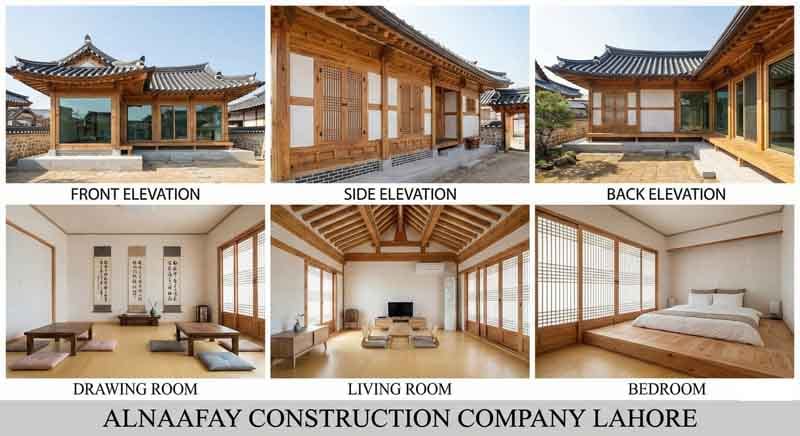
Korean Hanok 5 Marla Small House Design – Easy and Complete Guide
Designing a Korean Hanok 5 marla small house sounds very special and different. Many people may think this style is only possible in Korea or in big traditional villages. However, with smart planning and simple ideas, you can understand it easily and even imagine such a home on a 5 marla plot in your own city.
A Korean Hanok 5 marla small house design mixes three big ideas:
- Traditional Korean Hanok style
- A small city plot (5 marla)
- Modern needs of a normal family
Because of this mix, the result can be a peaceful, natural, and beautiful home that still works well in today’s busy life. Language in this guide will stay easy so that even children and beginners can understand. Hard architectural words will be explained in simple English.
You will learn:
- What 5 marla means in daily life
- What a Korean Hanok house is
- Why a Korean Hanok 5 marla small house design is a good idea
- How to plan rooms, garden, and structure
- Which country loves Hanok design the most
- What advantages and problems this style has
- How to plan and build step by step
Moreover, you will see many examples and tips that can help you turn this dream into a real plan.
1. Understanding 5 Marla for Korean Hanok Small House Design
Before thinking about roofs, courtyards, and wooden beams, it is important to understand the land size. Only then can a Korean Hanok 5 marla small house design become practical.
1.1 Simple Meaning of 5 Marla Plot
Land is measured in different ways across the world. In many countries people use square feet or square meters. In Pakistan and some parts of India, another unit is common: marla.
In many modern housing societies:
- 1 marla ≈ 225 square feet (sometimes 250 or 272, depending on rules)
- 5 marla ≈ 1,125 square feet of land (in the 225 sqft system)
So, a 5 marla plot is a small to medium-sized urban plot, usually for a compact family home.
On such a plot, people often plan:
- A car porch
- Small front strip garden
- Two floors (ground and first)
- Around 3–4 bedrooms
- Limited backyard or side yard
Because space is not huge, planning must be very smart. Every square foot should work well.
1.2 Typical Shape of 5 Marla Plots
Plots are not always perfect squares. Many 5 marla plots are:
- Narrow in front and deeper from front to back
- Sometimes wider in front and a bit less deep
- Occasionally on a corner touching two roads
Shape affects Korean Hanok 5 marla small house design in several ways.
For example:
- A narrow front may limit how wide the Hanok-style façade looks.
- A deeper plot allows you to add a tiny inner yard or a side court.
- A corner plot gets more light and air, which suits Hanok ideas very well.
Because of these differences, an architect always checks exact measurements before starting any detailed design.
1.3 Why 5 Marla Is a Challenge and Also an Opportunity
A 5 marla plot feels small compared to 1 kanal or big village land. Still, it also offers some good chances.
Challenges:
- Less space for big courtyards
- Limited area for large gardens
- Harder to copy full traditional Hanok shapes
Opportunities:
- Easier to manage and maintain
- Lower building cost than very large houses
- Forces you to keep only what is truly needed, which matches Zen-like Hanok thinking
Therefore, a Korean Hanok 5 marla small house design must be clever. It cannot copy a huge Korean farmhouse directly. Instead, it must compress the spirit and key elements into a compact, city-friendly form.
2. What Is a Korean Hanok House?
Now that plot size is clear, it is time to understand the heart of the idea: Hanok.
2.1 Simple Definition of Hanok
In very simple words:
A Hanok is a traditional Korean house, usually made with natural materials like wood, stone, and clay, designed to suit the land, the seasons, and the people living inside.
Hanok houses:
- Use wooden columns and beams
- Have curved, tiled roofs with wide eaves
- Often surround an inner courtyard (madang)
- Include floor heating (ondol)
- Connect strongly with nature and weather
These homes are not only beautiful. They are also designed very carefully for comfort in both winter and summer.
2.2 History and Spirit Behind Hanok
Hanok design started many centuries ago in Korea. In those times, people did not have air-conditioners or fancy machines. Consequently, they had to think deeply about:
- Sun direction
- Wind flow
- Heat from cooking fires
As a result, they created:
- Ondol floor heating systems that sent warm smoke under floors in winter
- Raised wooden floors (maru) that stayed cool with air movement in summer
- Long roof overhangs that blocked strong summer sun but allowed low winter sun
Beyond practical points, Hanok also carries a special spirit. It respects:
- Simplicity
- Balance
- Harmony with mountains, trees, and sky
Even today, many Koreans feel emotionally attached to Hanok style, because it connects them with history and nature.
2.3 Main Features of Korean Hanok Design
Several features are almost always seen in Hanok houses:
Natural materials
Wood, clay tiles, stone foundations, and sometimes paper-covered doors or windows.Curved roofs with upturned corners
Roofs are not straight boxes; they flow gently and often look like they are slightly smiling upwards.Inner yard (madang)
A central open space around which rooms stand.Ondol and maru
Warm floors for cold weather and raised wooden floors for hot days.Sliding doors and flexible rooms
Many internal walls are sliding, which lets families change room sizes as needed.
A Korean Hanok 5 marla small house design may not be able to include every single traditional detail, yet the design can still follow the main ideas and feelings.
3. Why Combine Hanok Style with a 5 Marla Small House?
After learning what Hanok is, another question comes naturally: why try a Korean Hanok 5 marla small house design at all, especially on a small city plot?
3.1 Calm Home in a Busy City
City life often feels noisy and fast. People deal with traffic, work stress, and phone screens all day. In such a situation, having a home that feels like a peaceful mini-retreat can be a big blessing.
Hanok style, even in a 5 marla small version:
- Brings nature closer
- Uses soft materials and colors
- Encourages slow living and family time
Therefore, you can feel calm when you enter your home, even if everything outside feels out of control.
3.2 Smart Climate Response
Traditional Hanok houses are designed for Korea’s cold winters and warm summers. Many cities in Pakistan and India also face hot summers and some cold months, although climate is not exactly the same.
Even so, several Hanok ideas help a lot:
- Deep roof overhangs shade walls and windows.
- Courtyards and open sides allow air to cross-ventilate.
- Natural materials often breathe better than all-concrete boxes.
While a Korean Hanok 5 marla small house design must adjust to local weather, the basic climate-smart thinking is already there.
3.3 Unique Look with Cultural Depth
Many modern city houses look similar: grey boxes with glass and metal. Choosing a Hanok-inspired house on a 5 marla plot gives a very different feel.
Benefits include:
- A unique identity in your street
- A story behind your design
- A mix of Korean tradition with local life
Some people love K‑dramas, Korean culture, or Asian aesthetics. For them, a Korean Hanok 5 marla small house design can feel especially close to the heart.
3.4 Teaches Simplicity and Respect
Hanok design is not only about looks. It also teaches values:
- Respect for natural materials
- Care for land and seasons
- Simple living instead of endless buying
Children growing up in such a house can slowly understand that simple things can be very beautiful and powerful.
4. Where Is Korean Hanok House Design Most Famous?
You also asked clearly: “Yeh design kis country main zyada famous hai?” So let us answer that fully.
4.1 Hanok in South Korea
The most famous country for Hanok design is South Korea itself. That is where Hanok houses were born and where they still stand in many villages and cities.
Popular places include:
- Bukchon Hanok Village in Seoul
- Jeonju Hanok Village
- Traditional areas of cities like Gyeongju
In these areas, you can see many well-kept Hanok homes, guesthouses, tea houses, and cultural centers. Korean people and tourists from around the world visit these spots to enjoy the architecture and atmosphere.
4.2 Hanok-inspired Homes in Other Countries
Over time, architects in other countries also became interested in Hanok style. Consequently, you can find Hanok-inspired buildings in:
- The United States – some modern homes borrow Hanok roof shapes and courtyards.
- European countries – certain designers study Hanok for its climate-smart ideas.
- Japan and China – there is some exchange of traditional East Asian timber building styles.
However, full traditional Hanok houses remain rare outside Korea. Mostly, you see modern mixes rather than pure Hanok.
4.3 Korean Hanok 5 Marla Small House Design in South Asia
When we speak about a Korean Hanok 5 marla small house design, with the “5 marla” unit, the focus turns toward:
- Pakistan
- Some parts of India
In these countries, 5 marla is a normal city plot size. So if someone decides to use Hanok ideas there, they naturally combine them with a 5 marla plan.
Because this approach is still very new, such houses are not yet common. Yet, they can become a trend among people who love both Korean culture and smart natural design.
To summarize:
- Hanok design is most famous in South Korea.
- A 5 marla Hanok-style house is especially relevant in Pakistan and India, where small urban plots follow the marla system.
5. Core Principles for Korean Hanok 5 Marla Small House Design
Now we can look at the deep rules that guide a good Korean Hanok 5 marla small house design.
5.1 Harmony with Land and Direction
Traditional Hanok builders always studied the land carefully. They checked:
- Sun path
- Wind direction
- Slopes and views
- Nearby hills and water
For a 5 marla plot in a city, natural land may be flatter and more regular. Even then, direction matters a lot.
Good practice:
- Place main living areas toward better light (often east or north).
- Use smaller windows on very hot sides, with deep shade.
- Keep at least one side or small courtyard open to sky for air and sun.
This way, the small Hanok-inspired home can still “sit well” on the land, just like big traditional Hanoks did.
5.2 Use of Natural Materials
Hanok homes depend strongly on:
- Wood for structure and frames
- Stone or brick for base and ground
- Clay or tiles for roofs
- Paper or thin material for screens and sliding doors
In Pakistan or India, real timber structure like in Korea may be expensive or difficult. However, you can still follow the spirit by using:
- Good-quality wood or wood-look materials for doors, windows, and ceilings
- Stone tiles or natural-look ceramic tiles for floors
- Soft neutral paints instead of plastic-like bright colors
A Korean Hanok 5 marla small house design feels more real and warm when materials look and feel natural.
5.3 Ondol and Modern Comfort
Ondol is the traditional Korean floor heating. In cold Korean winters, this system kept people warm.
In many parts of Pakistan and India, winters are shorter and not as severe. Consequently, you might not need full traditional ondol. Yet, floor comfort still matters.
Options include:
- Warm floor tiles or wooden floors in bedrooms and lounge
- Underfloor electric heating in very cold regions (if budget allows)
- Simple gas heaters or AC heating where ondol is not practical
The main idea is: people in a Hanok-like home spend time close to the floor, sitting on mats or low furniture. Because of that, the floor should feel pleasant and not too cold.
5.4 Courtyard and Open Space
Madang (courtyard) is like the heart of a Hanok.
On a 5 marla plot, you cannot create a huge yard in the middle, but you can still:
- Keep a small internal court
- Use a side yard as mini-madang
- Open the living room to a tiny yet beautiful garden patch
Even a 6–8 feet wide open-to-sky space can change the mood of the whole house, especially if framed by sliding doors and windows.
5.5 Flexibility of Rooms
Traditional Hanok rooms are often multi-purpose. Sliding walls and doors allow space to be:
- A sitting room in the day
- A sleeping room at night
- A larger hall when guests arrive
In a Korean Hanok 5 marla small house design, you can copy this flexibility partially by using:
- Sliding partitions
- Foldable furniture
- Floor cushions stored in cabinets
Small houses benefit a lot from flexible use of rooms, because you do not have space for dozens of separate, fixed-use rooms.
6. Adapting Korean Hanok Style to a 5 Marla City Plot
Traditional Hanok houses stand on bigger pieces of land. Therefore, some creative adaptation is needed when making a Korean Hanok 5 marla small house design.
6.1 Basic Plot Layout
A possible layout for a Hanok-style 5 marla plot might include:
- Car porch in front
- Tiny front garden strip or entry yard
- Main building with two floors
- Side or middle courtyard
- Small backyard, if depth allows
Rooms can be arranged in an L‑shape or U‑shape around a little open space. That way, you get a mini-version of the classic Hanok “around the yard” feeling.
6.2 Single-Story vs Two-Story Hanok Mini House
Space is the biggest question.
Options:
Single-story Hanok-style bungalow
Very close to traditional style. However, it may leave little room for yard on a 5 marla plot because the ground floor will use most of the land.Double-story compact Hanok-inspired house
More bedrooms and living space can fit. Some yard and open areas remain on ground floor and possibly on terrace.
In most city situations, a two-story Korean Hanok 5 marla small house design will make more sense. The upper floor can be made lighter in look to keep overall shape low and calm.
6.3 Placing the Courtyard or Open Space
Because land is tight, you must choose carefully where to put the open space.
Choices:
- Central courtyard (small), with rooms on three sides
- Side courtyard, open along one edge of house
- Back courtyard combined with backyard
Each option has pros and cons. For instance:
- Central court gives beautiful privacy but may make rooms narrower.
- Side yard is easier to fit on a standard 5 marla plot and still brings light.
Discuss these options with your architect, keeping your family’s habits in mind.
6.4 Respecting Local Building Rules
Housing societies and cities have rules about:
- Setbacks from front and sides
- Maximum height
- Percentage of plot covered by building
These by-laws will influence your Korean Hanok 5 marla small house design. Room for yard, roof shape, and balcony positions must all follow these rules. A good architect can still reach a Hanok feeling inside those limits.
7. Exterior Look of a Korean Hanok 5 Marla Small House
Now we can focus on how the outside of this small Hanok-style house might look.
7.1 Roof Shape and Eaves
The roof is one of the most recognizable parts of any Hanok. Traditional roofs:
- Have gentle curves
- Show upturned corners
- Use clay tiles
On a 5 marla plot, copying the full traditional roof may be difficult or costly. However, you can still:
- Use a low-slope or very gentle gable roof
- Extend eaves (overhanging edges) for shade
- Add a slight upward curve at visible corners if your structure allows
Alternatively, some people choose a flat roof but create a fake sloping roof edge in front that suggests Hanok style while keeping the structure simple and modern behind.
7.2 Façade Materials: Wood, Tiles, and Plaster
For walls and visible surfaces, a Korean Hanok 5 marla small house design can include:
- Wooden or wood-look panels around windows and entrance
- Plastered walls painted in soft cream or earthy tones
- Brick or stone at the base of walls
- Roof tiles or tile-like sheets on visible sloping parts
Real wood outside needs protection from sun and rain. Because of that, many modern Hanok-inspired homes now use treated wood, composite boards, or tiles that imitate wood grain.
7.3 Windows and Doors in Hanok Style
Doors and windows give character to the façade.
Hanok-inspired ideas:
- Wooden frames with slender lines
- Sliding doors opening to courtyards and gardens
- Windows divided into simple square or rectangular patterns
In a small house:
- Front main door may be a solid wood-look panel with a clean design.
- Glass sliding doors can open from lounge to side yard.
- Upper windows might be slightly simpler but still follow the same frame color and style.
Keeping all openings consistent in color and pattern helps maintain a calm Hanok-inspired look.
7.4 Entrance Gate and Boundary Wall
Many 5 marla plots sit right next to the street with a small boundary wall. So entrance details matter.
Design ideas:
- A simple wooden or wood-finish main gate with horizontal slats
- Low boundary wall with stone or brick base and plaster above
- Small wooden canopy over the gate, hinting at Hanok roof style
Including a tiny front court, even just a few feet deep, before the main door can create a nice transition space, similar to how big Hanok homes have entrance yards.
8. Interior Planning for Korean Hanok 5 Marla Small House Design
Inside the house, planning must serve both tradition and modern life.
8.1 Zoning: Public, Family, and Private Spaces
Like most homes, a Hanok-inspired 5 marla house has:
- Public zone – entrance and guest sitting room
- Family zone – lounge, dining, kitchen
- Private zone – bedrooms and bathrooms
Additionally, a nature zone exists wherever the courtyard or yard appears.
Smooth movement between these zones is important. Guests should reach the guest area easily. Family members should move between kitchen, lounge, and yard without squeezing through tight corners.
8.2 Ground Floor Plan Ideas
A common layout for the ground floor in Korean Hanok 5 marla small house design may include:
- Car porch in front
- Entrance foyer or small lobby
- Drawing room or multi-use sitting room
- Guest powder room
- Stairs to the upper floor
- Family lounge that opens to side or back courtyard
- Dining space near the kitchen
- Kitchen (and maybe a tiny store)
- One bedroom with attached bath, if space allows
Sliding doors can help in many places:
- Between lounge and courtyard
- Between dining and kitchen
- Between lobby and drawing room
These doors save swing space and give a soft division between areas.
8.3 First Floor Plan Ideas
Upper floor, if built, usually holds:
- One master bedroom with attached bath and maybe a small dressing area
- One or two additional bedrooms with bathrooms
- Small family sitting or study corner
- Terrace or balcony attached to lounge or bedroom
Balconies can follow Hanok style by using:
- Wooden or wood-look railings
- Simple vertical or horizontal patterns
- Overhanging roof or slab above
Access to roof may also exist for water tanks or laundry.
8.4 Multitasking Rooms in a Small Hanok House
Space is tight on 5 marla, so many rooms must do double duty.
Examples:
- Drawing room that also works as study or guest bedroom with a sofa bed
- Dining area that doubles as homework or work-from-home space
- Upper lounge that can also host guests when needed
Using sliding partitions and foldable furniture supports this flexible way of living, which is similar to how traditional Hanok rooms change roles during the day.
9. Room-by-Room Ideas for a Korean Hanok 5 Marla Small House
Now let us look more closely at each major room type.
9.1 Entrance Lobby in Korean Hanok 5 Marla Small House Design
At the entrance, a Hanok-inspired lobby often:
- Stays neat and uncluttered
- Offers a place to remove or store shoes
- Gives a first glimpse of wood and natural tones
Practical ideas:
- A low built-in shoe cabinet or a simple wooden bench
- A small plant in a corner
- Soft wall paint in off-white or beige
Lighting can be simple but warm, using wall sconces or a small ceiling light.
9.2 Drawing Room or Multi-use Sitting Space
In many South Asian homes, drawing room is a formal guest space. In Hanok-style thinking, it can still be formal yet flexible.
Design suggestions:
- Medium-height sofas with wooden arms and legs
- One or two floor cushions or low chairs to hint at floor-sitting culture
- Low center table with clean shape
- Minimal decorations on walls, maybe one or two art pieces showing nature
Curtains and fabrics should be calm in color and not too heavily printed. Light textures like linen or cotton blends work nicely.
9.3 Family Lounge in Korean Hanok 5 Marla Small House
Family lounge is a very important part of a Korean Hanok 5 marla small house design.
Good features:
- Direct connection to the yard through sliding doors
- TV wall kept simple, with a low wooden unit
- Mix of sofa seating and perhaps a small floor-sitting corner
- Plenty of daylight through wide windows
At night, you can create a cosy mood with table lamps and soft ceiling lights. Very strong, cold white lights are better avoided in this space.
9.4 Kitchen in a Hanok-inspired 5 Marla Home
Kitchen design can be both modern and Hanok-flavored.
Cabinet ideas:
- Plain or shaker-style doors in white, cream, or light wood
- Open shelves for a few bowls, jars, or tea sets
- Simple black, silver, or wooden handles
Counters may use:
- Granite or quartz in soft, natural tones
- Tiles that are easy to clean
Backsplash can be:
- Plain ceramic tiles
- Small vertical or horizontal patterns
- Subtle textures, not very loud prints
Keeping surfaces clear of extra items helps the kitchen feel just as peaceful as the rest of the Hanok-style house.
9.5 Dining Area in Korean Hanok 5 Marla Small House Design
Dining may sit between lounge and kitchen or be part of the lounge.
To create a Hanok-inspired dining corner:
- Choose a wooden table with simple lines.
- Use chairs with slim legs and supportive backs.
- Keep colors light or warm, such as light brown or beige.
- Hang a modest pendant light above the table, not too large or too shiny.
A window or sliding door near the dining table can give a view of the courtyard or plants, which makes meals more enjoyable.
9.6 Bedrooms in Korean Hanok 5 Marla Small House
Bedrooms should be the most peaceful rooms in the house.
Key points:
- Simple bed design, not over-decorated
- Neutral wall colors with maybe one darker or wood accent wall
- Built-in wardrobes to save space
- Minimal furniture, such as bed, side tables, and perhaps a small desk
Master bedroom in a Korean Hanok 5 marla small house design might:
- Open to a small balcony
- Include a low bench near the window
- Use soft bedding in white, cream, or pastel shades
Children’s rooms can have a few brighter accents, but the base should still be calm so they can sleep and study comfortably.
9.7 Bathrooms with a Touch of Hanok
Even bathrooms can show some Hanok flavor.
Design ideas:
- Wall tiles in light colors like white, grey, or beige
- Matte or lightly textured floor tiles to prevent slipping
- Wooden or wood-look vanity for storing towels and items
- Frameless or simple-glass shower area
A small plant in a corner (that can handle moisture) adds freshness. Light should be bright enough to be safe but not harsh.
9.8 Staircase and Movement
Staircases in a small house are important because they connect floors and also take space.
Hanok-style stair ideas:
- Wooden or wood-finish steps
- Simple railing in wood or metal with vertical lines
- Maybe a small indoor plant bed or decorative stone area under the lower part of stairs
Good lighting along the steps keeps the staircase safe and also attractive.
10. Materials, Colors, and Light in a Hanok 5 Marla House
The feeling of a home depends a lot on what you see and touch every day.
10.1 Flooring for Korean Hanok 5 Marla Small House Design
Floor material must be durable, easy to clean, and comfortable.
Popular options:
- Wood-look ceramic or porcelain tiles in living areas and bedrooms
- Slightly textured tiles for bathrooms and kitchen
- Simple stone or stone-look tiles for outdoor areas
Using similar flooring across many rooms makes the small house feel larger and more unified.
10.2 Wall Colors and Finishes
Hanok style prefers:
- Off-white
- Cream
- Light beige
- Soft grey
Accent walls may use:
- Deeper earthy colors like warm brown or olive green
- Wooden cladding or paneling
- Textured paint with subtle effect
Too many strong bright colors can disturb the calm mood. A better approach is to keep walls gentle and let wooden elements and plants add richness.
10.3 Lighting Design in a Hanok-inspired Small House
Light should support peace, not disturb it.
Layers of lighting:
- General lighting – main ceiling lights for each room
- Task lighting – focused lights in kitchen, study areas, and bathrooms
- Accent lighting – small lights highlighting a plant, a niche, or a wall texture
Warm white lights (not very blue) work best for living spaces. LED strips under shelves or behind TV units can add soft glow without being too strong.
10.4 Using Glass and Screens Wisely
Glass is important for bringing light inside. At the same time, privacy and heat control matter.
Suggestions:
- Use larger glass areas on sides where sun is not too harsh.
- Add wooden or metal screens outside windows for shade and privacy.
- Use frosted glass in bathrooms and near stairs where needed.
- Add curtains or blinds that fit the Hanok style, usually in light fabrics.
Screens with horizontal or vertical slats can create beautiful shadows and also remind you of traditional Korean patterns.
11. Outdoor Spaces in Korean Hanok 5 Marla Small House Design
Even on a small plot, outdoor areas can play a big role.
11.1 Mini Courtyard or Side Yard
A small courtyard is central to the Korean Hanok 5 marla small house design idea.
Possible features:
- A single small tree or taller plant
- Ground with pebbles, gravel, or simple tiles
- One or two larger stones as focal points
- A bench or low deck for sitting
Even if the space is only 6–8 feet wide, it can feel special if surrounded by windows and doors from lounge and maybe kitchen or stairs.
11.2 Front Strip Garden
In front of many 5 marla houses there is a narrow garden strip.
Hanok-style front garden:
- Use a simple composition of stones, low shrubs, and maybe one tree.
- Avoid too many mixed, bright flowers right at the entrance.
- Add a small lantern-style outdoor light if you like.
Keeping the design minimal respects Hanok simplicity and still gives life to the entrance.
11.3 Small Backyard or Terrace Garden
If plot depth allows, a small backyard can be used for:
- Evening tea
- Children’s play
- Washing area (hidden behind screens)
Where no backyard exists or is very small, terrace or roof gardens can become the main outdoor relaxation area.
Terrace ideas:
- Potted plants arranged neatly
- Wooden or wood-look deck tiles
- Simple seating: a bench or a couple of chairs and a table
- Railings that match the Hanok-inspired style of the balcony below
12. Advantages of Korean Hanok 5 Marla Small House Design
Choosing any style should be supported by clear benefits. Hanok-inspired design on 5 marla has many strengths.
12.1 Peaceful Atmosphere
First and most important, the overall feeling is calm.
Reasons include:
- Light, neutral colors
- Natural materials
- Limited decoration
- Connection with a little yard or plants
Living in such a space can reduce stress and help family members feel more balanced.
12.2 Smart Use of Small Space
Because of Japanese and Korean traditions of living in compact rooms, Hanok-style ideas match small plot needs well.
Advantages:
- Flexible rooms do more than one job.
- Sliding doors and screens save space.
- Simple furniture avoids crowding.
Therefore, a Korean Hanok 5 marla small house design can feel more open than many cluttered houses of the same size.
12.3 Strong Identity and Beauty
A Hanok-inspired home looks very different from a typical concrete box.
This uniqueness can:
- Give you pride in your home
- Make visitors remember it
- Increase interest if you ever sell it later
Beauty here does not come from heavy decoration, but from good proportion, materials, and connection with nature.
12.4 Better Natural Light and Air
Courtyards, side yards, and carefully placed windows improve:
- Daylight inside rooms
- Fresh air flow
- Indoor health and comfort
These benefits are useful for everyone, especially for children and elders.
12.5 Teaches Simple, Sustainable Living
Using natural-looking materials and respecting seasons leads naturally to:
- Less waste
- Less focus on show-off items
- More appreciation for small daily moments
That way, your Korean Hanok 5 marla small house design becomes not just a building, but a gentle teacher for your whole family.
13. Challenges and Mistakes to Avoid in Hanok 5 Marla Design
Along with benefits, some challenges need attention.
13.1 Trying to Copy Everything Exactly
Attempting to copy a big, traditional Korean Hanok exactly on a tiny city plot can lead to disappointment.
Risks:
- Roof shape becomes too heavy for the small house.
- Courtyard takes so much space that rooms feel too small.
- Cost rises because of complex woodwork.
Instead of copying, it is better to adapt. Keep the key feelings and features, and adjust details for your land, climate, and budget.
13.2 Using Weak or Fake Materials
Sometimes, low-quality materials that look like wood or stone may be used to save money.
Problems:
- Fading
- Peeling
- Quick damage from weather
These issues can spoil the calm beauty of a Korean Hanok 5 marla small house design and also increase maintenance.
Choosing fewer but better materials usually works better than covering everything with cheap imitations.
13.3 Poor Climate Control with Too Much Glass
Large windows and doors can overheat rooms in hot areas if not shaded.
To avoid that:
- Add roof overhangs.
- Use external screens.
- Choose better glass where possible.
- Plan for cross-ventilation through openings on different sides.
Careful design keeps the house cool and prevents you from feeling aggravated by heat or glare later.
13.4 Ignoring Storage
A clean Hanok look depends on clutter-free rooms. Without good storage:
- Clothes and toys pile up
- Kitchen surfaces get messy
- Floors lose their open feel
Therefore, built-in cupboards, kitchen cabinets, and bathroom storage must be part of the plan from the start.
13.5 Not Respecting Local Rules and Culture
Every place has building rules and cultural habits. For example:
- Many South Asian families need a proper closed kitchen.
- Separate drawing room for guests may be important.
- Some societies limit balcony or fence styles.
Designing a Korean Hanok 5 marla small house must respect all these. Otherwise, the house may cause daily stress or even legal problems.
14. Cost and Budget for Korean Hanok 5 Marla Small House Design
Money planning is essential for any house project.
14.1 Main Cost Categories
Costs usually divide into:
Grey structure
- Excavation, foundations
- Columns, beams, slabs
- Walls and rough plaster
Finishing
- Flooring
- Paint
- Doors and windows
- Kitchen and bathroom fittings
- Woodwork and wardrobes
External and garden work
- Boundary wall and gate
- Courtyards and paths
- Plants and ponds
Hanok-style design mainly affects finishing and external works, because of wood, tiles, and gardens.
14.2 Where Hanok Style Can Increase Cost
Extra cost may come from:
- Better quality wooden doors, windows, or cladding
- Special roof shapes or tiles
- High-quality screens and railings
- Well-made garden with stones and water features
However, you can manage this by:
- Limiting special treatments to front and main inner areas
- Using cost-effective but durable materials for hidden sides
- Starting with a simple garden and adding more slowly over time
Zen-like simplicity helps: if you avoid over-decoration, you automatically save some money.
14.3 Ways to Keep Budget Under Control
Some smart tips:
- Fix a budget range before design starts.
- Share that range honestly with your architect.
- Choose one main floor tile for most areas instead of many different types.
- Use wooden touch in some key places rather than full wooden ceilings everywhere.
- Avoid unnecessary complex curves in roof and structure.
A well-planned Korean Hanok 5 marla small house design can look rich and calm even with mid-range materials, if proportions and details are right.
14.4 Hidden or Extra Costs
Significant hidden items can be:
- Society drawing approval and fees
- Stronger foundations if soil is weak
- Underground water tank and pump
- Power backup or small solar system
- Garden lighting and water pump for ponds
Keeping a reserve of about 5–10% of total budget for such extras is usually wise.
15. Step-by-Step Planning for a Korean Hanok 5 Marla Small House
Turning idea into reality needs a clear path.
15.1 Step 1 – Note Your Family’s Needs
Sit with all family members and discuss:
- How many bedrooms and baths are truly needed
- Importance of a separate drawing room
- Need for home office or study area
- Expected number of cars
- Desire for open yard or courtyard
Write a short list. This will guide your Korean Hanok 5 marla small house design from the beginning.
15.2 Step 2 – Find an Architect Who Understands Hanok Style
Look for a designer who:
- Has done modern or traditional Asian-style houses
- Enjoys natural materials and simple forms
- Listens to you carefully rather than just pushing their own style
Show them:
- Photos of Hanok houses you like
- Examples of small Hanok-inspired homes, if any
- Your plot documents and by-law information
Clear communication now avoids confusion later.
15.3 Step 3 – Finalize the Floor Plan
The architect will draw one or more plan options.
While checking them:
- Imagine how you walk from entrance to kitchen, from bedroom to lounge.
- See if every bedroom has window and enough air.
- Confirm that courtyard or yard gets proper light and size.
- Check storage spaces for clothes, utensils, cleaning tools, and more.
After a few changes, agree on a final plan that suits your lifestyle.
15.4 Step 4 – Develop the Hanok-style Elevation
Next, the outer look will be shaped.
This stage includes:
- Roof form and eaves
- Window and door positions
- Materials like wood, tiles, and plaster
- Balcony and gate style
Ask for 3D views from front, back, and perhaps one side. These images will show how your Korean Hanok 5 marla small house design will actually appear.
15.5 Step 5 – Get Necessary Approvals
Submit drawings to the relevant housing authority or city department.
They may check:
- Setbacks
- Height
- Built area percentage
- Structural safety
Only after approval should you start full construction.
15.6 Step 6 – Decide on Construction Method and Contractor
Choose whether you will:
- Hire separate labor and manage materials yourself
- Use a builder for combined material-and-labor contract
- Give the project to a turnkey company for a full package price
Select a contractor with a good track record and clear communication. Written agreements and timelines help.
15.7 Step 7 – Build the Grey Structure
Construction starts on the ground.
This includes:
- Foundation work
- Columns and beams
- Slabs
- Walls
Visit the site often or send a trusted person. Confirm that:
- Room sizes match plans
- Locations of doors and windows match drawings
- Courtyard size and position feel right
Early checking prevents big problems later.
15.8 Step 8 – Install Electricity, Plumbing, and Services
Before finishing, hidden systems must go in:
- Electric wires and switch boxes
- Water and drainage pipes
- Gas lines if used
- AC piping
Plan:
- Where you need plugs (near beds, sofas, kitchen counters)
- Positions for TV and internet
- Fan and light points
A Hanok-inspired house can still be very modern inside with smart hidden wiring.
15.9 Step 9 – Do Finishing in Hanok Style
Finishing gives the house its final personality.
Work at this stage:
- Internal plaster and smoothing
- Floor tiles or wooden floors
- Ceiling work
- Paint and wood polish
- Doors, windows, and screens installation
- Kitchen and bathroom setup
Keep asking yourself:
- “Is this simple?”
- “Does this feel natural?”
- “Is there too much decoration?”
These questions ensure your Korean Hanok 5 marla small house design stays true to its spirit.
15.10 Step 10 – Garden, Furniture, and Moving In
Finally, complete the garden and bring furniture.
For garden:
- Place stones and plants in chosen spots
- Fill ponds and test water systems
- Arrange outdoor seating
For furniture:
- Choose simple lines, wooden looks, and neutral fabrics
- Avoid very bulky or over-carved items
Move in slowly. Give yourself time to understand the space before adding too many decorative pieces.
16. Frequently Asked Questions about Korean Hanok 5 Marla Small House Design
Finally, let us answer some quick questions that often arise.
16.1 How to Explain Korean Hanok 5 Marla Small House Design in One Easy Line?
You can say:
“It is a small 5 marla city house designed in the style of traditional Korean Hanok, using natural materials, simple shapes, and a little courtyard or garden to create a peaceful home.”
That line covers the main idea simply.
16.2 In Which Country Is Hanok Design Most Famous?
Hanok design is most famous in South Korea, where it started and where many Hanok villages still exist. People from all over the world visit Korean Hanok areas to learn about this architecture.
The 5 marla Hanok-style small house idea is mainly relevant in countries like Pakistan and India, because they use the marla system for city plots.
16.3 Is Korean Hanok 5 Marla Small House Design Very Expensive?
Cost depends on:
- How much covered area you build
- Quality of materials like wood, tiles, and glass
- Complexity of roof and garden
Hanok look does not require gold or heavy luxury items. A lot of its beauty comes from simplicity. By choosing mid-range but good-quality materials and a not-too-complex roof form, you can control cost.
16.4 Is This Style Practical in Hot Countries?
With some adjustments, yes.
Helpful steps:
- Use deeper roof overhangs on sunny sides.
- Place large glass areas where sun is softer.
- Add insulation in roof and perhaps some walls.
- Allow cross ventilation.
Traditional Hanok already responds to climate, so its lessons are useful even outside Korea.
16.5 Does This Style Suit Joint Families?
A Korean Hanok 5 marla small house design can work for joint families if planned wisely.
You may need:
- More bedrooms
- Possibly a shared upper lounge
- Flexible multi-use rooms
- More storage
Hanok-style sliding partitions and multi-purpose rooms are actually good for big families in small spaces.
16.6 Can I Mix Hanok with Modern or Local Styles?
Yes, mixing can be very successful if done carefully.
You can:
- Keep a modern structure but use Hanok-inspired roof edges and materials
- Combine Hanok courtyard ideas with local courtyard traditions
- Use modern furniture with some Hanok-style low seating or wooden screens
Key point is to maintain overall calm and harmony. Too many random style changes can make the house feel confused.
Quick Links
Social Icons
Contact Us Information
443 J3 Johar Town Lahore near Expo Center Lahore
