
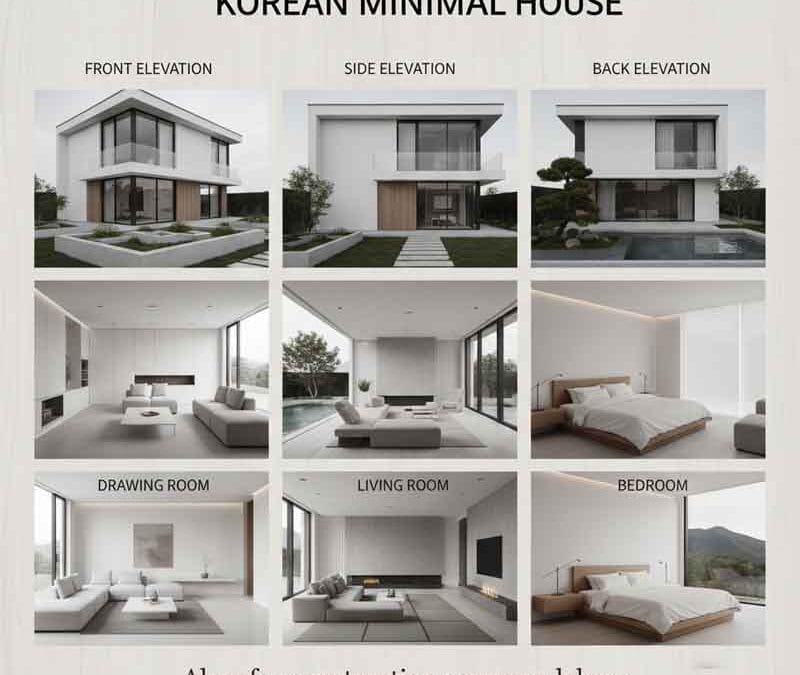
Korean Minimal House Design
Because Korean people love clean lines, calm colors, and smart storage, this style makes daily life feel light and happy. Rooms stay tidy without much effort. Light moves freely. Nature comes inside through big windows and small gardens. Moreover, the house feels safe, private, and peaceful for women, kids, and elders.
With patient planning, respect for local climate and codes, and good teamwork with experts, a Turkish stone house can become a timeless home. In the same way, a Korean Minimal House Design becomes a calm, healthy, and joyful place when every detail is thought about carefully.
What is Korean Minimal House Design? (Hanok meets modern minimalism)
Korean Minimal House Design is a beautiful mix of old Korean hanok wisdom and today’s simple living. It keeps the best parts of traditional hanok – natural wood, ondol heated floors, paper doors, and courtyard life – but removes everything extra. The result is a home that feels warm in winter, cool in summer, and always peaceful.
Key features children can understand
- Almost everything is made of light-colored wood.
- Floors are warm because heat comes from under the floor (ondol).
- Paper or glass sliding doors let light pass through rooms.
- Very few things are on display – everything has its own hidden place.
- There is always a small garden or courtyard in the middle.
- The house is quiet, bright, and smells like wood.
Where is Korean Minimal House Design most famous?
This style is most famous in South Korea. Seoul, Jeju Island, Busan, and new towns like Pangyo and Songdo show thousands of beautiful examples. Famous architects such as Kim Seong-youl, Kim Jung-sik, and studios like IROJE KHM and Bcho Architects made this style popular worldwide.
Many people in Japan, China, Europe, Canada, and the United States now build Korean-inspired minimal homes because they love the calm feeling. However, South Korea is clearly the country where Korean Minimal House Design is most famous and most perfectly done.
Seven golden rules of Korean Minimal House Design (easy for kids to remember)
- Less is more – keep only what you love.
- Let nature inside – big windows, plants, and courtyard.
- Everything has a place – hidden storage everywhere.
- Use natural materials – wood, stone, paper, clay.
- Keep colors calm – white, cream, light gray, soft wood tones.
- Make floors warm – ondol system or radiant heating.
- Create quiet zones – separate spaces for rest, work, and play.
Because these rules are simple, even a child can help plan the house!
Site planning for Korean Minimal House Design (sun, wind, and privacy)
Good comfort starts outside the walls.
- Face the living room and courtyard south – this brings warm winter sun and cool summer shade.
- Place the kitchen east – morning light makes cooking happy.
- Put bedrooms west or north – they stay cooler for sleeping.
- Keep a small courtyard in the center – it brings light and air to every room.
- Plant tall bamboo or trees on the north and west sides – they block cold winter wind.
- Make the entrance private – use a small gate and screen wall so people cannot see inside from the street.
Because Korean culture values privacy very much, the house always looks quiet from outside but feels open and bright inside.
Climate-smart secrets of Korean Minimal House Design
Korean winters are cold and dry. Summers are hot and wet. The house solves both problems naturally.
Winter comfort
- Ondol (underfloor heating) warms feet first – the best feeling ever.
- Thick walls and triple-glazed windows keep heat inside.
- South-facing windows catch low winter sun.
Summer comfort
- Deep roof overhangs block high summer sun.
- Courtyard creates cool air movement.
- Wooden floors and paper doors let breeze pass through.
- Light colors reflect heat.
As a result, you use very little air-conditioning or heating – bills stay low and the planet stays happy.
Layout ideas that work perfectly (Korean Minimal House Design plans)
- Tiny Korean minimal house (under 60 m² – perfect for one or two people)
- One big living-kitchen room with courtyard view.
- Sleeping loft above the bathroom.
- Hidden storage under the floor and in walls.
- Small deck for morning coffee.
- Family Korean minimal house (100–150 m² – most popular size)
- L-shaped or U-shaped plan around a central courtyard.
- Living room, kitchen, and dining all open to courtyard.
- Three bedrooms with built-in wardrobes.
- One big family bathroom + small powder room.
- Separate laundry and mudroom at the back entrance.
- Three-generation Korean minimal house (180–250 m²)
- Main house for parents + separate small house for grandparents.
- Connected by a glass corridor or shared courtyard.
- Private entrance for each part.
- Big shared kitchen for family gatherings.
Jeju-style Korean minimal villa (holiday home)
- Flat roof with big terrace.
- Floor-to-ceiling glass toward ocean.
- Black volcanic stone + light wood contrast.
- Outdoor shower and small infinity courtyard pool.
Because every family is different, you can mix these ideas to make your own perfect plan.
Room sizes that feel just right (Korean standard)
- Living + dining + kitchen (open plan): 35–50 m² feels very comfortable.
- Master bedroom: 12–18 m² is enough when storage is perfect.
- Child bedroom: 9–12 m² with built-in desk and wardrobe.
- Bathroom: 6–10 m² (Korean people love big, beautiful bathrooms).
- Courtyard: even 10–20 m² changes everything – it becomes the heart of the house.
Materials that make Korean Minimal House Design special
- Wood: pine, cypress, oak – always light color, never painted dark.
- Floor: Korean oak or engineered wood with ondol heating pipes below.
- Walls: white or light gray clay paint (breathable and natural).
- Doors and windows: wooden frames with rice-paper film or clear glass.
- Roof: gentle slope with gray or black tiles (modern versions use metal that looks like tile).
- Stone: only small amounts – maybe a feature wall or courtyard floor.
Because natural materials breathe, the house never feels stuffy. Moreover, they age beautifully – the house looks better after 10 years than on day one.
Ondol – the magic warm floor (every child’s favorite part)
Ondol is the traditional Korean underfloor heating system. Hot water pipes run under the beautiful wooden floor. You can sit, play, or sleep directly on the floor – it is always warm and clean.
Modern ondol is super efficient:
- Uses only 35–40 °C water (very safe).
- Heats the whole house evenly.
- No dust blowing like forced-air systems.
- Perfect for children who love playing on the floor.
Storage secrets – how Korean houses stay tidy forever
Korean Minimal House Design has the best hidden storage ideas:
- Floor storage: lift-up panels in the hallway hide shoes and seasonal items.
- Wall storage: entire walls become cabinets with no handles.
- Under-stair drawers: every inch is used.
- Bed with lifting mattress: huge storage for blankets and clothes.
- Kitchen island with drawers on both sides.
- Bathroom vanity that goes from floor to ceiling.
Because everything has a home, cleaning takes only 10 minutes a day – even with kids!
Color palette that calms the mind
- Main color: warm white or very light gray (makes rooms feel bigger).
- Wood tone: natural light oak or pine.
- Accent colors: soft sage green, muted lavender, or pale peach – only in small amounts.
- Black: only for window frames and small details.
Children love this palette because it feels like living inside a gentle cloud.
Lighting – soft and beautiful like moonlight
- Daytime: big windows and courtyard bring free natural light.
- Evening: warm LED lights (2700K) hidden in ceilings and under shelves.
- Reading lamps: simple paper or fabric shades.
- Night lights: tiny LEDs in the floor along hallways – perfect for kids who wake up at night.
Because light is soft and warm, everyone sleeps better.
Kitchen in Korean Minimal House Design (clean, fast, happy)
- Induction cooktop – safe for children, easy to clean.
- Big sink – Korean people wash everything by hand.
- Hidden appliances – rice cooker, kimchi fridge, everything goes inside cabinets.
- Long island for eating and homework.
- Window above sink looking at courtyard plants.
Bathroom – a daily spa
- Deep soaking tub – even in small houses.
- Rain shower with bench.
- Heated floor and heated towel rail.
- Big mirror with soft light.
- Plants or small window for fresh air.
Safety features for families and women
- Rounded corners on all furniture.
- No sharp table edges.
- Locks on cleaning cabinets.
- Windows that open only 10 cm at the top (child-safe).
- Video doorbell and motion lights at entrance.
- Safe room or panic button (in larger homes).
Because safety is built in quietly, everyone feels relaxed.
Cost guide – Korean Minimal House Design is not always expensive
- Small house (80 m²): $150,000 – $250,000 (depending on city).
- Medium family house (150 m²): $300,000 – $500,000.
- Luxury Jeju villa (200 m²+): $800,000 and up.
Ways to save money without losing beauty:
- Use engineered wood instead of solid oak.
- Keep the shape simple (square or rectangle).
- Choose standard windows instead of custom sizes.
- Do some finishing work yourself (painting, gardening).
Step-by-step building timeline (12–18 months)
1–2 months: planning and permits
3–5 months: foundation and structure
4–6 months: roof, windows, ondol system
2–3 months: interior finishing
1 month: courtyard, garden, final cleaning
Because Korean builders are very experienced with this style, construction is usually fast and clean.
Maintenance – almost zero!
- Wood floors: sweep and mop with water only.
- White walls: repaint every 7–10 years.
- Roof: check tiles every 5 years.
- Ondol pipes: last 50+ years.
Common mistakes to avoid (so your house stays perfect)
- Painting wood dark – makes rooms feel small and sad.
- Adding too many decorations – breaks the minimal magic.
- Forgetting the courtyard – this is the heart of the house.
- Using cheap windows – you will feel cold and pay high bills.
- Making rooms too small – Korean minimal needs breathing space.
Frequently asked questions (Korean Minimal House Design)
Q: Where is Korean Minimal House Design most famous?
A: South Korea – especially Seoul, Jeju, and new towns like Pangyo.
Q: Is it expensive?
A: It can be affordable if you keep the design simple and use local materials.
Q: Can I build it in a cold country?
A: Yes! Ondol + thick insulation + triple windows = super warm house.
Q: Can I build it in a hot country?
A: Yes! Big overhangs + courtyard breeze + light colors = naturally cool house.
Q: Is it good for children?
A: Perfect! Warm floors, no sharp corners, lots of safe playing space on the floor.
Q: How do I keep it clean?
A: Everything has a place + minimal things = 10-minute cleaning every day.
Q: Does it have a garage?
A: Usually not. Korean minimal houses have small carport or street parking to keep more garden space.
Final loving words
A Korean Minimal House Design is more than a house – it is a gentle way of living. It teaches us that we need very little to be very happy. The wood smells good. The floor is always warm. The light is always soft. The courtyard brings birds and butterflies inside. Children grow up knowing that beauty lives in simple things.
Because this design comes from hundreds of years of Korean wisdom, it already knows how to make people feel calm and loved. You just have to let it.
If choices start to go wild or budget seems to go out of control, remember the Korean saying: “Keep only what makes your heart happy.” Remove one thing. Then remove one more. Suddenly, everything becomes perfect.
With patient planning, respect for local climate and codes, and good teamwork with experts, your Korean Minimal House Design will become the most peaceful, beautiful, and loving home your family has ever known.
And one day, when your children grow up, they will remember the warm floor under their feet, the soft light through paper doors, and the quiet courtyard where they played for hours – and they will smile.
That is the real magic of Korean Minimal House Design.
Quick Links
Social Icons
Contact Us Information
443 J3 Johar Town Lahore near Expo Center Lahore
