
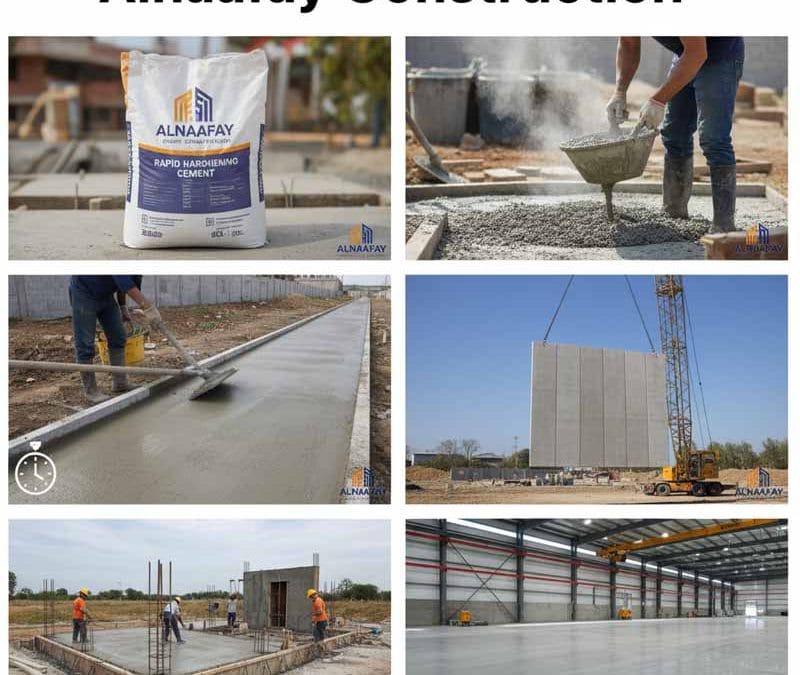
Rapid Hardening Cement for construction
1. What Is Rapid Hardening Cement?
Rapid Hardening Cement (RHC) is a special type of cement that gains strength faster than normal cement. It is most commonly used in places where the construction work needs to be completed quickly — without waiting 28 days for full strength.
In simple words:
It is a fast-working cement that helps you build quickly without compromising quality. Rapid Hardening Cement for construction
Although it hardens faster, it still meets the strength and safety standards needed for buildings, bridges, roads, and other works.
2. Why Is Rapid Cement Important in Construction?
Construction projects are often delayed due to weather, labor availability, or scheduling issues. In such scenarios, Rapid Hardening Cement becomes very useful.
When time is limited:
- Workers use RHC to speed up early-strength development.
- It helps remove shuttering (formwork) sooner, saving time and money.
- Roads or pavements that must open early can be completed faster.
That’s why engineers, site managers, and contractors value this technology.Rapid Hardening Cement for construction
3. Real-World Success Story: Honda Showroom Slab in 2 Days
In Lahore, a commercial project needed a concrete floor ready in just 3 days for a showroom opening.
Traditional cement would require 7–14 days for safe curing. However, the team used Rapid Hardening Cement, and within 24 hours, they reached 70% of full strength.
The client was surprised to see cars placed on the new slab in just 48 hours. No cracks appeared later — ensuring strength and speed together.
4. Key Properties of Rapid Hardening Cement
Now, let’s understand what makes RHC special.
| Property | Details |
|---|---|
| Early setting time | Begins setting in 30–60 minutes |
| Fast strength gain | 3-day strength equals 7-day strength of OPC |
| Composition | High C3S (Tri-calcium silicate) content |
| Fineness | Ground finer than ordinary cement |
| Heat of hydration | Higher, so gains power faster |
| Compatibility | Works well with general aggregates |
Thanks to these properties, RHC works quickly without compromising strength or quality.
5. Comparing RHC With Ordinary Portland Cement (OPC)
| Property | Ordinary Cement (OPC) | Rapid Hardening Cement |
|---|---|---|
| Setting Time | Slower (initial 45–60 mins) | Fast (initial 30–45 mins) |
| Strength @ 3 Days | ~20 MPa | ~30 MPa |
| Shuttering Removal | After 7 days | After 3 days |
| Best Used For | Normal speed builds | Urgent projects |
| Cost | Cheaper | Slightly higher |
| Final Strength | Similar after 28 days | Equal or more |
So, if you need speed and strength, go with RHC. For long-term slow work, OPC remains a good option.Rapid Hardening Cement for construction
6. Where Is Rapid Hardening Cement Used?
While RHC can be used almost everywhere, it is preferred in:
- Road construction
- Bridge repairs
- Airport runways
- Precast concrete items
- Cold weather concreting
- Commercial slabs with strict deadlines
- Emergency repair works
- Industrial floorings
- Quick renovation projects
- Beam and column casting where fast formwork removal is needed
Basically, when time is short and strong structure is needed, RHC is ideal.Rapid Hardening Cement for construction
7. How Does Rapid Hardening Cement Work Faster?
Because of its unique formula, RHC:
- Contains more tricalcium silicate (C3S) which reacts faster with water
- Quickly forms a hard gel, bonding aggregates together
- Releases more heat during hydration
- Is finer than standard cement, which means more surface reacts at once
This leads to concrete becoming hard and strong in less time, often saving weeks over regular cement use.Rapid Hardening Cement for construction
8. Advantages of Using RHC in Construction Works
Here are some strong reasons to use Rapid Hardening Cement:
- ✅ Faster project delivery
- ✅ Early removal of shuttering (formwork)
- ✅ Time-saving in project phases
- ✅ Reduces labor cost due to shorter site-time
- ✅ Minimizes delay in big projects
- ✅ Avoids cracks from early cold weather
- ✅ Suitable for pre-mix plants and prefab elements
- ✅ Keeps pace with fast urban development needs
In short: You save time, manpower, and indirect costs.
9. Limitations: Is Rapid Cement Always the Right Choice?
While RHC is helpful, it may not suit all projects.
Limitations include:
- Higher cost than OPC
- Greater heat of hydration — not good for mass concrete (e.g. dams)
- Requires careful curing because fast drying may invite shrinkage cracks
- Limited shelf-life — should be used quickly after bag is opened
- May not blend with every soil condition
So, for general home projects or village houses under no time pressure, OPC might be more practical.
10. Mixing, Water Ratio, and Handling of Rapid Cement
Follow these good practices:
- Always use clean, fresh water
- Maintain a lower water-cement ratio (0.38 to 0.45)
- Mix thoroughly before setting begins
- Use mix within 15–30 minutes
- Apply proper curing — don’t let mix dry too fast
- Avoid working in extreme heat unless additives are used
If unsure, follow the guidelines on the cement bag or consult your site engineer.
11. Site Safety and Handling Guidelines
- Wear gloves and mask during mixing
- Use closed drum or shed for cement storage
- Do not mix old and new cement types together
- Keep water source nearby
- Additives must be measured properly
- Dispose of solid waste safely
Good safety enables better construction — always.
12. Top Brands Selling RHC in Pakistan
Here are local and international cement companies offering quality rapid hardening cement:
| Brand | Product Name |
|---|---|
| Maple Leaf | Extra Fast Cement |
| DG Khan | DG Speed Set |
| Bestway | Rapid Build |
| Kohat Cement | Fast Track |
| Lucky Cement | QuickSet Premium |
| Pakcem | Rapid Max |
| ASKARI | Special Rapid Cement |
For assurance, check:
- Date of manufacture
- Strength test reports
- Packaging intactness
Always buy from authorized dealers only.
13. Best Practices for Using RHC in Walls, Slabs, and Foundations
A few notes on what works best:
- In brick bonding, use plasticizer to avoid uneven absorption
- For slab casting, avoid direct sunlight during pouring
- Keep slabs wet for at least 3–5 days
- Use vibrators to ensure better compaction
- Avoid joint gaps unless required by design
Within hours, RHC starts hardening, so action must be quick and guided.
14. Is Rapid Cement More Expensive or Worth It?
Yes, RHC price per bag is slightly higher than ordinary cement (by Rs. 80–Rs.150).
However, this is balanced because:
- You need less time on-site
- It reduces labor bills
- Faster formwork reuse saves material costs
- No delays = no client complaints
Total cost may equal or be lower in fast-paced jobs.
15. Rapid Cement and the Environment
Experts say:
Faster construction = fewer emissions per project
Also:
- Lower fuel used due to shorter machinery run-time
- Deadline-driven projects reduce material waste
- Best for green construction with low-carbon cements
Use responsibly, and it supports both earth and economy.
16. Common Myths About RHC – Cleared
| Myth | Truth |
|---|---|
| It is weak cement | ✖ False – It’s stronger in earlier stages |
| It’s only for roads | ✖ Not true – even homes can use it where needed |
| It cracks easily | ✖ Only if curing is ignored |
| Not good for home builders | ✖ It suits fast renovation and prefabrication jobs too |
Always talk to your engineer or consultant before deciding.
17. What Do Engineers Think About It?
A few words from real projects:
Engr. Usman (Lahore):
“We completed 4 beams in 2 days instead of 5 using RHC. Unbelievable strength gain!”
Engr. Ayesha (Karachi):
“Precast companies rely on it 100%. Especially for slabs and fence panels.”
Engr. Rizwan (Multan):
“If used with trained team, RHC gives better finish and faster results.”
18. How to Transport and Store Rapid Cement Safely?
Tips that help:
- Keep bags in dry, covered space
- Make sure water doesn’t enter store room
- Use first in, first out (FIFO) method
- Avoid stacking bags more than 12
- Use bags within 3 months of production date
- Don’t transport during heavy rain if unpackaged
Use care, and you get value!
19. Is It Useful for House Owners and Small Projects?
Yes — even homeowners can use RHC for:
- Fast repairs (like wall damage)
- Water tank casting
- Kitchen or bathroom slabs
- Stairs casting indoors
- Parapet walls or driveways
Remember: It saves time & money if used wisely.
Quick Links
Social Icons
Contact Us Information
443 J3 Johar Town Lahore near Expo Center Lahore
