Ready Mix Concrete
Introduction
Concrete is one of the most widely used building materials in the world. From small houses to huge skyscrapers, bridges, and dams – concrete plays a central role in construction. Traditionally, concrete has been mixed on-site using cement, sand, stone, and water. Workers manually prepare the mixture and then use it for construction.
But in modern construction, this method is slowly being replaced by a more advanced solution called Ready Mix Concrete (RMC).
Ready Mix Concrete is concrete that is manufactured in a factory (batching plant) under strict quality control, then transported to construction sites in special mixer trucks. This ensures high quality, consistency, and efficiency in every batch.
In this blog, we will explain:
What is Ready Mix Concrete?
History and development of RMC
Composition of RMC
How it is produced step by step
Why it is used in construction
Major advantages and disadvantages
Types of RMC
Uses of RMC in Pakistan
Ready Mix Concrete suppliers in Lahore and other cities
Future of RMC in Pakistan
Keyword focus: Ready Mix Concrete
What is Ready Mix Concrete?
Ready Mix Concrete is a specially prepared mixture of cement, sand, aggregates, and water. Unlike traditional site-mixed concrete, RMC is manufactured in a central batching plant where every ingredient is measured with high precision.
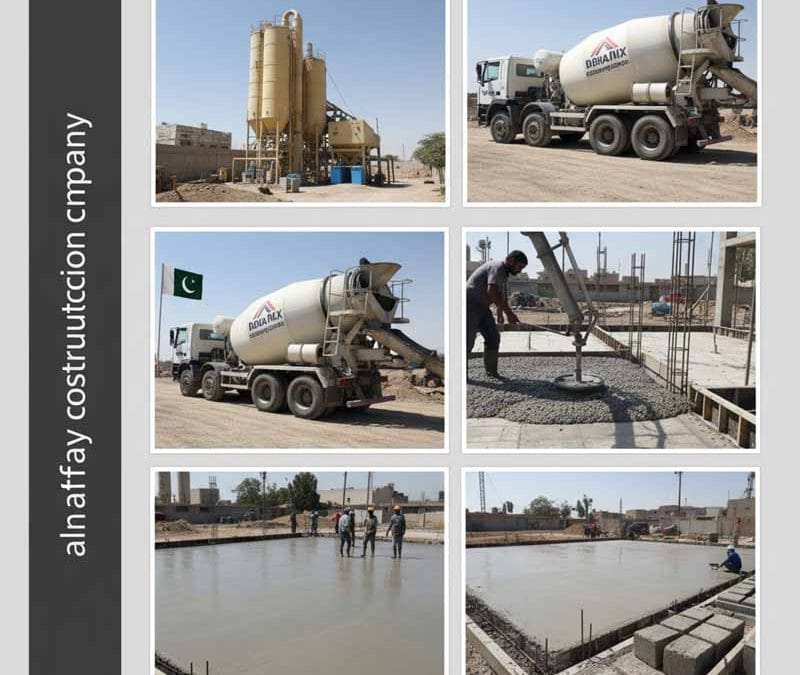
Once mixed, the concrete is loaded into transit mixer trucks that keep rotating while transporting to the construction site. This ensures that the concrete does not set or harden during transport.
When the truck arrives, the concrete is ready to be poured directly into formwork or pumped into higher floors using concrete pumps.
History of Ready Mix Concrete
The concept of RMC started in early 20th century in Europe.
By the 1920s, the first commercial plants were established in the USA.
In developed countries, more than 70% of concrete used today is ready mix.
In Pakistan, RMC became popular only in the last 15–20 years, especially in Lahore, Karachi, and Islamabad.
Now, many big projects in Pakistan prefer Ready Mix Concrete because it ensures strength, speed, and quality.
Composition of Ready Mix Concrete
The ingredients of RMC are the same as normal concrete, but they are measured with more accuracy.
Cement – Ordinary Portland Cement (OPC) or special types (SRC, PPC).
Sand (Fine Aggregate) – Usually river sand or crushed sand.
Coarse Aggregate (Crush Stone) – Margalla, Sargodha, or Dina crush.
Water – Clean and free from impurities.
Admixtures (optional) – Chemicals to improve workability, setting time, or durability.
The proportion of these materials depends on the required grade of concrete (M15, M20, M25, etc.).
How is Ready Mix Concrete Produced? (Step-by-Step Process)
1. Batching
Raw materials (cement, sand, stone, water) are measured by weight using computerized systems.
2. Mixing
All materials are mixed in a large machine at the batching plant. Uniform mixing is ensured.
3. Loading
Fresh concrete is transferred into transit mixer trucks.
4. Transportation
Trucks transport the mix to the construction site. The drum keeps rotating to avoid setting.
5. Placement
Concrete is poured directly from trucks or pumped using special pumps to higher levels.
6. Compaction and Curing
After placement, concrete is compacted (to remove air gaps) and cured (to maintain moisture).
Why Use Ready Mix Concrete?
In today’s fast-paced construction, time and quality are everything. Ready Mix Concrete provides:
Consistent quality
Faster completion of projects
Reduced labor costs
Suitable for large pours (slabs, foundations, bridges)
Advantages of Ready Mix Concrete
1. High Quality
Accurate batching and mixing under strict supervision.
Stronger and more durable than site-mixed concrete.
2. Saves Time
No need to mix concrete on site.
Projects can move faster, especially large-scale works.
3. Reduces Labor Cost
Fewer workers are needed compared to site mixing.
4. Less Wastage
Materials like cement and sand are not wasted.
5. Environment Friendly
Less dust and noise at construction site.
6. Easy to Place
Trucks can pour directly into formwork.
Pumps can deliver concrete to tall buildings.
7. Consistency
Every batch has the same quality, reducing risk of weak spots.
Disadvantages of Ready Mix Concrete
1. Higher Cost
More expensive compared to site-mixed concrete, especially for small projects.
2. Transportation Problems
Concrete must be used within 1–2 hours.
Traffic jams can cause delays and spoil concrete.
3. Requires Planning
Site must be ready before concrete arrives.
4. Supplier Dependence
Construction depends on the supplier’s punctuality.
5. Not Economical for Small Jobs
For small repairs, traditional mixing is still cheaper.
Types of Ready Mix Concrete
Transit Mixed Concrete – Prepared in plant, transported in trucks.
Shrink Mixed Concrete – Partially mixed in plant, completed in truck.
Central Mixed Concrete – Fully mixed in plant before loading into truck.
Uses of Ready Mix Concrete in Construction
High-rise Buildings – RCC columns, beams, slabs.
Bridges and Flyovers – Large volumes needed quickly.
Industrial Projects – Warehouses, factories.
Housing Societies – Large-scale foundations and infrastructure.
Road Projects – Rigid pavements, airports.
Ready Mix Concrete in Lahore, Pakistan
In Lahore, many suppliers provide RMC for both residential and commercial projects. Some well-known suppliers are:
Bestway Cement Ready Mix
Askari Cement RMC
Maple Leaf Ready Mix
Local batching plants near Thokar, Raiwind, Shahdara
Price of Ready Mix Concrete in Lahore (Approximate)
(Prices vary depending on grade and supplier)
M15 (normal strength): PKR 8,000 – 9,000 per cubic meter
M20 (medium strength): PKR 9,000 – 10,500 per cubic meter
M25 (high strength): PKR 11,000 – 12,500 per cubic meter
Ready Mix Concrete vs Site Mixed Concrete
| Feature | Ready Mix Concrete | Site Mixed Concrete |
|---|---|---|
| Quality | High, consistent | Variable |
| Cost | Higher for small projects | Cheaper for small jobs |
| Speed | Fast | Slow |
| Labor Need | Less | More |
| Waste | Very low | High |
| Best For | Large projects | Small residential works |
Future of Ready Mix Concrete in Pakistan
As Pakistan’s urban development increases, Ready Mix Concrete will play a major role. Lahore, Karachi, and Islamabad already rely heavily on RMC for modern construction. In coming years, small cities will also adopt this technology due to its quality and speed.
Quick Links
Social Icons
Contact Us Information
443 J3 Johar Town Lahore near Expo Center Lahore
