
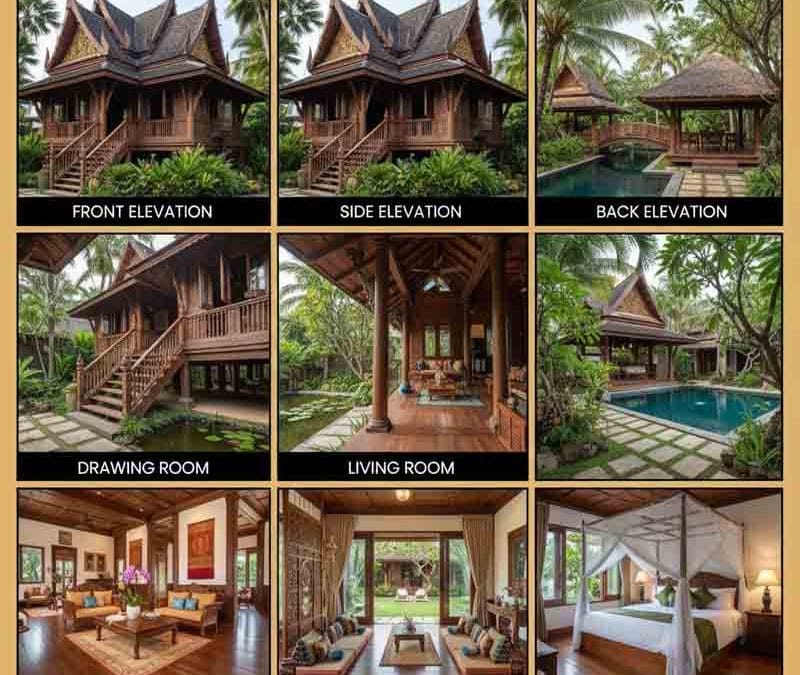
Thai Traditional House Design for weekends
1. What Is Thai Traditional House Design for Weekends?
Before going into details of roofs, decks, and wood, we should understand the basic idea.
1.1 Simple Meaning of Thai Traditional House Design
In very easy words:
Thai traditional house design is a way of building homes from Thailand using wood, raised floors, steep roofs, and open terraces, designed to stay cool and dry in a hot, rainy climate.
When we say Thai Traditional House Design for weekends, we mean:
Using that same traditional style to create a small holiday or weekend house where people can rest, meet family, and enjoy nature away from the city.
Such homes usually:
- Stand above the ground on wooden or concrete posts
- Have large verandas or terraces for sitting
- Use plenty of natural air and light
- Include open spaces where people can gather
Because of these features, a Thai traditional house can feel like a natural resort even if it is simple and small.
1.2 Why Thai Traditional House Design Fits Weekend Life
Weekends are for:
- Sleeping longer
- Eating slowly
- Talking with family
- Playing games
- Relaxing, not rushing
Thai homes are designed exactly for slow, comfortable living. Raised floors catch the breeze. Open terraces give space to sit together. Shade under the house can be used for hammocks, storage, or even extra sitting.
Therefore, a Thai Traditional House Design for weekends supports the kind of relaxed life that people want on holidays:
- No tight, closed rooms all the time
- Easy movement between inside and outside
- Natural views of trees, water, or fields
Many people feel less aggravated and less stressed when they spend time in such friendly spaces.
1.3 Where Is This Style Most Famous?
The answer to “yeh design kis country main zyada famous hai?” is simple:
- Thailand is the country where Thai traditional houses are most famous.
This style was born there. Historically, Thai villages and towns used these houses for daily living. Today, you can still see them:
- In older rural areas
- In cultural villages and museums
- In resorts and boutique hotels
- In some modern homes that respect tradition
Other countries in Southeast Asia, like Laos or Cambodia, have similar stilt houses, yet the specific Thai traditional house design for weekends remains most closely linked with Thailand.
2. History Behind Thai Traditional House Design
Understanding the past makes it easier to see why this style is so good for weekend homes now.
2.1 Climate and Environment of Thailand
Thailand is a tropical country. That means:
- Weather is generally hot or warm
- There is a rainy season with heavy showers
- Humidity (water in the air) can be high
- Flooding can happen in some areas
Because of this climate, old Thai builders had to solve several problems:
- How to keep houses cool in strong heat
- How to protect homes from flood water
- How to handle heavy rain without damage
- How to let air move so people do not feel suffocated
Thai traditional houses grew from these real needs.
2.2 Traditional Thai Village Life
In the past, many Thai families lived in rural villages. They:
- Farmed rice
- Fished in rivers or canals
- Used boats often
- Lived close to their relatives
Houses usually stood on posts above the ground or water. Underneath, people stored boats, tools, and sometimes animals. Above, they slept, cooked, and socialized in airy rooms and terraces.
Life often happened outdoors. Children played in open yards. Adults cooked and worked under shade. The home was not just a closed box; it was a series of platforms and roofs.
That open, social feeling is exactly what we want again in a Thai Traditional House Design for weekends.
2.3 Spiritual and Cultural Ideas
Thai culture is influenced by:
- Buddhism
- Respect for nature and ancestors
- Community values
These beliefs shape houses too. Often, there is:
- A small spirit house or shrine in the yard
- A clear separation between clean, high areas and lower areas
- Respect for certain directions or positions for important spaces
Buildings are not only machines for living. They are also tools for balanced and peaceful life.
When we borrow Thai Traditional House Design for weekends, we can also borrow these calm and respectful ideas.
3. Key Features of Thai Traditional House Design for Weekends
Next, we can look at the physical parts that make this style special.
3.1 Raised Floor on Stilts or Posts
One of the strongest features is the raised floor. Traditional Thai houses:
- Stand on wooden or concrete posts
- Leave open space under the house
This design helps in many ways:
- Protects living spaces from flood water
- Keeps floors cooler because air can flow under them
- Reduces insects and small animals entering living areas
- Provides shaded space for sitting, working, or storing items
For a Thai Traditional House Design for weekends, raised floors also create a feeling of being in a treehouse or cabin, separate from everyday street level. That alone can make you feel like you are truly on holiday.
3.2 Steep, Wide Roofs
Roof shapes are also very important. Thai traditional roofs:
- Have steep slopes
- Extend out far beyond the walls
- Are often made of tiles or sometimes thatch in older times
Wide overhangs:
- Protect wooden walls from heavy rain
- Create shaded zones around the house
- Lower the heat from direct sunlight
In a weekend house, sitting on a terrace under this deep roof while listening to rain can be an unforgettable experience. Protection and comfort come together in Thai Traditional House Design for weekends.
3.3 Open Terraces and Verandas
Large open decks or terraces, called “chan” or platforms, act as:
- Living rooms
- Play areas
- Dining spots
- Meeting places
Instead of one closed living room, Thai houses often have:
- A series of covered yet open spaces
- Different platforms connected by steps or walkways
For weekend life, these terraces are perfect for:
- Family breakfasts
- Evening tea
- Board games or reading
- Sleeping on mats when weather is nice
They turn the house into a natural social space.
3.4 Wooden Structure and Natural Materials
Traditional Thai houses are often built using:
- Teak wood or other strong local hardwoods
- Bamboo for some parts
- Clay tiles for roofs
Wood:
- Smells pleasant
- Feels warm under bare feet
- Ages beautifully if cared for
In a modern Thai Traditional House Design for weekends, full solid teak may be too costly. Yet, wood-like materials or partial real wood can still be used for:
- Floors
- Ceilings
- Balustrades
- Doors and window frames
Natural materials give a friendly, cozy feeling that supports rest and relaxation.
3.5 Modular and Moveable Design
Historically, many Thai wooden houses were modular. That means:
- Parts of the house were built as separate sections
- Sections could be taken apart and moved if needed
If a family shifted or sold land, they sometimes dismantled the house and rebuilt elsewhere. Joints used wooden pegs more than nails.
For a weekend house, you may not move the building. However, this modular idea still helps:
- Sections of the house can be built in stages
- Different pavilions can be added later
- Design stays flexible for changes
Therefore, Thai Traditional House Design for weekends can grow with your family’s needs over time.
4. Planning a Weekend Getaway: Thai Traditional House Design Ideas
When planning a weekend home, layout is the heart of the project.
4.1 Choosing the Right Location
Firstly, you need to decide where to build or adapt a Thai-style weekend house.
Good locations might be:
- Near a river or pond
- On a hill with views
- At the edge of a forest
- In a village outside the city
Important things to consider:
- How long it takes to travel from your main home
- How safe and flood-free the land is
- Whether there are nice views to frame from the house
- If neighbors’ houses are too close or far
Thai Traditional House Design for weekends works best when you can see some trees, sky, and open space, not only concrete walls.
4.2 Arranging the House on the Land
After choosing land, you must place the house correctly.
Thoughtful placement can:
- Catch cooling breezes
- Avoid harsh afternoon sun on main terrace
- Give privacy from neighbors and road
- Create a comfortable entry experience
Often, designers:
- Put the main terrace facing the best view (river, trees, hills)
- Place bedrooms where morning light is gentle
- Keep kitchens and toilets in a separate, lower corner of the plan
- Use trees to shade roofs and open areas
This planning phase decides much of the success of your Thai Traditional House Design for weekends.
4.3 Zoning: Public, Private, and Service Areas
Just like in other house types, Thai weekend homes divide spaces into zones.
Typical zones:
- Public / social – terraces, open living decks, dining areas
- Private – bedrooms, inner sitting rooms
- Service – kitchen, store room, toilets, utilities
In a Thai traditional layout:
- Public spaces usually sit at the center, open to all
- Private rooms stand around or slightly apart
- Service spaces are kept to one side or at the back
When the family arrives for the weekend, everyone usually gathers first on the central deck. After that, people move to bedrooms only when needed. This flow gives a natural holiday feeling in your Thai Traditional House Design for weekends.
5. Floor Plan Ideas for Thai Traditional House Design for Weekends
Now we can imagine some simple floor plan examples.
5.1 One-Bedroom Thai Weekend Cottage
For a couple or small family, a very simple design can work:
- Raised platform with one large terrace at the front
- One bedroom with space for a double bed and small seating
- One attached bathroom at the back or side
- Small pantry or kitchenette in a corner or separate unit
- Stairs up to the terrace from the ground
Terrace might be larger than the bedroom. During the day, most time is spent outside. At night, the bedroom offers privacy and safety.
Such a small Thai Traditional House Design for weekends is affordable and easier to maintain.
5.2 Two-Bedroom Thai Weekend House for Family
For a family with children or for those who host guests:
- Main central terrace connects two bedroom units
- Each bedroom has its own bathroom
- A small indoor sitting area may attach to one bedroom
- External staircase brings you to the raised terrace
- Underneath, shaded space can be used for storage or extra seating
Parents can relax on the terrace while children play. Guests can stay in the second room with some independence.
5.3 Cluster of Small Thai Houses for Big Families
Some families have many siblings, parents, and cousins. For them:
- Several small Thai-style pavilions can be grouped around a shared deck
- Each pavilion might be a bedroom plus bathroom
- One building becomes the shared kitchen and dining space
- A big deck in the middle is used for gatherings, games, and meals
This kind of cluster feels like a private resort. Everyone gets both togetherness and personal space in the Thai Traditional House Design for weekends.
6. Interiors in Thai Traditional House Design for Weekends
Exterior shape and layout are important. However, interior design truly controls comfort.
6.1 Simple, Open Rooms
Traditional Thai rooms:
- Are not overloaded with furniture
- Often have one or two key pieces, like a bed or low table
- Leave space free for mats, seating, or prayer areas
For weekend homes, this simplicity is perfect. You do not need:
- Huge wardrobes filled with clothes
- Many cabinets and shelves
- Heavy, dark furniture everywhere
Instead, Thai Traditional House Design for weekends uses:
- Light, movable furniture
- Open floor area for children to play
- Simple chairs for reading and resting
Clean, open rooms are also easier to clean after each weekend.
6.2 Natural Wood and Earthy Colors
Inside a Thai traditional weekend house, color schemes usually stay gentle.
Common colors:
- Warm browns from wooden floors and walls
- Cream or off-white fabrics for curtains and bedding
- Light beige or grey for simple walls or plastered areas
- Darker wood for beams and railings
Accent colors can appear through:
- Cushions
- Wall art
- Thai woven textiles (silk or cotton)
In a weekend home, such earthy colors help the brain slow down. Bright neon shades and very strong contrasts may feel too loud after a busy week.
6.3 Thai Textiles and Craft
Thai culture produces many beautiful crafts. You can add them in a soft way.
Ideas:
- Handwoven mats on the floor
- Thai silk cushions with subtle patterns
- Simple wall hangings with local motifs
- Carved wooden panels as headboards
These items bring Thai identity into your Thai Traditional House Design for weekends without making interiors feel crowded.
6.4 Lighting Inside Thai Weekend Homes
Because Thai houses rely heavily on daylight, electric lighting can remain simple.
Best choices include:
- Warm white bulbs, not harsh blue ones
- Ceiling fans with attached lights in living areas
- Wall lamps and bedside lamps in bedrooms
- A few hanging lamps above dining table or corner areas
Switch positions should be easy to reach. In a weekend house, you want to walk in, turn on a few switches, and feel ready to relax, not search for controls.
7. Outdoor Living in Thai Traditional Weekend House Design
Spending time outside is almost more important than inside in this style.
7.1 Ground-Level Space Under the House
Since the house stands on posts, there is always space below. This can be:
- Left open for air
- Used as parking for a car
- Turned into a shaded sitting area
- Filled with hammocks or low chairs
During hot afternoons, the coolest spot may be under the house. Children can play here without too much sun. In rainy weather, this area stays dry, so weekend fun does not fully stop.
7.2 Gardens and Trees
Thai countryside houses usually have:
- Fruit trees
- Coconut or banana plants
- Small vegetable patches
- Flowering shrubs
For your weekend home, you may want:
- Low-maintenance plants that survive without care all week
- Some grass or groundcover for a soft feel
- Stones or gravel in areas where grass would be hard to maintain
Tree shade on roof and terrace reduces heat. In addition, watching leaves move in the breeze is good for stress reduction.
7.3 Water Elements
Water adds coolness and sound.
Simple water features may include:
- A pond with fish
- A small reflecting pool
- An old jar or pot with water and lotus plants
If your plot and budget allow, a small plunge pool can be added in modern Thai Traditional House Design for weekends. This is especially useful in hot climates where a quick dip can refresh you after outdoor activities.
7.4 Outdoor Cooking and Eating
Many Thai people cook and eat outdoors, especially in villages.
In your weekend home, you can:
- Create an outdoor kitchen under the house or near the terrace
- Use a simple gas stove, clay stove, or barbecue grill
- Place a long table on the deck for meals
Eating in open air:
- Reduces cooking smell inside bedrooms
- Gives more feeling of holiday
- Encourages longer, more relaxed meals
Family and friends often value these shared outdoor meals more than anything else in the Thai Traditional House Design for weekends.
8. Modern Comforts in Thai Traditional House Design for Weekends
Traditional design is charming, but modern life has its own needs.
8.1 Bathrooms and Toilets
In old times, toilets and baths may have been separate or basic. For a modern weekend house, most families want:
- Clean, tiled bathrooms
- Western-style toilets
- Proper hand-wash basins and showers
You can still design these rooms in harmony with Thai style by:
- Using neutral tiles
- Adding wooden or bamboo accents
- Providing proper ventilation and daylight
Positioning bathrooms slightly away from main terrace areas keeps both hygiene and privacy.
8.2 Kitchen Facilities
Weekend houses do not always need a full city-style kitchen, yet they should be comfortable.
Useful features:
- A small fridge
- A simple stove
- Shelves for dry food and utensils
- Basic sink with running water
Keeping the kitchen open or semi-open suits the Thai Traditional House Design for weekends. At the same time, a small store room or closed cabinet protects food from insects.
8.3 Electricity, Fans, and Optional Air-Conditioning
Even though Thai houses are made for natural cooling, some modern additions help.
Electric systems may include:
- Ceiling fans in all main spaces
- Air-conditioning in bedrooms only, for better sleep in very hot climates
- Enough sockets for phone charging, laptop use, portable speakers
While enjoying the natural style, you do not want to feel out of control because there is no way to sleep comfortably on very hot nights. Proper planning keeps technology helpful but not dominant.
8.4 Internet and Work Corners
Many people now like to work from their weekend homes sometimes.
Your Thai weekend design can include:
- A small writing desk with a good chair
- A strong Wi‑Fi signal point
- Curtains or screens to reduce glare on screens
This corner should still match the Thai Traditional House Design for weekends, using wood and simple forms, not heavy office-style furniture.
9. Adapting Thai Traditional House Design for Weekends to Other Countries
Someone living outside Thailand may still want this style. Adapting it is possible.
9.1 Climate Adjustments
In a place with colder winters or more extreme seasons:
- You may need to insulate roofs and walls
- Open sides might be closed with sliding glass doors
- Heating may be added to some rooms
Spirit of the Thai house can remain:
- Raised floor
- Big roof overhangs
- Wooden interior atmosphere
Technical details simply change to keep you comfortable all year.
9.2 Legal and Structural Considerations
Local building rules might control:
- How high you can raise the house
- What materials are allowed
- Distance from boundaries
You must:
- Check rules with local planners
- Use engineers who understand how to safely build on posts
- Ensure earthquake or wind needs are respected, if relevant
Safe building is more important than perfect copying of Thai Traditional House Design for weekends.
9.3 Local Materials with Thai Feeling
Real Thai teak may be difficult to find or very expensive elsewhere. However, you can use:
- Local hardwoods
- Good-quality engineered wood
- Fiber-cement boards with wood appearance
- Local tiles that match Thai color schemes
What truly matters is the feeling:
- Warmth
- Simplicity
- Connection with air and light
Exact material names can vary from country to country.
10. Where Thai Traditional House Design for Weekends Is Popular Today
We already know Thailand is the center. Yet, the weekend-house version appears elsewhere too.
10.1 Thailand as the Main Home
In Thailand itself, Thai Traditional House Design for weekends is used:
- By city families building weekend houses near canals or mountains
- By resorts that want tourists to experience traditional life
- By cultural projects and homestays that keep old homes alive
Bangkok residents sometimes buy land in nearby provinces and build Thai-style stilt houses only for weekends and holidays.
10.2 Neighboring Southeast Asian Countries
Other countries with similar climates, such as:
- Laos
- Cambodia
- Myanmar
- Parts of Vietnam
have house types that look related. Some designers there also borrow specific Thai details for weekend resorts and homestays.
10.3 Rest of the World
Outside Asia, this style is less common, yet it appears:
- In eco-resorts and retreat centers
- In private holiday homes for people who love Thailand
- In design magazines and online platforms as inspiration
Nevertheless, when asked “yeh design kis country main zyada famous hai?”, the honest and clear answer remains: Thailand.
11. Advantages of Thai Traditional House Design for Weekends
Choosing any style means trusting it will give benefits. Thai design has many.
11.1 Natural Cooling and Comfort
Raised floors, open sides, and high roofs:
- Let hot air escape
- Allow wind to flow
- Reduce need for heavy air-conditioning
On weekends, you can sit in a shady, breezy terrace rather than inside closed rooms. That gentle feeling is one of the main strengths of Thai Traditional House Design for weekends.
11.2 Strong Weekend Mood
Because the house looks different from standard city homes:
- Your brain understands you are now in “vacation mode”
- Routine stress reduces faster
- Family members behave more relaxed
Architecture itself sends a message: “Slow down, breathe, and enjoy.”
11.3 Simple, Flexible Spaces
Thai traditional weekend houses:
- Do not need many fixed, specialized rooms
- Adjust easily to different uses
- Accept sleeping mats, extra chairs, or temporary beds
A terrace can be a playroom, dining room, or even sleeping spot. Under the house, a simple hammock becomes the best reading corner.
11.4 Strong Connection with Nature
Trees, water, insects, birds, and sky all become part of the experience. Children learn where food and wood come from, not only from shops. Adults get a break from screens and indoor air.
11.5 Beauty with Modest Cost (If Planned Well)
Building a full steel-and-glass villa can be very expensive. By using simple wood, local stone, and basic forms,
- You can create a beautiful Thai Traditional House Design for weekends
- Without needing extreme budgets
Cost still exists, but money goes into useful things like structure and roof, not just showy details.
12. Disadvantages and Challenges of Thai Traditional House Design for Weekends
Along with benefits, there are some real challenges.
12.1 Maintenance of Wood and Natural Materials
Wood and bamboo:
- Need protection from rain and sun
- Must be treated against insects
- May warp or crack if not cared for
Weekend houses sometimes stand empty for many days. That can:
- Let dust build up
- Allow small animals to enter
- Delay noticing small problems until they grow larger
Planning regular maintenance visits or hiring local caretakers is wise.
12.2 Security When the House Is Empty
Weekend homes are not used every day. Security is important.
Possible risks:
- Break-ins
- Theft of tools or furniture
- Damage by animals
Solutions may include:
- Strong locks and secure storage
- Local neighbors or caretakers who keep watch
- Simple alarm or camera systems
Balancing openness with safety is part of designing Thai Traditional House Design for weekends.
12.3 Insects and Wildlife
Being close to nature means:
- Mosquitoes
- Ants
- Lizards
- Sometimes snakes or other animals, depending on region
Mesh screens, nets, and good cleaning habits help. Still, people who are very afraid of insects may find it hard to relax completely.
12.4 Weather Surprises
Climate change can bring:
- Stronger storms
- Unusual rain patterns
- Higher heat waves
Houses must be built to handle future conditions, not only past weather. Good engineering of posts, roofs, and drainage is necessary.
13. Step-by-Step Guide to Plan a Thai Traditional House Design for Weekends
To turn ideas into a real project, a clear path is helpful.
13.1 Step 1 – Clarify Your Weekend Dream
Ask yourself:
- Do I want a tiny, simple hut or a larger family house?
- Will I visit often, or only sometimes?
- Do I need internet and work space, or mainly rest space?
- How many people should sleep there comfortably?
Writing clear answers guides all later choices.
13.2 Step 2 – Fix a Budget Range
Next, decide:
- How much total money can I spend on land plus building?
- How much is only for building and finishing?
Try to include:
- Construction cost
- Basic furniture
- Legal and approval fees
- A small extra fund for surprises
Without a realistic budget, Thai Traditional House Design for weekends can easily feel out of control.
13.3 Step 3 – Choose and Study Your Land
Once you know your budget, you can:
- Search for land or choose from land you already own
- Study slope, soil, trees, and water on the site
- Watch sun path and wind direction if possible
Taking photos and simple sketches helps your architect later.
13.4 Step 4 – Find an Architect or Designer Who Understands Thai Style
Look for someone who:
- Has done tropical or Thai-style houses before
- Respects traditional forms
- Also knows modern building methods
During the first meeting:
- Share your weekend dream and budget
- Show photos of Thai houses you like
- Explain your land conditions
Good communication at this stage avoids confusion later.
13.5 Step 5 – Develop the Floor Plan
Architect will propose a first layout. While reviewing:
- Imagine arriving on Friday night: where do you walk first?
- Visualize Saturday morning: where do you sit, cook, and relax?
- Check if bedrooms are quiet and private enough
- Confirm that terrace size is enough for your family
Do not rush. Adjust plan until it feels both beautiful and practical.
13.6 Step 6 – Design the Roof and Exterior Look
With the plan fixed, designer will shape:
- Roof slopes and overhangs
- Post heights and under-floor atmosphere
- Balcony railings and stairs
Decide carefully:
- How traditional or modern you want the roof to appear
- How much wood will be visible on the outside
- What color range the house exterior should have
This step defines the face of your Thai Traditional House Design for weekends.
13.7 Step 7 – Plan Structure and Safety
Engineers will:
- Calculate post sizes
- Design beams and connections
- Check foundation needs
Check that:
- Flood levels are understood
- Local earthquakes or strong winds are considered, if relevant
- Safe stairs and railings are included
Safety must always be first, even before style.
13.8 Step 8 – Select Materials and Finishes
Now comes the fun part:
- Choose floor materials (wood, tile, or a mix)
- Decide wall finishes inside and out
- Select roof cover material (tiles, metal, or special local options)
Try to keep:
- Materials limited to a simple, clear palette
- Finishes easy to clean and maintain
Too many different surfaces can weaken the peaceful Thai feeling.
13.9 Step 9 – Detail Interiors and Lighting
Next, plan:
- Kitchen layout and cabinets
- Bathroom tiles, fittings, and windows
- Furniture positions in bedrooms and terrace
- Lighting points plus fan positions
Think about:
- How to walk at night with minimal lights
- Where you want stronger light (for cooking, reading)
- Which areas should stay dim and restful
Smart interior planning makes living easy every weekend.
13.10 Step 10 – Build, Check, and Enjoy
Finally, construction will start. During building:
- Visit site often, or ask someone trusted to do so
- Check that raised floor height and roof slopes match drawings
- Discuss small changes early if needed
After completion:
- Move in basic furniture first
- Spend a few weekends learning how spaces feel
- Add more decoration slowly based on real use
With time, your Thai Traditional House Design for weekends will become a beloved second home, full of memories.
14. Frequently Asked Questions about Thai Traditional House Design for Weekends
Ending with a few quick questions can help fix the main ideas.
14.1 What Is Thai Traditional House Design for Weekends in Simple Words?
It is:
A weekend or holiday home built in the old Thai style, standing on posts with wooden floors, big roofs, and open terraces, designed to feel cool, natural, and relaxing.
That single sentence sums up the concept.
14.2 In Which Country Is Thai Traditional House Design Most Famous?
This design is most famous in Thailand. The traditional Thai house grew from Thai climate, Thai culture, and Thai rural life. Other countries have houses on stilts too, yet the specific shape, roof, and layout of Thai houses are most closely linked to Thailand.
14.3 Can Thai Traditional House Design for Weekends Work on a Small Plot?
Yes, it can. Even on limited land, you may:
- Raise the house on posts
- Create one good-sized terrace
- Plan one or two bedrooms and a small kitchen
- Add a few trees and plants around
Good design uses height and open space so that the house feels bigger than it is.
14.4 Is Building a Thai Weekend House Very Expensive?
Cost depends on:
- Size
- Materials (teak vs. cheaper woods)
- Level of detail
To manage cost:
- Use simple shapes instead of complex carved parts
- Combine real wood with more affordable materials
- Keep the house modest in size but strong in design
By focusing on smart planning, Thai Traditional House Design for weekends can be cheaper than many heavy concrete villas.
14.5 Is This Style Only Good for Hot Climates?
It is best for warm or tropical climates, because it was designed for such weather. In colder places, extra work is needed:
- Adding insulation
- Closing some open sides with glass
- Using heating systems
Even then, you can still borrow many ideas such as raised floors, big roofs, and wooden interiors.
14.6 Is It Difficult to Maintain a Thai Traditional Weekend House?
Maintenance can be more work than a simple concrete house, but it is not impossible.
You should:
- Protect wood with proper coatings
- Check roofs for leaks after big storms
- Clean open spaces after each visit
- Ask neighbors or caretakers to watch the place when empty
With regular small care, the house stays safe and beautiful for many years.
Quick Links
Social Icons
Contact Us Information
443 J3 Johar Town Lahore near Expo Center Lahore
