
Why Beam is Important in Construction
When we see a house, office, or any large building, we mostly notice the walls, doors, windows, or tiles. But the real strength of a building comes from something that is not always visible. That hidden hero is called a beam.
In simple words, a beam is a horizontal support in a structure that carries the weight of slabs, walls, and roofs and transfers it safely to the columns and foundations. Without beams, most buildings would not stand strong.
In this blog, we will discuss:
What is a beam?
Why beam is important in construction.
Types of beams, including suspension beams.
When beams are required (span length).
How beams are used.
Steel used in beams and recommended bar sizes.
Simple diagrams to make it easy to understand.
What is a Beam?
A beam is a strong, horizontal member in construction. Imagine it like a wooden log placed between two chairs. If you stand in the middle, the log bends slightly but holds your weight. This is exactly how a beam works in a building.
Beams connect columns and carry the load from slabs and walls above. They make sure that the load is transferred evenly and safely to the foundation.
Why Beam is Important in Construction
The keyword question: why beam is important in construction?
Here are the main reasons:
Load Distribution
Beams distribute the load from the slab or roof to the columns. Without beams, the entire pressure would fall on walls, which can crack or collapse.Strength and Stability
Beams increase the strength of a building. They stop slabs from bending too much and keep the structure stable.Longer Spans Possible
With beams, we can make bigger rooms without too many walls in between. This is useful in halls, auditoriums, and offices.Earthquake Resistance
Beams tie the structure together and make it more resistant to earthquakes.Support for Openings
Above doors and windows, small beams called lintels are used. They make sure the wall does not crack above the opening.
In short: beams are like the bones of a building. Without them, no strong structure is possible.
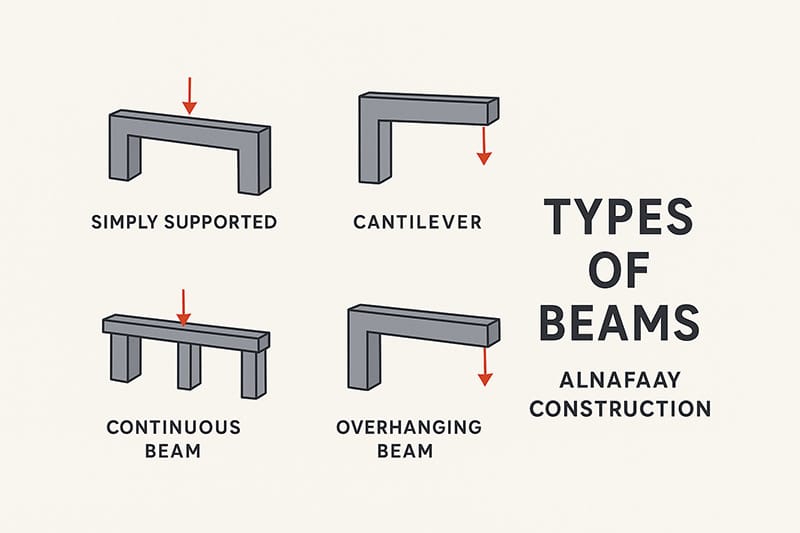
Types of Beams
There are different types of beams used in construction:
More Types of Beams in Construction
Simply Supported Beam
Supported at both ends, load is carried in the middle. Common in houses.Cantilever Beam
Fixed at one end and free at the other, like a balcony.Continuous Beam
Supported on more than two supports/columns, strong for long spans.Overhanging Beam
Extends beyond its support at one or both ends.Fixed Beam
Both ends are fixed rigidly in walls or columns. Less movement but high internal stress.Suspension Beam
Supported with cables or hangers, usually in bridges.Lintel Beam
Small beam above doors and windows to carry wall load.T-Beam
Looks like a "T" in cross-section. Common in reinforced concrete slabs.L-Beam (or Angle Beam)
Shaped like an "L," used at corners.Box Beam (or Hollow Beam)
Hollow inside, used in bridges for lightness and strength.I-Beam (or H-Beam)
Steel beam shaped like "I" or "H." Very common in steel structures.Girder Beam
A very large beam that supports smaller beams. Main load carrier in bridges and buildings.Trussed Beam
Beams combined with triangular steel sections for extra strength.Curved Beam (or Arch Beam)
Beams with a curved shape, used in arches and bridges.Composite Beam
Made with two different materials, usually concrete + steel, for better strength.
In Which Span Beams are Required?
The span is the distance between two supports (columns or walls). Beams are necessary when the span is more than 2 meters. For small openings like windows, a small lintel beam is enough.
For residential houses, beams are usually provided after every 10 to 15 feet span.
For commercial buildings, the design may allow larger spans, but strong beams with bigger reinforcement are used.
Rule of thumb: The longer the span, the stronger the beam needed
How Beams are Used in Construction
Design Stage
Engineers calculate the load and design the beam size.Steel Placement
Steel bars are placed according to the design. Bottom bars resist bending, and stirrups (ring-shaped bars) hold the beam together.Formwork
Wooden or steel shuttering is used to make the shape of the beam.Concrete Pouring
Concrete is poured and vibrated to remove air gaps.Curing
The beam is kept moist for at least 7–14 days for proper strength.
Which Steel is Used in Beams?
Steel is the backbone of a beam. In Pakistan, the commonly used steels are:
Grade 40 and Grade 60 deformed steel bars.
High strength TMT bars are also used in modern projects.
Common Bar Sizes (in mm):
10 mm – used as stirrups (rings).
12 mm / 16 mm – used in small residential beams.
20 mm / 25 mm – used in main beams for heavy loads.
For high-rise projects, even 32 mm bars can be used.
Always use branded steel from reliable companies like Mughal Steel, Amreli, Ittefaq, or Agha Steel in Pakistan
Quick Links
Social Icons
Contact Us Information
443 J3 Johar Town Lahore near Expo Center Lahore
