
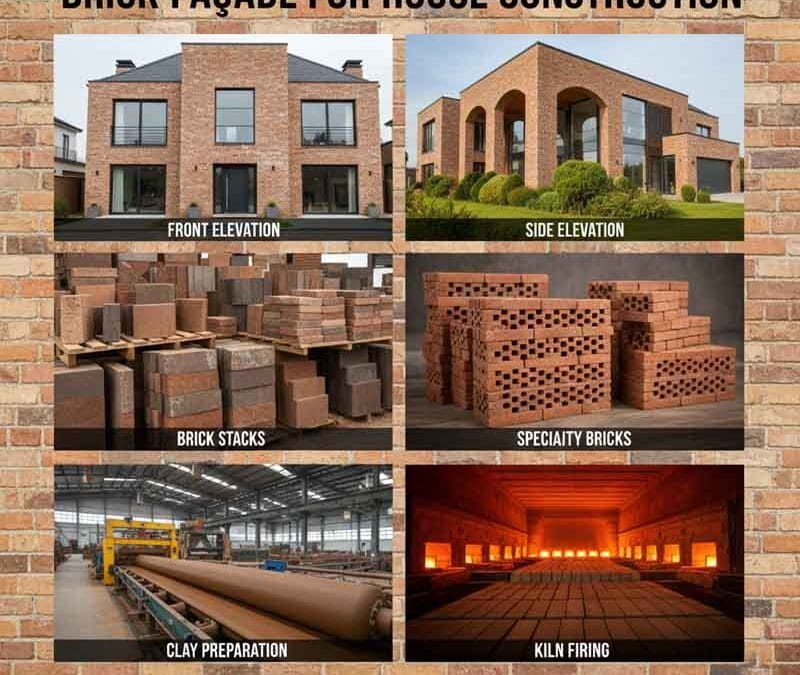
Brick Façade for house construction
A house is a bit like a person going outside. Clothes protect the body from sun, rain, wind, and dust. In the same way, the outside “skin” of a home protects the inside rooms. That outside skin is called a façade.
A Brick Façade for house construction is like a strong, handsome jacket made from baked clay blocks. It looks warm, it lasts a long time, and it can handle hard weather when it is built correctly. Additionally, brick can fit many styles: modern, traditional, farmhouse, Mediterranean, and even minimalist.
This guide explains everything in easy English, using clear examples and step-by-step thinking. No emojis are used. Also, you will not see the phrase “to go crazy.” If a project feels stressful, safer alternatives such as to go wild, to go out of control, to go up the wall, to be aggravated, or to get confused are used instead.
With patient planning, respect for local climate and codes, and good teamwork with experts, a Turkish stone house can become a lasting home. The same planning mindset helps a brick façade project stay calm, safe, and beautiful.
What is a Brick Façade for house construction?
A Brick Façade for house construction means brick is used on the outer face (the “front skin”) of a building. In many houses, that outer brick layer is not the main structure. Instead, it is a protective and decorative layer.
Three common meanings exist:
- Solid brick masonry wall
A thick brick wall carries loads (older method in many places). - Cavity wall with outer brick and inner block/brick
An outer brick “leaf,” an air gap (cavity), and an inner wall that carries most loads. - Brick veneer or brick cladding on a framed wall
A wood/steel/concrete frame holds the building, and brick sits as a facing layer tied back to the structure.
Because people use the word “façade” differently, always confirm what system your designer is proposing. A brick look can be achieved with real brick, thin brick, or brick slips; each option has different cost, durability, and detailing needs.
Why families love brick front elevation design
Brick is popular for more than just looks.
Durability and low maintenance
Brick is known for long life and strong weather resistance when properly detailed and installed. The Brick Industry Association describes fired clay brick as a durable, noncombustible material used widely in construction. BIA
Fire performance
Brick is noncombustible. That fact is one reason it has been used for centuries in dense towns and cities. BIA
Sound comfort
Heavier walls can reduce outside noise. While the exact performance depends on the full wall assembly, brick and masonry often help create quieter rooms compared with thin exterior skins.
Style flexibility
Brick can look rustic, modern, or classic depending on color, bond pattern, mortar, and lighting.
Resale value and “trust”
Many buyers feel brick looks solid and permanent. That emotional trust can matter when selling.
Brick cladding for house exterior: what makes it “good” and not “just brick”?
A brick façade is not only about choosing a nice brick. Good brickwork depends on:
- Moisture control (rain must leave the wall safely)
- Movement allowance (materials expand and shrink with temperature)
- Strong detailing (lintels, sills, flashing, weep holes)
- Quality mortar and workmanship
- Correct ties and support angles in veneer systems
When these parts are ignored, the project can go out of control with repairs later. Proper detailing prevents leaks, stains, and cracking.
Which country is brick façade design most famous in?
Brick façades are common worldwide, yet a few places are especially known for them.
United Kingdom
Brick is strongly linked with British housing streetscapes, especially in England. The UK has a long history of brick domestic architecture, and brick remains a dominant exterior for many new homes. Industry sources in the UK often highlight brick as the most popular material for new-build housing façades. Brick Development Association (UK)
The Netherlands and Belgium
Dutch and Belgian towns are famous for brick architecture, from canal houses to modern brick buildings. This is partly because suitable clay and strong masonry traditions shaped local design culture. RCE Netherlands Cultural Heritage
Germany (and parts of Northern Europe)
Northern German “Brick Gothic” and many civic buildings helped keep brick culture strong, although that is more historic architecture than only houses. Encyclopaedia Britannica – Brickwork
If you need a single-country answer for “most famous,” the UK is a strong choice for residential brick façades. If you want the broader “brick culture” answer, the Netherlands and Belgium are also top names.
Brick Façade for house construction: real brick vs thin brick vs paint look
Many people see a brick look and assume it is “real brick.” However, three main approaches exist:
Full-depth brick veneer
Real brick units, usually about 3–4 inches thick (varies by region), attached to a structural wall using ties. It looks authentic and lasts well when detailed correctly.
Thin brick cladding (brick slips)
Thin slices of brick, often around 1/2 to 1 inch thick, attached with adhesives or mechanical systems. This can reduce weight and cost, yet it needs high-quality waterproofing and a trusted installation system.
Brick-pattern paint or panels
Some products copy a brick look using panels or coatings. They can be budget-friendly, although they may not age like true masonry.
Because the exterior protects your house, long-term durability matters more than short-term savings. Even so, a well-installed thin-brick rainscreen system can perform excellently if designed properly.
How a brick wall keeps rain out: the kid-friendly “raincoat rule”
Here is a simple rule a child can understand:
Rain should never be trapped. Rain must always have a path to leave.
Modern exterior wall design often follows a “drainage plane” approach. Building science guidance explains that walls should manage water with layers that shed and drain moisture, rather than pretending water will never get in. Building Science Corporation
A good brick façade system usually includes:
- An outer brick layer that blocks most rain
- A cavity or drainage space behind the brick
- A water-resistant barrier (WRB) on the backup wall
- Flashing to direct water out
- Weep holes so water can exit near the bottom
If those elements are missing, water may sit inside the wall and cause stains, mold, or damage. That is when owners feel aggravated because the wall “looked strong” but was missing the hidden safety system.
Brick veneer façade details that matter most
Small details create big results. Focus on these areas early.
Flashing at the base
Flashing is like a tiny roof inside the wall. It catches water that gets behind the brick and sends it outward through weep holes. Many building science references describe flashing and drainage as critical for moisture control in masonry veneer walls. Building Science Corporation
Weep holes
Weeps are small openings that let water out. They should be placed above flashing locations, often at the bottom of walls and above windows.
Lintels above windows and doors
A lintel is the support above an opening. Steel lintels are common in brick veneer work. Rust protection and correct end bearing are vital. Poor lintel detailing can lead to cracks and stains.
Sills under windows
A proper sill should shed water outward. Sloped sills with drip edges reduce staining and water entry.
Movement joints
Brick expands and contracts slightly with temperature and moisture. Movement joints (control/expansion joints) reduce random cracking. Placement and spacing should follow local standards and the engineer’s guidance.
Because these pieces are not “pretty,” people sometimes ignore them. Later, problems go up the wall quickly when water and movement join forces.
Brick bonds and patterns: the “LEGO art” of masonry
Kids often love this part because it feels like pattern-building.
Common brick bond patterns include:
- Running bond (most common): bricks stagger like a zipper.
- Flemish bond: alternating headers and stretchers; classic and decorative.
- English bond: alternating courses; strong, traditional look.
- Stack bond: bricks line up; modern look, usually needs reinforcement details.
Changing the bond changes the personality of the house. A simple running bond can look modern with thin mortar joints, while Flemish bond can feel classic and rich.
Brick color choices: warm, cool, and “the street harmony test”
Brick color is not only personal taste. It also affects heat, dust visibility, and how the home fits the neighborhood.
Warm families of brick
- Red, terracotta, orange-brown
- Looks friendly and traditional
- Pairs well with cream, beige, or off-white trims
Cool families of brick
- Gray, charcoal, near-black
- Looks modern and sharp
- Pairs well with black window frames and light mortar
Mixed blends
- Multi-tone bricks create depth
- Great for hiding small stains and dust
- Easier to match with many roof colors
A simple trick helps:
Stand 10–15 meters away and imagine the house on a cloudy day. If the color still feels calm, it will likely age well.
Mortar matters: the “glue line” that changes everything
Many people pick brick carefully and forget mortar. That mistake can make the final look go wild in an unwanted way.
Mortar affects:
- Color (white, gray, buff, charcoal)
- Joint thickness (thin looks modern; thicker feels rustic)
- Joint shape (tooled, concave, flush, raked)
Durability also depends on mortar selection suited to climate and brick type. Using the wrong mortar can cause cracking or moisture issues. A qualified mason and engineer should guide mortar type based on local practice and standards.
For accurate mortar behavior and best practices, consult local building codes and masonry standards used in your region.
Brick Façade for house construction in hot climates vs cold climates
Brick can work in many climates, yet details must adapt.
Hot and sunny climates
- Use shading (overhangs, pergolas, fins) to reduce heat gain through windows.
- Choose lighter brick colors if overheating is a concern.
- Add insulation behind the veneer for indoor comfort.
Cold and snowy climates
- Strong freeze-thaw resistance matters; brick must be rated for exposure.
- Proper drainage becomes critical so water does not freeze inside the wall.
- Air sealing and insulation behind the brick help reduce condensation.
Freeze-thaw damage is a known risk in masonry when water saturates materials and freezes repeatedly. Guidance on masonry durability in cold climates is widely discussed in building science references. Building Science Corporation
Modern brick façade design ideas for houses
A brick façade can look modern without losing warmth.
Idea 1: “Two-tone brick frame”
- Dark brick at the base
- Light brick on the upper portion
- Thin black window frames
- Simple canopy over the door
Idea 2: “Brick + wood warmth”
- Brick on main volume
- Timber slats around entry or balcony
- Warm lighting under eaves
- Minimal landscaping with grasses
Idea 3: “Brick screen wall”
- A perforated brick jali-like wall in front of windows
- Creates privacy and shade
- Looks artistic in morning and evening shadows
Idea 4: “White brick Scandinavian”
- Whitewashed brick façade
- Natural wood door
- Black metal railings
- Clean, calm feel
These ideas work because they rely on shape, shadow, and proportion, not too many decorations.
Traditional brick front elevation ideas that never get old
Classic looks survive for a reason.
Idea 1: Symmetry and strong entry
- Center door, matching windows
- Brick arches above openings
- Simple cornice or parapet detail
Idea 2: Brick with stone accents
- Stone base course
- Brick walls above
- Stone window sills
- The house looks grounded and “serious”
Idea 3: Brick piers and boundary wall harmony
- Matching brick in boundary wall pillars
- Metal gate design that repeats brick rhythm
- A unified street view
Because traditional patterns are familiar, they usually keep resale value stable.
Brick Façade for house construction: structure vs decoration
A key question decides many technical details:
Is brick carrying weight, or is it just a facing layer?
If brick is load-bearing
- Wall thickness is larger
- Openings need careful support
- Seismic and wind detailing becomes very important
- Engineering must be strict
If brick is veneer/cladding
- A structural frame carries loads
- Brick needs proper ties and support angles
- Drainage plane and flashing become critical
- Expansion joints are still important
Many modern homes use a structural frame with brick veneer because it balances strength, speed, and design freedom.
Construction steps: how a brick façade is built
Here is a simple timeline-style explanation:
Step 1: Drawings and approvals
- Architect designs elevation and wall sections
- Engineer approves structure and loads
- Local authority checks code compliance
Step 2: Foundation and structural wall
- Concrete footings and plinth are built
- Structural frame or backup wall is completed
Step 3: Weather barrier and cavity setup
- A WRB membrane is installed on the backup wall
- Cavity space is planned
- Flashings are placed at key locations
Step 4: Brickwork installation
- Bricks are laid course by course
- Wall ties connect veneer to backup wall
- Weep holes are placed above flashing points
Step 5: Tooling and cleaning
- Mortar joints are finished (tooled)
- Brick faces are cleaned carefully to avoid damage
Step 6: Final protection
- Sealants are applied where required (not always everywhere)
- Landscaping and drainage are shaped to keep water away from walls
Because timing matters, never rush curing and finishing. Good brickwork is patient work, not work that goes out of control.
Quality checks: how to tell if brickwork is good
A homeowner can do simple checks.
- Straight lines: look along the wall; it should not wave.
- Even joint thickness: random thick joints look messy.
- Clean weeps: weep holes must not be blocked.
- Correct slopes: sills should tilt outward.
- No white salt stains early: light “efflorescence” can happen, but heavy staining suggests moisture issues.
Efflorescence is a common masonry phenomenon caused by salts moving with moisture and drying on the surface. It is often discussed in masonry guidance and building science resources. BIA
Common mistakes that make brick projects go up the wall
Mistakes usually happen when people focus only on beauty and ignore performance.
- No cavity drainage planning
Water has nowhere to go, so walls get damp. - Blocked weep holes
Water becomes trapped and stains appear. - Weak flashing detailing
Leaks appear around windows and doors. - Wrong mortar choice
Cracking or poor durability can follow. - No movement joints
Random cracks appear over time. - Bad cleaning methods
Harsh acids can damage brick faces and joints.
If your team gets confused during construction, step back to drawings and wall sections. A single good detail drawing can prevent weeks of rework.
Brick façade maintenance: easy routines that keep it beautiful
Brick is often low maintenance, yet it is not “zero maintenance.”
- Check gutters and downpipes before rainy season.
- Keep soil and garden beds slightly lower than the damp-proof level.
- Repair small cracks in sealant around windows.
- Clean gently with approved methods; avoid aggressive chemicals.
- Watch for rust stains from metal lintels and fix early.
Small care prevents big repairs. A calm approach always beats panic when something looks aggravated on the wall.
Is sealing brick a good idea?
This depends on brick type, climate, and wall design.
Some bricks are dense and handle rain well. Other bricks are more porous and may benefit from breathable water repellents. However, sealing can also trap moisture if the wall needs to “dry” outward.
Building science guidance often warns that moisture management must consider drying potential, not only water blocking. Building Science Corporation
A safer rule is this:
Use sealers only when recommended by a knowledgeable professional for your specific brick and wall assembly.
Brick Façade for house construction costs: what affects price?
Costs vary by country, city, and market conditions. Still, the main cost drivers are predictable:
- Brick quality and brand
- Transport distance (heavy materials cost more to move)
- Bond pattern (complex patterns cost more labor)
- Number of corners and details (more cuts and time)
- Scaffolding needs (height and access)
- Lintels, arches, and special shapes
- Mortar color and special pointing
Budget trouble happens when the design becomes too complex late in the project. Lock the elevation early so pricing does not go out of control.
Sustainability and brick: is it “green”?
This topic needs balanced thinking.
Brick is fired in kilns, which uses energy. That is a real environmental cost. On the other hand, brick can last for decades or centuries, reducing replacement waste. Long life can improve sustainability in a full life-cycle view.
Many sustainability discussions emphasize life-cycle thinking: durability, maintenance, and end-of-life reuse matter, not only manufacturing impacts. For general life-cycle framing in buildings, see widely used building sustainability references such as the U.S. EPA’s life-cycle approach discussions. EPA Life Cycle Assessment
Practical “greener brick façade” steps include:
- Choose locally made bricks to cut transport emissions.
- Use brick where it matters most (front and key sides), and simpler finishes elsewhere.
- Pair brick with strong insulation and airtightness to cut energy use over decades.
- Reuse bricks from old buildings when possible and allowed.
Brick façade + insulation: the comfort combo
A brick façade looks strong, yet comfort often comes from what is behind it.
Good comfort usually needs:
- Proper insulation layer
- Air sealing
- Controlled ventilation
- Thermal bridge reduction around slabs and lintels
A brick veneer system can work very well with modern insulation strategies, especially when the wall assembly is designed as a complete system rather than random layers.
Brick façade lighting: how to make texture look magical at night
Brick looks best when light creates shadows in the joints and edges.
Try these:
- Warm wall washers near the ground
- Small up-lights for feature piers
- Soft porch lights under a canopy
- Step lights for safety
Harsh white lighting can make brick look flat. Warm, gentle light usually suits brick better.
Brick Façade for house construction: style matching guide
Modern minimalist
- Smooth, single-tone brick
- Thin joints
- Black or dark bronze frames
- Simple roof line
Classic traditional
- Red or mixed brick
- Decorative sills and lintels
- Symmetry in window placement
- Deep porch entry
Industrial loft look
- Dark brick
- Metal railings and exposed concrete accents
- Large, shaded windows
Mediterranean blend
- Warm brick with textured plaster sections
- Arched porch openings
- Terracotta roof tones
Because brick is flexible, you can mix it with wood, plaster, stone, or metal without losing harmony.
Safety and teamwork: keeping the site calm
Construction can make people be aggravated if communication is poor. A simple teamwork structure helps:
- Architect controls design intent and details
- Engineer controls safety and structure
- Contractor controls workmanship and site planning
- Client controls decisions and budget priorities
Clear drawings, written approvals for changes, and regular inspections keep the project steady instead of letting it go wild.
Kid-friendly mini glossary
- Façade: the front face of a building.
- Veneer: a thin outer layer that is not carrying the main weight.
- Cavity: a small gap behind the brick that lets water drain.
- Flashing: a sheet material that guides water out of a wall.
- Weep holes: small openings that let water escape.
- Lintel: a support above a window or door.
- Mortar: the “glue” between bricks.
Quick checklist before you choose a brick façade
- Confirm whether it is solid brick, cavity wall, or veneer.
- Ask for wall section drawings showing WRB, cavity, flashing, and weeps.
- Select brick color in real sunlight, not only in showroom lights.
- Decide mortar color and joint style early.
- Ensure lintels and sills are detailed to shed water.
- Plan movement joints according to standards.
- Keep ground level and landscaping away from damp-risk zones.
- Schedule quality checks during brickwork, not only after.
Quick Links
Social Icons
Contact Us Information
443 J3 Johar Town Lahore near Expo Center Lahore
