
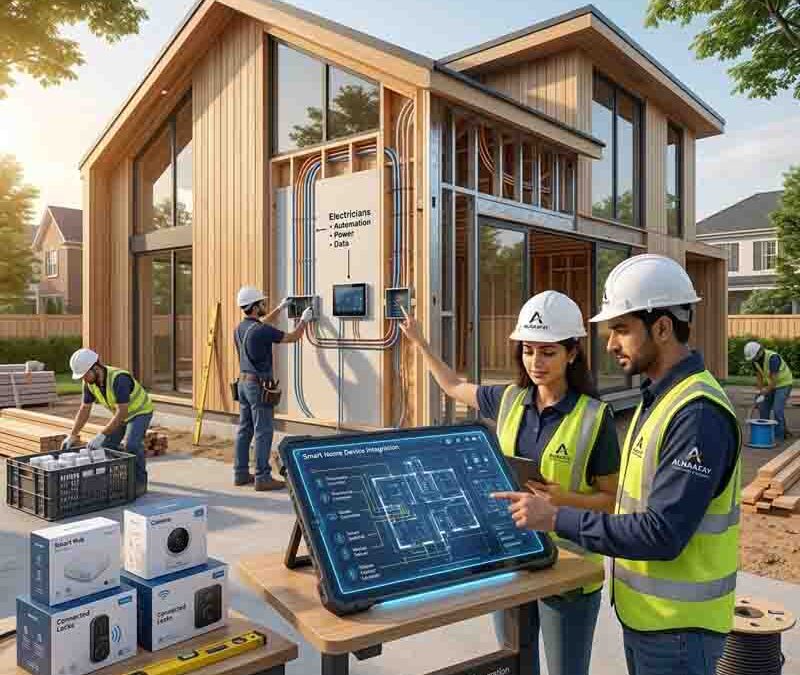
Smart Home Technology Integration: A Complete Guide for the Build Phase
Building a home is one of the most significant investments most people make in their lifetime. Yet many homeowners and builders treat smart home technology as an afterthought — something to be added after the walls are up and the paint is dry. That approach is costly, technically limiting, and entirely avoidable.
Smart Home Technology Integration, when planned and executed during the construction phase, produces results that are simply not possible through retrofitting. The wiring is cleaner, the systems are more reliable, the costs are lower, and the finished home performs at a level that a post-construction upgrade cannot match. We have seen both approaches play out across dozens of residential builds, and the difference is not marginal. It is substantial.
This guide walks you through every aspect of integrating smart home technology during the build phase — from understanding what smart home integration actually means, to planning the right systems, executing the installation correctly, and avoiding the mistakes that derail even well-intentioned projects. Whether you are a homeowner working with a builder or a construction professional looking to sharpen your process, this resource gives you the concrete information you need to get it right the first time.
Table of Contents
- What Is Smart Home Technology Integration?
- Why Integrate Smart Home Technology During the Build Phase?
- Key Smart Home Systems to Plan During Construction
- How to Integrate Smart Home Technology Step by Step
- Smart Home Wiring and Infrastructure Planning
- How a Construction Company in Lahore Can Integrate Smart Home Technology
- Common Mistakes to Avoid During Smart Home Integration
- Best Practices for Smart Home Technology Integration
- FAQs
- Conclusion
What Is Smart Home Technology Integration?
Smart Home Technology Integration is the process of planning, installing, and connecting automated systems throughout a residential property so that lighting, climate control, security, entertainment, and energy management all work together through a unified interface. Rather than operating as separate, disconnected devices, integrated smart home systems communicate with one another — and with you — through a central hub, a mobile application, or voice control.
The term "integration" is the key word here. A single smart thermostat does not constitute a smart home. A collection of disconnected smart devices that happen to share the same Wi-Fi network is not a smart home either. True Smart Home Technology Integration means that your systems are deliberately designed to interact, share data, and respond to your preferences automatically. For example, a fully integrated system can dim the lights, lower the blinds, activate the security cameras, and adjust the thermostat simultaneously when you trigger a single "away" command.
This level of coordination requires deliberate planning. It requires decisions about protocols, hub architecture, wiring pathways, and device compatibility to be made before construction begins — not after. When those decisions are deferred to the finish phase or post-occupancy, the result is a compromised system that costs more to install and delivers less.
Why Integrate Smart Home Technology During the Build Phase?
The build phase — specifically the period between framing and drywall installation — is the most important window for smart home technology integration. During this window, walls are open, conduit can be run cleanly, structured wiring can be routed without damage to finishes, and infrastructure decisions can be made without the expense of demolition and repair.
After the drywall goes up, every wiring pathway becomes significantly more difficult and expensive to access. Retrofitting a smart home system into a finished home typically costs 30 to 50 percent more than planning the same system during construction, according to industry estimates from the Consumer Technology Association. Furthermore, retrofitted systems often require wireless solutions that introduce reliability limitations, latency issues, and dependency on battery-powered devices that require ongoing maintenance.
There are four specific reasons why Smart Home Technology Integration during the build phase produces superior outcomes.
Lower Installation Cost: Running cables through open walls costs a fraction of what it costs to fish cables through closed ones. Moreover, the labor hours required to route structured wiring, install conduit, and position junction boxes are dramatically lower when walls are accessible.
Higher System Reliability: Hardwired connections are consistently more reliable than wireless alternatives. Consequently, systems integrated during construction — using structured wiring for networking, audio distribution, and security — perform at a higher standard over the long term.
Cleaner Aesthetics: In-wall speakers, flush-mounted touchscreens, concealed conduit, and invisible cable pathways are achievable during construction. After the walls are closed, achieving the same aesthetic result requires invasive retrofitting that is rarely worth the disruption.
Greater Flexibility for Future Upgrades: Conduit runs installed during construction allow future cable upgrades without opening walls. As technology evolves, a home with properly installed conduit infrastructure can be updated without demolition. That built-in flexibility adds lasting value to the property.
Key Smart Home Systems to Plan During Construction
Effective Smart Home Technology Integration begins with identifying which systems to include and understanding how they interact. Not every home requires the same configuration. However, the systems listed below represent the most commonly integrated categories in residential construction, and each benefits substantially from being planned during the build phase.
Integrated Lighting Control
Lighting control systems allow you to program, schedule, and automate every light in the home from a single interface. Lutron and Control4 are among the most widely installed platforms for residential lighting control. These systems require dedicated wiring runs from each fixture back to a central processor, which is why they must be planned before walls are closed.
Additionally, lighting integration extends beyond simple on/off control. Dimming, color temperature adjustment, scene programming, and daylight harvesting — automatically adjusting artificial light based on natural light levels — are all features that require the right infrastructure from the start.
Integrated Climate Control
Smart thermostats and HVAC zoning systems are among the most impactful smart home investments in terms of energy savings. A properly integrated climate system allows different zones of the home to be maintained at different temperatures independently, reducing energy waste in unoccupied areas. According to the U.S. Department of Energy, proper HVAC zoning can reduce heating and cooling costs by up to 30 percent.
During construction, the HVAC contractor and the smart home integrator must coordinate the placement of zone dampers, sensor locations, and thermostat wiring runs before ductwork is finalized.
Integrated Security and Access Control
Security integration covers door and window sensors, motion detectors, surveillance cameras, video doorbells, smart locks, and alarm systems. Each of these devices requires either a power source, a data connection, or both. Planning camera mounting locations, running conduit for camera cables, and positioning junction boxes for sensors during framing prevents the need for exposed surface-mounted wiring later.
Smart lock integration, in particular, requires coordination between the door hardware specification and the home automation platform to ensure compatibility before doors are ordered and installed.
Integrated Audio and Video Distribution
Whole-home audio systems distribute music and audio content to speakers in every room from a central source. Systems from Sonos, Denon HEOS, and Control4 offer whole-home audio solutions that range from simple wireless setups to fully hardwired distributed audio architectures. For premium performance, in-wall and in-ceiling speakers require rough-in installation during construction.
Similarly, structured video distribution — routing HDMI signals from a central equipment rack to displays throughout the home — requires dedicated cable pathways that are difficult to add after construction.
Integrated Energy Management
Energy management systems monitor and control electricity consumption across the home, often integrating with solar panel systems, battery storage units, and electric vehicle charging infrastructure. These systems require coordination with the electrical contractor during rough-in to ensure that monitoring circuits, smart electrical panels, and EV charging conduit are positioned correctly.
Integrated Window Treatments
Motorized shades and blinds are increasingly specified as part of smart home integration packages. These systems require low-voltage wiring at each window opening and must be coordinated with the window schedule during construction. Furthermore, integration with the lighting and climate systems allows automated shading based on sun position and indoor temperature — a feature that requires all three systems to share a common platform.
How to Integrate Smart Home Technology Step by Step
Smart Home Technology Integration follows a structured sequence. Deviating from this sequence — by skipping steps or reversing their order — is one of the most common causes of integration failures and cost overruns. We follow this process on every build.
Step 1: Define the Scope During Pre-Design: Before architectural drawings are finalized, determine which smart home systems will be included. This decision affects structural elements — equipment room sizing, conduit pathways, electrical panel capacity, and wall penetration locations — that cannot be easily changed once design is complete.
Step 2: Select a Smart Home Platform: Choose a central platform — such as Control4, Crestron, Savant, or a more accessible option like Google Home or Amazon Alexa — and confirm that all planned devices are compatible with it. Platform selection affects every subsequent decision, so it must be made early.
Step 3: Engage a Smart Home Integrator Before Framing: The integrator must be on site before framing is complete to mark conduit runs, junction box locations, and equipment room placement. Their input at this stage prevents costly conflicts with the electrical, HVAC, and plumbing trades.
Step 4: Run Rough-In Wiring During the Appropriate Construction Window: Structured wiring, conduit, speaker rough-ins, camera conduit, and sensor wiring are all installed after framing is complete and before insulation and drywall. Coordinate inspection scheduling around this window so that all rough-in work is reviewed before walls are closed.
Step 5: Install Infrastructure During the Finish Phase: Once drywall is complete, keypads, touchscreens, speaker grilles, camera housings, and thermostat bases are installed. The central equipment rack is populated and tested during this phase as well.
Step 6: Commission and Program the System: Programming is the final step, and it is distinct from installation. During commissioning, the integrator configures scenes, schedules, access permissions, and automation rules. This step requires dedicated time after all devices are installed and powered — typically two to five days for a complete whole-home system.
Step 7: Train the Homeowner: A system that the homeowner does not understand is a system that will not be used. We schedule a formal training session with every homeowner after commissioning is complete, covering daily operation, app navigation, troubleshooting basics, and how to request changes to programming.
Smart Home Wiring and Infrastructure Planning
Wiring and infrastructure planning is the technical foundation of Smart Home Technology Integration. Without the right cables in the right locations, even the best devices and platforms will underperform. The following wiring categories are standard in a fully integrated residential smart home.
Structured Network Wiring
Ethernet is the backbone of any reliable smart home system. We specify Cat6A cable as the minimum standard for all network drops in the homes we build, because it supports 10-gigabit speeds and is forward-compatible with emerging network standards. Every device that can accept a wired network connection — smart TVs, audio processors, security cameras, access points — should be connected via Ethernet rather than Wi-Fi wherever possible.
Network wiring runs home-run from each device location to a central structured media center or equipment room. We size the equipment room to accommodate the network switch, wireless access point controller, smart home hub, audio distribution equipment, and security system panel — all in a single, organized, and ventilated enclosure.
Low-Voltage Wiring for Security and Sensors
Door and window sensors, motion detectors, and glass break sensors require two-conductor low-voltage wire runs back to the security panel. Camera locations require either a coaxial or Cat6 run, depending on the camera type. All of these runs must be planned in advance and routed before insulation is installed.
Speaker Wiring
In-ceiling and in-wall speakers require 14- or 16-gauge two-conductor speaker wire run from each speaker location back to the audio distribution equipment. For large rooms or long cable runs — exceeding 50 feet — we specify 14-gauge to minimize signal loss over distance.
Lighting Control Wiring
Dedicated lighting control systems, such as those from Lutron RadioRA or Lutron Homeworks, require line-voltage wiring from each fixture to a local dimmer or to a central processor, depending on the architecture. The electrical contractor and smart home integrator must coordinate this work during rough-in to ensure that circuits align with the lighting control plan.
Conduit for Future Flexibility
In addition to the cables listed above, we install empty conduit runs between the equipment room and key locations throughout the home — including above the garage, in the attic, and at exterior camera locations. These conduit pathways allow new cables to be pulled in the future without opening walls. We document every conduit run on an as-built drawing that we provide to the homeowner at project completion.
How a Construction Company in Lahore Can Integrate Smart Home Technology
Smart Home Technology Integration is not limited to North American or European markets. A construction company in Lahore is well-positioned to integrate these systems into residential builds, given the strong growth in demand for premium housing in major Pakistani cities and the increasing availability of smart home devices and platforms internationally.
The fundamental process of Smart Home Technology Integration is the same regardless of geography. Wiring must be run before walls are closed. Platform selection must precede device specification. Commissioning must follow installation. These principles apply as directly to a construction company in Lahore as they do to a builder in Los Angeles or London.
That said, a construction company in Lahore should account for a few context-specific factors when planning smart home projects.
Power Stability: Voltage fluctuations and power interruptions are more common in Pakistan than in some other markets. Therefore, smart home infrastructure should include UPS (uninterruptible power supply) protection for the central equipment room, and all sensitive electronics should be connected through surge protection devices. This is not optional in markets with inconsistent grid power — it is a baseline requirement for protecting the investment.
Local Device Availability and Support: Some smart home platforms sold in North American or European markets are not readily available or supported in Pakistan. A construction company in Lahore should evaluate platforms that have established local distributors and authorized service providers, so that programming support and hardware replacement are accessible when needed.
Climate Considerations: Lahore's climate — characterized by intense summer heat — affects equipment room design. The equipment room must be air-conditioned or at minimum adequately ventilated, because network switches, audio processors, and smart home hubs generate heat that, if not managed, shortens equipment life and causes system instability.
Client Education: In markets where Smart Home Technology Integration is newer, homeowners benefit from more extensive education during the planning phase. A construction company in Lahore that invests time in helping clients understand what integrated systems can do — and what they require in terms of ongoing maintenance — will deliver projects that achieve higher client satisfaction scores and generate stronger referrals.
We recommend that any construction company in Lahore beginning to offer smart home integration services start by developing a standard package — a defined set of systems, brands, and wiring specifications that the team can install consistently — rather than approaching each project from scratch. This standardization reduces installation time, improves quality control, and makes client communication more straightforward.
Common Mistakes to Avoid During Smart Home Integration
Even experienced builders and integrators make avoidable errors during Smart Home Technology Integration. The following mistakes are the most common ones we encounter, and understanding them in advance allows you to prevent them.
Selecting Incompatible Platforms and Devices
Mixing devices from platforms that do not communicate with one another creates a fragmented system that frustrates homeowners. Before specifying any device, confirm that it is compatible with the chosen central platform. Additionally, verify that the integration between the device and the platform goes beyond basic on/off control — because limited integration often means limited functionality in real-world use.
Under-Sizing the Network Infrastructure
Smart home systems are network-dependent. Consequently, an inadequate network — too few access points, insufficient switch capacity, or poor placement of network equipment — undermines the performance of every connected device. We size the network for the number of devices that will be connected at full occupancy, not just the devices that are installed on day one.
Failing to Coordinate Trades
Smart home integration touches every major trade on a construction project — electrical, HVAC, low-voltage, framing, and finish carpentry. Without deliberate coordination, trades make decisions that conflict with the smart home plan. For example, an electrician who runs circuits without consulting the lighting control plan may position switch boxes in locations that do not align with the keypad layout. We require a coordination meeting between the smart home integrator and all relevant trade contractors before rough-in begins.
Skipping the Commissioning Phase
Installation and commissioning are separate activities. Installing devices without properly programming and testing the system produces a home full of hardware that does not perform as intended. Commissioning requires dedicated time after all devices are installed — typically two to five days for a complete system — and should not be compressed to meet a move-in deadline.
Neglecting Ongoing Support Planning
Smart home systems require periodic software updates, occasional troubleshooting, and sometimes reprogramming as the homeowner's preferences change. Builders and integrators who do not establish a clear support plan leave homeowners without a path to assistance when issues arise. We provide every homeowner with a written support plan that defines response times, update schedules, and the process for requesting programming changes.
Choosing Wireless-Only Solutions to Save Money
Wireless smart home devices are legitimate in specific applications, but relying on wireless solutions for all systems — to avoid the cost of running cable during construction — is a decision that homeowners frequently regret. Wired connections are more reliable, faster, and not subject to interference from neighboring networks or household electronics. Furthermore, the incremental cost of running cable during construction is minor compared to the cost of retrofitting wired connections later.
Best Practices for Smart Home Technology Integration
Across the smart home integration projects we have completed, a consistent set of practices separates successful outcomes from difficult ones. We apply these practices on every project, regardless of size or budget.
Document Everything: Maintain a complete as-built drawing set that shows every cable run, device location, IP address assignment, and equipment specification. This documentation is essential for troubleshooting, future upgrades, and handover to the homeowner. Without it, the next person who works on the system is working blind.
Build a Dedicated Equipment Room: Central equipment — network switch, smart home hub, audio processor, security panel, and UPS — should be housed in a single, organized, and accessible enclosure. Routing all cable runs to a central location simplifies troubleshooting and allows the entire system to be assessed from one point.
Specify Commercial-Grade Networking Equipment: Residential-grade routers and switches are not designed for the demands of a fully integrated smart home. We specify commercial-grade network switches and access points — typically from Ubiquiti, Cisco Meraki, or Ruckus — because they are more reliable, more manageable, and more durable than consumer alternatives.
Test Every Run Before Walls Are Closed: After rough-in wiring is complete and before insulation and drywall installation begins, test every cable run for continuity and signal integrity. Finding a damaged cable at rough-in costs minutes to fix. Finding the same fault after drywall installation costs hours and may require opening walls.
Plan for Power Redundancy: Integrate UPS protection for the central equipment room so that network, security, and access control systems remain operational during power outages. A smart lock that cannot be operated during a power failure is a security liability, not an asset.
Involve the Homeowner Early and Often: Homeowner preferences should drive system design, not the other way around. We conduct a formal discovery session with every homeowner at the start of the smart home planning process, asking detailed questions about their daily routines, technology comfort level, and long-term plans for the property. Those answers directly inform the system design.
Follow a Pre-Commissioning Checklist: Before programming begins, verify that every device is powered, connected to the network, and reachable by the central hub. A 25-point pre-commissioning checklist ensures that the programming session is productive rather than spent troubleshooting connectivity issues that should have been resolved during installation.
FAQs
How early in the construction process should smart home planning begin?
Smart home planning should begin during the design phase — before architectural drawings are finalized. Decisions about equipment room placement, conduit pathways, and electrical panel capacity affect structural and mechanical elements that are difficult to change after design is complete. We recommend engaging a smart home integrator during design development, not after construction documents are issued.
What is the typical cost of Smart Home Technology Integration during a new build?
Costs vary based on the scope of systems included, the platform selected, and the size of the home. Entry-level whole-home integration — covering lighting control, climate, security, and networking — typically ranges from $15,000 to $30,000 for a mid-size residence. Comprehensive high-end integration, including whole-home audio, motorized window treatments, and home theater, can range from $50,000 to $150,000 or more. However, integrating these systems during construction rather than retrofitting them post-occupancy typically reduces overall cost by 30 to 50 percent.
Which smart home platform is the best choice?
The right platform depends on the complexity of the system, the homeowner's technical comfort level, and the level of local support available. For professionally installed, high-complexity systems, Control4, Crestron, and Savant are the most capable platforms. For simpler systems where the homeowner prefers self-management, Google Home and Amazon Alexa ecosystems offer broad device compatibility and intuitive interfaces. We evaluate platform options during the initial planning meeting based on the specific requirements of each project.
Can smart home systems be added after construction is complete?
Yes — but with significant limitations and added cost. Post-construction integration typically relies on wireless devices and workarounds that cannot replicate the reliability and aesthetics of a properly planned built-in system. Additionally, the cost of fishing cables through finished walls, repairing drywall, and repainting adds substantially to the installation budget. We strongly recommend planning smart home integration during construction rather than deferring it.
How do smart home systems affect property value?
According to a 2023 survey by the National Association of Realtors, 72 percent of homebuyers say that smart home features influenced their purchasing decision, and professionally integrated smart home systems consistently command a premium in resale. Moreover, energy management and security features are among the most valued by buyers. However, the system must be documented, maintained, and transferable — a smart home with no documentation or support plan adds less value than one with clear owner training and a service record.
How long does Smart Home Technology Integration take to commission?
Commissioning time depends on the complexity of the system. A basic integrated system covering lighting, climate, and security can typically be commissioned in one to two days. A comprehensive system that includes whole-home audio, video distribution, motorized shading, and advanced automation programming may require four to seven days of commissioning work. We build commissioning time into every project schedule and never compress it to meet a move-in date.
Can a construction company in Lahore deliver the same quality of smart home integration as builders in other markets?
Absolutely. The principles of Smart Home Technology Integration are universal — structured wiring, platform selection, trade coordination, commissioning, and homeowner training apply regardless of location. A construction company in Lahore that follows a disciplined process, selects platforms with local support, and accounts for market-specific factors such as power stability and climate will deliver integrated smart home systems that match international quality standards. The differentiator is process discipline, not geography.
Conclusion
Smart Home Technology Integration during the build phase is not a luxury reserved for high-end custom homes. It is a practical, cost-effective decision that produces more reliable systems, cleaner installations, and better long-term value than any retrofit approach can deliver. The window of opportunity is open during construction, and it closes when the drywall goes up.
We apply a structured, documented process to every smart home integration project we undertake — from pre-design planning through platform selection, trade coordination, wiring, commissioning, and homeowner training. Every step is covered by a checklist, every cable run is tested before walls are closed, and every homeowner receives complete documentation and a formal training session before move-in.
If you are planning a new build and want to understand exactly how to integrate smart home technology into the construction process, contact our team. We will walk you through every step, answer your specific questions, and help you develop a smart home plan that fits your budget, your lifestyle, and the long-term goals you have for your property.
