
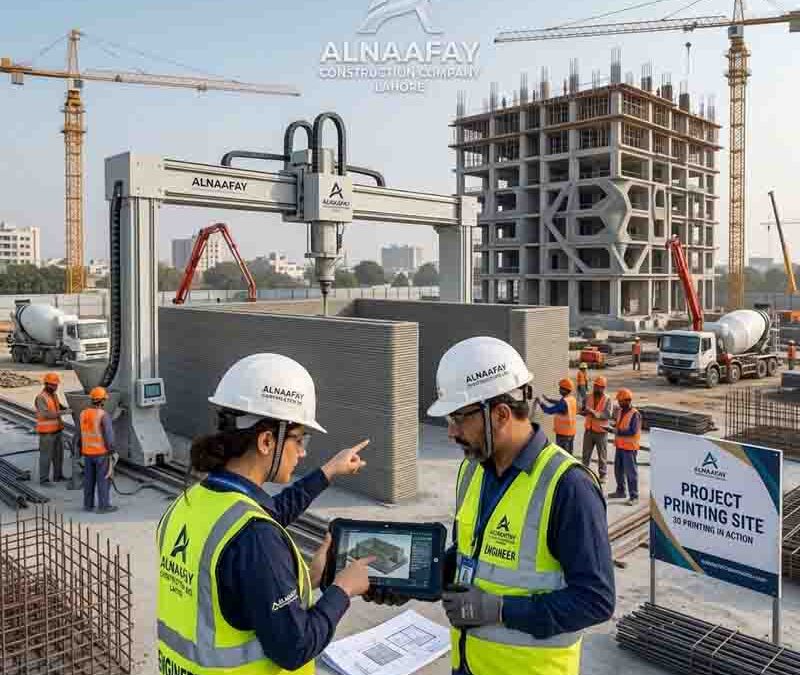
3D Printing in Construction: Where Is It Actually Being Used?
Three-dimensional printing has moved well beyond prototypes and plastic figurines. Across the globe, construction teams are using large-scale 3D printing systems to build homes, bridges, offices, and entire neighborhoods — faster, cheaper, and with less waste than traditional methods allow. The technology is no longer a concept confined to research papers. It is happening right now, on real job sites, in real cities.
Yet many construction professionals still have questions. Where exactly is 3D printing in construction being used today? What does the process actually involve? And what are its real limitations — the ones that rarely make the headline?
This guide answers all of those questions in plain, straightforward language. Whether you are a contractor, developer, engineer, or simply someone curious about where construction technology is headed, you will find clear and honest information here. By the end of this post, you will have a solid understanding of what 3D printing in construction can do, where it is already delivering results, and what challenges still need to be worked through.
Table of Contents
- What Is 3D Printing in Construction?
- Where Is 3D Printing in Construction Actually Being Used?
- 3D Printing for Residential Homes
- 3D Printing in Commercial and Infrastructure Projects
- How 3D Printed Construction Is Being Used in Developing Markets
- 3D Printing and Construction Companies in Lahore
- Key Benefits of 3D Printing in Construction
- Real Limitations of 3D Printing in Construction
- The Future of 3D Printed Buildings
- FAQs
- Conclusion
What Is 3D Printing in Construction?
At its core, 3D printing in construction — also called additive manufacturing or contour crafting — is the process of using large, computer-controlled machines to deposit material layer by layer until a structure takes shape. Instead of traditional bricklaying or concrete formwork, a robotic system follows a digital blueprint and builds up walls, foundations, and structural elements automatically.
The material used most commonly in construction 3D printing is a specially formulated concrete mix, often called printable concrete or geopolymer concrete. This mix is designed to flow easily through the printer's nozzle but harden quickly enough to support the next layer without collapsing. Some systems also work with other materials, including clay, recycled plastic composites, and even soil-based mixtures in low-cost housing applications.
There are three main types of 3D printing systems currently used in construction:
- Gantry systems: A large frame is erected over the build site, and the print head moves along rails within that frame. These systems are common for printing entire buildings on-site.
- Robotic arm systems: An industrial robotic arm is mounted on a mobile base and used to print structures with a high degree of precision. These are often used for smaller structures or prefabricated components.
- Crane-mounted systems: In some large-scale applications, the print head is mounted on a crane or cable system to allow printing over a wider area.
The process always starts with a digital model — typically created using Building Information Modeling (BIM) software. That model is then converted into a set of machine instructions, which the printer follows to build the structure layer by layer. Consequently, the design flexibility offered by 3D printing in construction is significantly greater than what traditional methods allow. Curved walls, complex geometries, and integrated channels for plumbing and wiring can all be incorporated into a printed structure far more easily than in a conventional build.
Understanding this foundation makes it much easier to appreciate where the technology is currently being deployed — and why.
Where Is 3D Printing in Construction Actually Being Used?
The honest answer is: more places than most people realize. While coverage of 3D printing in construction tends to focus on headline-grabbing prototypes, the reality is that this technology has already been deployed in a wide range of genuine, completed construction projects across multiple continents.
Furthermore, the applications are not limited to experimental showpieces. Increasingly, 3D printed construction is being used for projects that are occupied, functional, and built to code. The sectors showing the most activity include residential housing, commercial development, infrastructure, disaster relief, and low-cost housing in developing markets.
Each of these applications presents a different set of requirements, challenges, and outcomes. Therefore, it is worth examining them separately to understand where 3D printing in construction is making the most meaningful impact today.
3D Printing for Residential Homes
Residential construction is currently the most active area of 3D printing in construction. Several companies around the world have already delivered completed, habitable homes using large-scale 3D printing technology, and the pace of delivery is accelerating.
ICON and the East 17th Street Community — Austin, Texas, USA
One of the most cited examples of 3D printed residential construction is the work of ICON, an American construction technology company. In 2021, ICON completed a community of 3D printed homes in Austin, Texas, in partnership with the developer 3Strands. These homes — ranging from approximately 1,000 to 2,000 square feet — were printed using ICON's proprietary Lavacrete material and Vulcan construction system. Notably, these were not affordable housing units. They were listed on the open market at competitive prices, demonstrating that 3D printed homes can appeal to mainstream buyers.
ICON has since gone further. In 2022, the company began construction on what it describes as the world's largest 3D printed community — a 100-home development in Georgetown, Texas, built in partnership with Lennar, one of the United States' largest homebuilders. This collaboration is significant because it represents the entry of a major conventional builder into the 3D printed housing space. As a result, the technology is no longer limited to specialist firms working on experimental projects.
Mighty Buildings — California, USA
Mighty Buildings takes a different approach to 3D printed residential construction. Rather than printing homes on-site, the company prints prefabricated panels and modules at its factory in Oakland, California, then ships them to the build site for assembly. This off-site model addresses some of the logistical challenges associated with on-site printing, particularly in urban areas with limited access. Additionally, it allows for greater quality control, since the printing process takes place in a controlled factory environment.
Tvasta Manufacturing Solutions — Chennai, India
In 2021, Tvasta Manufacturing Solutions completed what is widely reported as India's first 3D printed home — a 600-square-foot structure built on the campus of IIT Madras. The home was completed in less than five days of printing, demonstrating the speed advantage that 3D printing in construction can deliver even at modest scale.
These examples share a common theme: 3D printing in the residential sector is producing real homes that people can actually live in. The technology has moved beyond the prototype stage and into genuine delivery.
3D Printing in Commercial and Infrastructure Projects
Beyond residential housing, 3D printing in construction is making steady inroads into commercial buildings and public infrastructure. These applications tend to involve larger structures, more complex engineering requirements, and longer timelines — but the results are increasingly impressive.
The World's First 3D Printed Office Building — Dubai, UAE
In 2016, Dubai completed what was widely recognized as the world's first fully 3D printed office building. The structure, which houses the Dubai Future Foundation, was printed in approximately 17 days using a large gantry-mounted printer. The building covers around 2,700 square feet and is fully functional, with a working office environment inside.
Dubai's government has since set an ambitious target: by 2030, 25 percent of all new buildings in the city must incorporate some element of 3D printing. This policy commitment is driving rapid growth in the use of 3D printed construction technology across the emirate.
3D Printed Bridges
Infrastructure is another area where 3D printing in construction has delivered tangible results. In 2017, the Dutch company MX3D completed a 3D printed steel pedestrian bridge in Amsterdam — a 12-meter structure printed using robotic welding technology over a period of approximately six months. The bridge has since been installed and opened to the public, serving as both a functional piece of infrastructure and a demonstration of what additive manufacturing can achieve at scale.
Similarly, China has used concrete 3D printing to produce bridge components and short pedestrian bridges in several locations. Winsun, one of China's leading 3D printing construction companies, has built multiple printed bridge structures, some of which are in public use. Consequently, the bridge sector is emerging as one of the most active areas for 3D printing in construction globally.
Military and Government Applications
The United States Marine Corps and the US Army Corps of Engineers have both conducted field trials using 3D printing to construct barracks, shelters, and other military structures. In 2018, US Marines successfully printed a concrete barracks hut in approximately 40 hours during a field exercise — a result that demonstrated the potential of 3D printing in construction for rapid deployment scenarios.
How 3D Printed Construction Is Being Used in Developing Markets
Some of the most compelling applications of 3D printing in construction are taking place in developing markets, where housing shortages are acute and the need for fast, low-cost, durable construction is most pressing.
New Story and ICON — Tabasco, Mexico
In 2019, a partnership between the nonprofit organization New Story and ICON used 3D printing technology to begin construction on a community of homes for families living in extreme poverty in Tabasco, Mexico. The homes were designed specifically for the local climate and context, and the 3D printing process reduced both cost and construction time significantly compared to conventional methods. Critically, the homes were built to a standard that far exceeded what traditional informal construction in the region could deliver.
This project is particularly significant because it demonstrated that 3D printing in construction is not exclusively a technology for wealthy markets. When the right system, materials, and design approach are used, it can deliver genuine social impact.
Habitat for Humanity and Alquist 3D — Virginia, USA
In 2021, Alquist 3D partnered with Habitat for Humanity to build a 3D printed home for a deserving family in Williamsburg, Virginia. The home was completed at a cost significantly below what a conventionally built Habitat home would typically require. Furthermore, the project created a template for using 3D printing in construction to address affordable housing needs — a model that has since been replicated in other US communities.
African Applications
In several African nations, organizations are piloting the use of 3D printed construction for low-cost housing and community facilities. For example, 14Trees — a joint venture between Holcim and CDC Group — has used 3D printing to construct homes and a school in Malawi. The school was built in less than 18 hours of printing time, at a fraction of the cost of conventional construction. As housing demand in African cities continues to surge, these applications are becoming increasingly relevant to governments and developers across the continent.
3D Printing and Construction Companies in Lahore
Pakistan's construction sector is growing rapidly, and Lahore — as the country's second-largest city and a major hub for commercial and residential development — sits at the heart of that expansion. Demand for housing in Lahore significantly outpaces supply, and the cost and time pressures facing construction companies in Lahore are intensifying year by year.
Against this backdrop, 3D printing in construction presents a genuinely relevant opportunity for Pakistani builders and developers. While the technology has not yet been widely deployed in Lahore, the conditions that have driven adoption in other developing markets — housing shortages, labor cost pressures, and a need for faster project delivery — are all present in abundance.
There are several ways that 3D printing in construction could benefit a construction company in Lahore specifically.
Faster Project Delivery
One of the most immediate benefits of 3D printing in construction is speed. A structure that would take weeks to build using conventional methods can often be printed in days. For a construction company in Lahore managing multiple projects simultaneously, this acceleration in delivery timelines could be a significant competitive advantage.
Reduced Dependency on Manual Labor
Construction labor markets in Lahore face challenges related to cost, availability, and consistency. Skilled tradespeople are increasingly in demand, and wages are rising accordingly. 3D printing in construction automates much of the wall-building and structural element production process, reducing the need for large on-site labor teams. As a result, construction companies in Lahore could achieve better cost control and more predictable project timelines.
Lower Material Waste
Traditional construction in Lahore — as in most cities — generates significant material waste. Bricks are broken, concrete is over-ordered, and offcuts accumulate on every job site. By contrast, 3D printing in construction deposits material only where it is needed, dramatically reducing waste. This not only saves money but also aligns with growing regulatory and client pressure to adopt more sustainable construction practices.
Design Flexibility
Lahore has a rich architectural heritage, and there is strong demand from both commercial and residential clients for buildings that combine contemporary functionality with distinctive design. 3D printing in construction allows for far greater design flexibility than conventional methods, making it easier and more affordable to incorporate curved walls, decorative facades, and complex geometrical forms into a building's design.
Affordable Housing Applications
Perhaps the most pressing application for any construction company in Lahore considering 3D printing technology is affordable housing. The city faces an enormous shortfall in housing for low- and middle-income families, and the government has introduced several initiatives to address this gap. 3D printing in construction, with its combination of speed, cost efficiency, and design adaptability, is well-suited to helping construction companies in Lahore deliver affordable housing at the scale and pace that is needed.
Of course, adoption in Lahore also comes with challenges. Access to the specialized equipment and materials required for 3D printing in construction remains limited within Pakistan. Regulatory frameworks for approving 3D printed structures are still being developed. Additionally, awareness of the technology among clients and developers in Lahore is relatively low.
Nevertheless, the trajectory is clear. As international 3D printing technology providers expand into emerging markets — and as local Pakistani companies begin to explore partnerships and licensing arrangements — it is only a matter of time before 3D printing in construction becomes a real option for forward-thinking builders in Lahore. Construction companies in Lahore that begin exploring this technology today will be better positioned to lead when that moment arrives.
Key Benefits of 3D Printing in Construction
Having looked at where 3D printing in construction is actually being used, it is worth summarizing the core benefits that are driving its adoption across so many different markets and project types.
Speed: Structures that take weeks to build conventionally can often be printed in days. This acceleration delivers real savings in time and project overhead.
Cost Efficiency: By reducing labor requirements, minimizing material waste, and shortening construction timelines, 3D printing in construction can significantly lower overall project costs. Some studies suggest cost savings of 30 to 50 percent compared to conventional construction in certain applications.
Design Freedom: The ability to print complex, curved, and non-standard geometries without additional cost or complexity opens up a new world of architectural possibility. Designers are no longer constrained by what can be efficiently formed with bricks, blocks, or timber framing.
Sustainability: Less material waste, lower energy consumption during construction, and the ability to incorporate recycled or locally sourced materials all contribute to a more sustainable construction process. As environmental regulations tighten and client expectations around sustainability rise, this advantage will become increasingly important.
Precision and Consistency: Computer-controlled printing eliminates the variability that comes with manual construction. Every layer is deposited exactly as specified, producing a level of dimensional accuracy that is difficult to achieve consistently through conventional means.
Reduced Site Risk: Fewer workers performing manual tasks on-site means fewer opportunities for accidents. Additionally, the automation of physically demanding work reduces the risk of musculoskeletal injuries among construction workers.
Real Limitations of 3D Printing in Construction
It would be misleading to present 3D printing in construction as a solution without limitations. Like any technology, it comes with genuine constraints that construction professionals need to understand before committing to its adoption.
High Upfront Equipment Costs: Large-scale 3D printing systems for construction are expensive. The capital investment required to purchase and maintain a construction-grade printer, together with the associated software and materials infrastructure, puts the technology out of reach for many smaller contractors. Leasing arrangements and third-party service providers are beginning to address this barrier, but the upfront cost remains a significant consideration.
Material Limitations: While printable concrete mixes have improved significantly, they are not yet suitable for all structural applications. Reinforcement strategies — particularly for multi-story buildings — are still being developed. In most current applications, 3D printing produces the walls and basic structure, while conventional methods are still needed for roof structures, floors, windows, and mechanical systems.
Skilled Operator Requirements: Operating a construction 3D printer is not a simple task. It requires trained technicians who understand the equipment, the materials, and the digital design files. In markets where this expertise is scarce, recruitment and training add time and cost to any adoption program.
Regulatory Gaps: Building codes and regulatory frameworks in most countries were written long before 3D printed construction existed. As a result, getting approval for 3D printed structures often requires a project-by-project engagement with local authorities — a process that can be slow and unpredictable. Until clearer regulatory pathways are established, this uncertainty creates risk for developers and their financiers.
Limited Multi-Story Capability: Most commercial 3D printing systems in construction are currently better suited to single-story or low-rise structures. Engineering solutions for multi-story 3D printed buildings are being developed, but they are not yet mature enough for widespread commercial deployment.
Site Access Constraints: Gantry-based printing systems require a clear, level area around the build site that may not be available in dense urban environments. Robotic arm systems are more flexible, but they still require space for the machinery and its support infrastructure.
Weather Sensitivity: Like conventional concrete work, 3D printing in construction is affected by extreme weather. Very hot or cold temperatures, high humidity, and strong winds can all affect the quality of the printed material. Planning for weather disruptions is an important part of managing a 3D printed construction project.
The Future of 3D Printed Buildings
The trajectory of 3D printing in construction points clearly toward wider adoption, greater capability, and lower costs. Several developments on the near horizon are likely to accelerate this trend significantly.
Multi-Story Printing
Engineering teams around the world are actively working on systems and structural solutions that will allow 3D printing to be used reliably for multi-story residential and commercial buildings. As these solutions mature, the range of projects suitable for 3D printing in construction will expand dramatically.
Integrated Reinforcement
Current 3D printed construction typically requires manual placement of steel reinforcement, which limits automation and adds time to the process. Emerging technologies are developing methods for printing reinforcement directly into the structure — either by embedding fibers in the printable mix or by printing steel components alongside concrete. This integration will make 3D printed buildings structurally equivalent to conventionally built ones across a much wider range of applications.
Faster Print Speeds
Print speed is a key determinant of cost and competitiveness in 3D printed construction. Manufacturers are continuously working to increase throughput without compromising quality. As print speeds improve, the economic case for 3D printing in construction will strengthen further.
AI-Driven Design Optimization
Artificial intelligence is beginning to be applied to the design process for 3D printed structures, automatically generating optimized geometries that use the minimum amount of material to achieve the required structural performance. When combined with the geometric freedom that 3D printing offers, AI-driven design optimization could produce buildings that are both cheaper and structurally superior to anything achievable through conventional methods.
Sustainable and Recycled Materials
Researchers are actively developing printable materials that incorporate recycled content — including recycled plastic, fly ash, and even construction and demolition waste. These materials not only reduce the environmental footprint of 3D printing in construction but also lower material costs in markets where conventional printable concrete mixes are expensive or difficult to source.
Mainstream Regulatory Frameworks
As 3D printing in construction matures and its safety record accumulates, building codes and regulatory frameworks will evolve to accommodate it. This will reduce the project-by-project approval burden that currently slows adoption and will make it easier for developers and contractors to commit to 3D printing on a larger scale.
Taken together, these trends suggest that 3D printing in construction will become an increasingly mainstream option over the next decade — not a replacement for conventional construction, but a powerful complement to it for a growing range of project types.
FAQs
What materials are used in 3D printing in construction?
The most common material is a specially formulated concrete mix — sometimes called printable concrete or geopolymer concrete — designed to flow through the printer's nozzle and harden quickly enough to support successive layers. Some systems also use clay, recycled plastic composites, and other locally sourced materials. Research is ongoing to expand the range of materials suitable for construction 3D printing.
How long does it take to 3D print a house?
Print time varies depending on the size and complexity of the structure, as well as the speed of the printing system being used. In general, the walls of a modest single-story home can be printed in as little as 24 to 48 hours of machine time. However, the overall construction timeline — including foundation work, installation of windows, doors, roofing, and mechanical systems — is typically longer. Total project timelines of one to four weeks are common for simple residential structures.
Is 3D printed construction structurally safe?
Yes, when properly engineered and executed. Multiple 3D printed homes, bridges, and commercial buildings around the world have been built, inspected, and approved by relevant authorities. Structural performance depends on the quality of the material mix, the design, and the execution — just as it does in conventional construction. As with any construction method, adherence to engineering standards and regulatory requirements is essential.
How much does 3D printing in construction cost?
Costs vary widely depending on the market, the scale of the project, the system being used, and the materials available locally. In some developing-market applications, cost savings of 30 to 50 percent compared to conventional construction have been reported. In higher-cost markets, savings tend to be more modest, though they are still meaningful. The upfront cost of equipment is a significant factor for companies considering in-house adoption.
Can 3D printing in construction be used for multi-story buildings?
Currently, most commercial 3D printing systems in construction are best suited to single-story and low-rise structures. Multi-story 3D printed buildings are being developed and tested, but the engineering solutions required for taller structures are still maturing. Expect this to change significantly over the next five to ten years as the technology advances.
Is 3D printing in construction available in Pakistan?
As of now, 3D printing in construction has not been widely deployed in Pakistan. However, the technology is advancing rapidly in neighboring markets, and interest among Pakistani developers and construction companies is growing. As equipment becomes more accessible and international providers expand into South Asian markets, adoption in Pakistan — including in major cities like Lahore and Karachi — is likely to accelerate.
What software is used to design 3D printed buildings?
Most 3D printed construction projects begin with a digital model created in BIM software such as Revit, ArchiCAD, or similar platforms. This model is then converted into a format that the printing system's control software can interpret — typically a G-code file, similar to what is used in smaller-scale 3D printing. Some construction 3D printing companies have developed their own proprietary software platforms that integrate design, structural analysis, and machine control into a single workflow.
How does 3D printing in construction impact construction workers?
3D printing in construction automates some of the most physically demanding and repetitive tasks in the construction process, which reduces the risk of musculoskeletal injuries associated with traditional manual labor. At the same time, the technology creates demand for new types of skilled roles — including 3D printing technicians, digital modeling specialists, and materials scientists. Like most major technological transitions, the shift to 3D printing in construction will involve a period of workforce adaptation, requiring investment in retraining and upskilling programs.
Conclusion
3D printing in construction has moved from the research laboratory to the real world with impressive speed. Across residential, commercial, infrastructure, and humanitarian applications, this technology is delivering genuine results — homes that families live in, bridges that carry pedestrians, offices that house workers, and communities built for people who need affordable shelter most urgently.
The limitations are real and should not be minimized. High equipment costs, material constraints, regulatory uncertainty, and the challenge of multi-story applications all represent genuine barriers to wider adoption. Nevertheless, the pace of progress is steady, and the direction of travel is clear.
For construction professionals in any market — including a construction company in Lahore navigating a period of rapid urban growth and intense demand for housing — 3D printing in construction represents an opportunity worth understanding now, even if full adoption is still a few years away. The companies that take the time to learn, explore, and prepare today will be the ones that lead when the technology reaches its full potential.
The next phase of construction is being built layer by layer. The question is not whether 3D printing will transform the industry — it is whether your organization will be ready when it does.
