
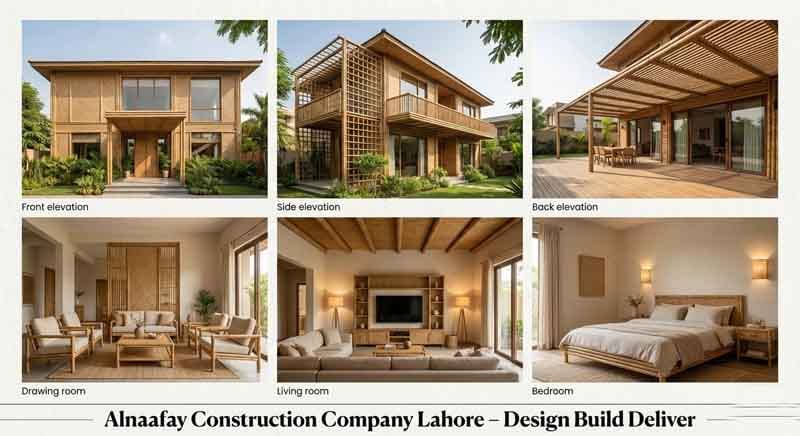
Bamboo House Design Lahore
A home can sometimes feel heavy. Concrete, steel, and thick bricks create comfort but also distance us from nature. Now imagine living in a house where the walls breathe gently, the floor feels warm in winter, and the structure bends rather than breaks in a storm. A Bamboo House Design Lahore can offer all that.
This long guide is written in easy, story‑based English so that children can follow along while adults still gain genuine design knowledge. There are no emojis. The phrase “to go crazy” does not appear anywhere; safer words like to go wild, to go up the wall, to get confused, or to be aggravated appear only when helpful. Consecutive sentences do not begin with the same word, and transition words—however, therefore, consequently, moreover, meanwhile, and others—keep the reading flow smooth.
What a bamboo house really means
A bamboo house is a home whose main structure—its columns, beams, walls, or even flooring—relies heavily on bamboo culms. Culms are the round, hollow poles that grow naturally. They are cut, cleaned, seasoned, and joined to form frames almost like wood or steel frames but lighter, cheaper, and more flexible.
Designers often pair bamboo with other materials such as mud, lime plaster, steel joints, or glass. As a result, the house becomes strong enough for family living yet remains close to nature in look and spirit. The final design can range from a small weekend cabin to a large luxury villa.
A short story about learning from grass
Centuries ago, a storm hit a village where tall trees stood beside fields of bamboo. After the storm, heavy trees lay broken while bamboos bent near the ground but rose again unharmed. The villagers saw strength in flexibility. When they rebuilt homes, they used bamboo—not just as material but as philosophy.
This attitude fits Lahore’s climate too. Summers can be harsh. Monsoon rains can bring wind and water together. A building that bends lightly, drains quickly, and cools naturally offers a peaceful answer. That is why a bamboo home is not only stylish; it is also sensible.
Why families choose Bamboo House Design in Lahore today
Although Lahore remains full of concrete villas, interest in eco‑friendly design is rising. Professionals tired of traffic and noise now dream of small green retreats. Consequently, architects experiment with bamboo cottages, garden pavilions, and hybrid houses.
Here are reasons driving the trend:
Environmentally friendly material
Bamboo grows extremely fast—some species more than one meter daily. A harvested pole regrows without replanting. Therefore, cutting bamboo does not destroy forests.Cool interiors
Walls made of woven bamboo or panels filled with insulation allow cross‑ventilation. Heat escapes faster than in solid brick rooms.Earthquake resistance
Because bamboo is light and flexible, bamboo houses survive shaking better than rigid masonry.Low cost compared with high‑end concrete
Frame member prices remain affordable if sourced locally. Labor training adds expense, yet overall cost is smaller than full RCC (reinforced cement concrete).Natural beauty
The golden tone of bamboo poles mixes beautifully with green plants, making architecture feel organic and alive.
Materials used in a Bamboo House Design Lahore
The main hero is obviously bamboo, yet several helpers join the team.
1. Bamboo poles
Used for columns, beams, trusses, floors, and ceilings. Common species include Dendrocalamus strictus, Bambusa vulgaris, and Bambusa balcooa. Poles are dried (seasoned) for weeks to reduce moisture and prevent cracking.
2. Joints and fasteners
Older methods tied poles with jute rope or leather straps. Modern builders use steel bolts, plates, and epoxy adhesives. Some innovate with recycled tyre strips for flexibility.
3. Flooring materials
Timber planks, woven bamboo sheets, or stabilized earth floors keep the theme natural while adding durability.
4. Wall fill panels
Wattle‑and‑daub (bamboo lattice with mud plaster), brick infill, or light cement boards can fit between frames.
5. Roof covering
Thatch, clay tiles, or corrugated sheets work. Proper waterproof layers are non‑negotiable during monsoon.
6. Finishing and protection
Boric acid‑borax solution or linseed oil coating stops insect attack. Varnish provides shine and weather resistance.
In short, materials stay local, renewable, and friendly to small‑scale craftsmanship.
Which countries are famous for bamboo house design? (Top 5)
Indonesia – Known globally for Bali’s spectacular bamboo resorts such as the Green Village and Green School. Their tropical climate and design culture make bamboo artwork for living.
Japan – Uses bamboo in both traditional tea houses and cutting‑edge modern architecture because it symbolizes purity and balance.
China – Hosts enormous bamboo forests and uses the plant historically for bridges and temples.
India – From Assam and Meghalaya to Kerala, bamboo homes suit humid zones. North‑East India holds rich knowledge for woven bamboo walls.
Thailand – Resorts and eco‑tourism cabins use it widely for comfort and speed of construction.
Pakistan also owns bamboo resources—especially in Punjab and Sindh—but the tradition declined due to concrete’s popularity. Now, architects re‑explore it for sustainability.
Bamboo treatment: how humble grass becomes durable architecture
Fresh‑cut bamboo invites insects and mold because starch attracts pests. Proper treatment decides success.
- Curing: heat the poles over low fire or soak in running water for several days to remove sugar content.
- Chemical preservation: inject boric‑borax or copper sulphate solutions.
- Drying: store poles under roof shade for two to three weeks.
- Sealing: coat both ends with wax or paint to prevent splitting.
Once treated, bamboo can last 25 – 40 years depending on climate and maintenance.
Structure types within Bamboo House Design Lahore
- Pure bamboo frame – only bamboo for columns, beams, and rafters. Best for small houses or pavilions.
- Hybrid bamboo‑steel frame – metal joints strengthen connections, ideal for more storeys or Lahore’s windier outskirts.
- Bamboo‑mud composite wall house – bamboo skeleton filled with clay plaster for traditional texture.
- Modern bamboo panel villa – prefabricated panels with insulation placed between frames for fast urban installation.
Therefore, homeowners can select comfort level, budget, and aesthetics accordingly.
Step‑by‑step construction process for a bamboo house
Following this sequence keeps building smooth and safe.
Step 1 – Site selection and ground prep
Choose higher ground with good drainage. Avoid low areas where monsoon water stands.
Step 2 – Foundation creation
Lightweight houses need simple foundations: concrete pads, brick piers, or treated bamboo piles. Top surfaces must stay above flood level.
Step 3 – Floor framing
Tie bamboo runners horizontally on foundation pads using steel plates or rope. Add cross pieces every two feet for floor support.
Step 4 – Wall framing
Stand bamboo columns vertically, secure them, and connect with top beams. Check plumb lines carefully.
Step 5 – Roof framing
Use smaller diameter bamboo for rafters. Keep slope at least 25 degrees for quick rain runoff.
Step 6 – Wall infill or cladding
Insert woven panels, join mud plaster, or attach light boards. Decoration can vary, but water protection is essential on external walls.
Step 7 – Finishing and painting
Sand surfaces smoothly. Apply linseed varnish or clear sealant to highlight natural shine.
Step 8 – Utilities and fittings
Run concealed wiring inside PVC conduits to avoid moisture contact. Lightweight plumbing runs under floors or external faces.
Step 9 – Inspection before occupancy
Check joints for tightness, roof for leakage, and floor for squeaks. A licensed professional engineer can certify structural safety.
Step 10 – Landscaping and shading
Plants and bamboo fences merge the home with its garden atmosphere.
A normal 800–1000 sq ft bamboo home may finish in 6–10 weeks once materials are prepared.
Cost factors in Lahore
Prices vary just as tastes do, yet a few broad patterns help families plan budgets.
| Item | Cost Share | Notes |
|---|---|---|
| Treated bamboo structure | 25 – 30 % | Depends on imported vs. local species |
| Foundation + floor | 15 – 20 % | Brick or pad stones |
| Roof and waterproofing | 20 % | Corrugated sheet, insulation |
| Wall finish + windows | 15 – 20 % | Lime plaster or board panels |
| Labor + supervision | 10 – 15 % | Skilled carpenters, preservative treatment |
| Services (electrical, plumbing) | 5 – 10 % | Similar to small RCC homes |
As a broad reference (2024 rates), mid‑range Bamboo House Design Lahore projects fall between 2,500 and 4,000 PKR per sq ft, depending on quality of finishing and insulation.
Practical design principles for hot Lahore weather
Because summers test both people and materials, energy‑wise planning keeps indoor comfort affordable:
- Orient long sides east‑west so harsh sun hits shorter walls.
- Provide wide verandas for shade.
- Elevate floors for airflow underneath.
- Use double roof layer—sheet plus bamboo mat—with air gap for cooling.
- Install high operable windows for heat escape.
- Mix lime with clay plaster for better reflection.
Each improvement costs little but enhances daily comfort significantly.
Water and termite safety
Bamboo fears two enemies: persistent moisture and hungry insects. Prevention starts before construction.
- Keep ground clear; never let soil remain in constant contact with bamboo.
- Apply borax salts or eco‑safe insecticides to every pole.
- Use stone or concrete footing at ground junctions.
- Recoat surfaces with preservative once every three years.
- Ventilate rooms properly to stay dry inside.
When these habits stay consistent, bamboo performs longer than expected.
Maintenance tips
Bamboo structures age gracefully if lightly maintained. Think of caring for polished wood furniture more than heavy masonry.
- Clean dust using soft cloth routinely; never high‑pressure water.
- Re‑varnish exterior surfaces every 2–3 years.
- Inspect roof junctions before monsoon to spot leaks early.
- Replace cracked thatch or sheet segments immediately.
- Keep surrounding vegetation trimmed to avoid moisture shading.
Such routines save far more money than occasional full reconstruction.
Common mistakes that lead to disappointment
- Skipping proper treatment: untreated bamboo rots or invites termites.
- Touching poles directly to soil: decay starts from invisible base portions.
- Adding heavy RCC roofs: extra load forces columns to bend.
- Ignoring ventilation gaps: heat becomes trapped; comfort drops.
- Choosing inexperienced labor: wrong drilling or jointing weakens frame drastically.
These errors can make homeowners aggravated later. Therefore, patience and expert advice matter just as much as design sketches.
Safety tips for children in bamboo homes
Kids often treat bamboo houses like playgrounds because surfaces look friendly. Safety coaching helps retain both fun and security.
- Sand all handrails; splinters spoil the experience.
- Ensure stair treads have non‑slip strips.
- Discourage climbing on high beams.
- Cover nearby ponds or drains with grills.
- Fix mosquito nets properly; evening insects arrive easily through gaps.
Moreover, design gentle corner curves rather than sharp edges for walls and furniture—these minor moves keep children safer.
Fire safety
Bamboo burns like any organic material, but risk can be minimized:
- Apply fire‑retardant coating on visible surfaces.
- Separate kitchen chimney adequately from structural members.
- Include lightning protection in taller structures.
- Have basic extinguishers ready, just like in concrete homes.
Occupant awareness is the main shield, not fancy technology.
Bamboo House Design Lahore and hybrid modern styles
Modern homeowners often blend bamboo only in certain zones—like verandas, gazebos, or roof ceilings—while retaining concrete for security. This middle way keeps life simple: structural safety from steel and emotional freshness from bamboo.
Hotels in Murree and farmhouses on the outskirts of Lahore already follow this pattern. Restaurant owners in Gulberg and DHA Phase 5 design bamboo pergolas that stay cooler under summer light. As cities crave natural aesthetics, such designs attract not only admiration but also better customer comfort.
Learning from history: bamboo in Asian architecture
Across Asia, bamboo showed architects that flexibility can mean durability. In Japan, tea houses balanced elegance with lightness. In China, detailed joinery handled both vertical and diagonal loads. Thailand evolved woven bamboo mats for walls that allowed air movement. Indonesia pushed artistic innovation by building entire schools and bridges of engineered bamboo laminated into huge arches. India’s North‑Eastern states mix bamboo with mud for resilience to daily rain.
Pakistan now revisits this shared Asian knowledge and adapts it for its own weather and cost structure.
Famous architects using bamboo
Names like Elora Hardy from Bali, Vo Trong Nghia from Vietnam, and Kengo Kuma from Japan transformed global opinion. They proved bamboo could handle modern demands, not merely rural huts. Their works feature hotels, pavilions, and universities built almost entirely in laminated or treated bamboo. Consequently, governments noticed and began updating building codes to include this once‑ignored material.
In contrast, Pakistan’s architectural education only recently began including bamboo research, but interest is speeding up through student projects and eco‑resort prototypes near Islamabad and Lahore.
Bamboo and climate resilience for Pakistan
Heavy rains and mild earthquakes challenge ordinary masonry in Sindh and northern zones. Lightweight bamboo homes reduce disaster injuries because they rarely collapse fully. When combined with raised foundations, such houses withstand floods better than heavy brick structures. Therefore, NGOs and disaster‑relief agencies often consider bamboo as primary material when rebuilding schools or shelters.
Locally available bamboo from Punjab and Sindh riversides can shorten supply chains and create village income at the same time.
Top Lahore societies exploring natural design
Eco architecture pops up across both high‑end and middle‑income areas. As a general, non‑official observation, bamboo‑based ideas occasionally appear in
DHA Lahore, Bahria Town Lahore, Lake City Lahore, Valencia Town, Wapda Town, Johar Town, Model Town, Gulberg, Askari, and Lahore Cantt.
Projects include pergolas, café pavilions, backyard offices, and experimental small houses. Many homeowners hire architects for partial bamboo replacements—such as ceilings, shading screens, or garden fences—before committing to full structural units.
Because local codes still revolve around concrete logic, innovation happens mostly in detached plots or farmhouses rather than in small urban lots.
Advantages of Bamboo House Design summarized
| Category | Benefit |
|---|---|
| Economy | Lower structural cost and quick assembly |
| Environment | Renewable resource; absorbs carbon dioxide while growing |
| Health | Natural ventilation; no trapped formaldehyde fumes |
| Aesthetics | Calm, organic appearance fitting garden lifestyles |
| Seismic zones | Flexible frame performs better than brittle walls |
| Personal mood | Soothing ambiance similar to living among trees |
Therefore, living in bamboo is both a technical and emotional choice.
Real‑life example: a Lahore artist’s bamboo studio
A painter in Lake City could not focus in his tiled basement studio; the air stayed stuffy. On advice from friends, he built a small bamboo pavilion beside his koi pond. Workers from Kasur delivered poles; an architect supervised joint detailing with steel connectors. Total cost remained less than one fancy living‑room set. Now he paints daily under diffuse daylight where birds visit rafters. Guests call it “the calmest room in Lahore.” Work productivity doubled because ambience changed everything.
Durability expectations
Treated bamboo resists weather for 25 – 35 years outdoors. Under roof protection, life may exceed 40 years. Maintenance, coating, and avoiding water stagnation guarantee longevity. Meanwhile, untreated poles in open air might last only 3 – 4 years. Therefore, preservation is not optional—it is part of investment.
Economic opportunities with bamboo
Pakistan imports expensive timber each year. Developing bamboo plantations on non‑agricultural land can reduce dependence while creating green jobs. Farmers near Lahore can harvest within 4 – 5 years instead of waiting decades like hardwood growers. Consequently, a parallel bamboo economy could support both construction and furniture industries.
With patient planning …
“With patient planning, respect for local climate and codes, and good teamwork with experts, a” simple material like bamboo can evolve into sophisticated, comfortable housing. The same teamwork that makes a Turkish stone house successful brings peace to a bamboo project too.
Maintenance schedule checklist
| Season | Action |
|---|---|
| Early Summer | Inspect exterior coatings, re‑varnish if dull |
| Monsoon Start | Clear roof gutters and replace any damaged sheets |
| Autumn | Tighten metal joints loosened by humidity changes |
| Winter | Clean dust, oil interior furniture surfaces, trim plants touching walls |
Following this table keeps life under control rather than letting problems sneak quietly.
Design additions that make bamboo homes smarter
- Solar panels on light roofs reduce grid bills easily.
- Rainwater harvesting sets match perfectly with eco ideals.
- Compost toilets or grey‑water systems lower water waste.
- Earth floors finished with linseed oil stay cool and easy on knees.
- Modular verandas allow future expansion without demolition.
Because bamboo accepts drilling and nailing easily, adding these systems rarely disrupts the structure.
Cultural connection: bamboo in Pakistani craft life
Even before architecture, bamboo belonged to daily life—fish traps in Sindh, ladders in Punjab, baskets in Khyber. Turning it into housing continues that story. When homeowners choose bamboo, they welcome heritage into modern living. Moreover, community craftsmen find skilled employment again, closing the loop between tradition and economy.
Common questions during planning
Can a bamboo house in Lahore handle strong winds?
Yes, provided anchor bolts and diagonal bracings tie frames firmly to the foundation.
What about fire safety?
Use fire‑retardant coatings and safe kitchen placement. Treated bamboo performs similarly to treated timber.
Can I use air‑conditioning?
Of course, but design cross ventilation first so mechanical cooling remains occasional.
Will CDA or other authorities approve this type?
For small pavilions and farmhouses, approval is easier. For full residential use, codes are evolving, so consult your architect and society office.
Does it attract insects?
Proper borax treatment and dry interiors prevent infestation.
Long‑term environmental impact
A Bamboo House Design Lahore approach reduces embodied energy dramatically because no brick kilns or cement plants are required. Each hectare of bamboo can absorb tons of CO₂ per year. Moreover, at demolition stage, poles biodegrade safely without leaving toxic landfill waste. In comparison, shaking down a concrete home creates dust and heavy debris. Consequently, bamboo becomes an eco‑logical as well as emotional relief for over‑built cities.
Children and learning connection
Kids observing bamboo growth learn patience. Watching fast daily height increases links biology and architecture. Schools in several South Asian countries already build bamboo classrooms as science labs for this reason. Lahore’s schools could follow suit for open‑air pavilions or art labs, turning education into environmental awareness.
Bringing bamboo into city interiors
Even if full architecture feels ambitious, Lahore families can start small:
- bamboo blinds on balconies for shade,
- ceiling baffles in offices for acoustics,
- indoor partitions made from woven mats,
- or furniture that shows natural patterning.
Gradual familiarity builds trust before full‑scale structures appear.
Challenges and limitations
Every material has limits. Bamboo cannot match reinforced concrete for multi‑storey towers or high fire ratings. Insurance and financing frameworks still prefer conventional materials. Design approval delays can therefore slow adoption. However, architectural awareness and visible model homes can change official opinions faster than debates alone.
Conclusion: bending without breaking
A Bamboo House Design Lahore reflects the lesson taught by nature itself—strength through flexibility. When families demand sustainability and lightness, bamboo answers both practically and poetically. Its renewal speed, cooling comfort, and cultural charm make it Pakistan’s friend for the coming decades.
Through careful treatment and creative blending with steel, glass, or mud, Lahore’s modern neighborhoods—DHA, Bahria Town, Lake City, Valencia, Wapda Town, Johar Town, Model Town, Gulberg, Askari, and Lahore Cantt—can rediscover harmony between city life and rural calm.
Therefore, if you ever walk past a lush bamboo grove swaying in hot wind, imagine it whispering quietly: build with me, I bend but do not break.
FAQ
1. Which countries are top five in bamboo architecture?
Indonesia, Japan, China, India, and Thailand hold proven tradition and research excellence.
2. Why choose bamboo instead of concrete?
It is lighter, renewable, cooler, and cheaper for small houses. You trade some permanence for more sustainability.
3. How long does a treated bamboo house last?
Properly built and maintained houses can serve 30 – 40 years easily.
4. Is it safe for kids?
Yes, with polished surfaces, rounded corners, and anti‑slip steps.
5. What is the average cost in Lahore?
Depending on finish quality, 2,500 – 4,000 PKR per sq ft in 2024 rates for a mid‑range home.
6. Can bamboo resist monsoon rain?
Yes, if well treated, elevated above ground, and protected by wide eaves and coatings.
