
Construction Labor Shortage: Causes, Impacts, and Solutions
The construction industry is the backbone of modern civilization. Roads, bridges, hospitals, schools, and homes — all of these essential structures depend on a skilled and available workforce to come to life. Yet, across the globe, a deepening construction labor shortage is threatening to stall progress, drive up costs, and delay critical projects that communities depend on.
This crisis is not a new phenomenon. However, it has accelerated in recent years, leaving construction companies scrambling to fill open positions, meet deadlines, and stay profitable. Whether you are a contractor, a project manager, a government official, or simply someone curious about why your neighborhood development is taking longer than expected, understanding the construction workforce shortage is more important than ever.
In this post, we will break down what the construction labor shortage is, why it is happening, how it is affecting businesses and communities, and — most importantly — what can be done to fix it. By the end, you will have a clear, practical understanding of one of the most pressing challenges facing the built environment today.
Table of Contents
- What Is the Construction Labor Shortage?
- Main Causes of the Construction Labor Shortage
- Key Impacts of the Construction Worker Shortage
- How Construction Companies Are Affected
- Construction Company Lahore and the Labor Shortage
- Effective Solutions to the Construction Labor Shortage
- The Role of Technology in Solving the Construction Workforce Crisis
- How Governments Can Help Fix the Construction Labor Shortage
- FAQs
- Conclusion
What Is the Construction Labor Shortage?
Simply put, the construction labor shortage refers to a situation where the demand for skilled construction workers significantly outpaces the available supply. Contractors post job listings that go unfilled for weeks or even months. Projects get delayed because there simply are not enough qualified people to do the work. Meanwhile, wages rise as companies compete for a shrinking pool of talent — and those costs are ultimately passed on to clients and consumers.
According to the Associated Builders and Contractors (ABC), the U.S. construction industry alone needed to attract an estimated 546,000 additional workers in 2023, on top of its normal hiring pace, just to meet demand. Similar trends are emerging in the United Kingdom, Australia, Canada, and across parts of Asia and the Middle East.
This shortage is not limited to a single trade. Electricians, plumbers, carpenters, ironworkers, equipment operators, and general laborers are all in short supply. Furthermore, the problem extends beyond entry-level positions — experienced project managers, site supervisors, and specialized tradespeople are equally difficult to find.
Understanding this shortage requires a closer look at its root causes, because the solution must match the problem.
Main Causes of the Construction Labor Shortage
An Aging Workforce Driving the Construction Skills Gap
One of the most significant drivers of the construction labor shortage is the aging of the existing workforce. A large percentage of skilled construction workers are approaching or have already reached retirement age. In the United States, for example, the median age of a construction worker is around 43 — and many experienced tradespeople are leaving the industry faster than new workers can replace them.
When a veteran carpenter with 30 years of experience retires, the industry does not just lose one worker. It loses decades of accumulated knowledge, mentorship capability, and hard-won expertise. Consequently, even if companies hire new workers to fill those positions numerically, the skills gap often remains.
Declining Interest Among Younger Generations
For several decades, society has heavily promoted four-year college degrees as the primary path to career success. As a result, vocational training and skilled trades have been systematically undervalued in many educational systems. Young people have been steered away from careers in construction, plumbing, welding, and other trades — even though these careers often offer strong wages, job stability, and meaningful work.
This cultural shift has had measurable consequences. Enrollment in trade school and apprenticeship programs has declined in many countries, leaving a generation of potential workers unprepared for — or simply uninterested in — construction careers.
The COVID-19 Pandemic's Lasting Effect on the Construction Workforce
The pandemic created a significant disruption to labor markets worldwide, and construction was no exception. Many workers left the industry during lockdowns and never returned. Others shifted to different sectors that offered remote work or more predictable conditions. Additionally, immigration restrictions during the pandemic reduced the flow of foreign workers who had historically filled labor gaps in many countries.
Even though the pandemic is largely behind us, its effects on the construction workforce crisis continue to be felt. The industry is still working to recover the workers it lost, while simultaneously trying to keep up with surging construction demand driven by infrastructure investment and housing shortages.
Physically Demanding Working Conditions
Construction work is demanding. Workers face extreme temperatures, long hours, physical strain, and exposure to hazards that office workers never encounter. While safety standards have improved considerably over the years, the physical nature of the job still discourages many potential workers — especially younger people accustomed to sedentary digital careers.
Moreover, injuries and physical wear can force experienced workers to leave the trade earlier than planned, further compounding the shortage. Therefore, the physically intensive nature of construction both limits the pool of potential new entrants and shortens the working careers of those already in the field.
Immigration Policy Changes
Historically, many construction labor markets have relied heavily on immigrant workers to fill both skilled and unskilled positions. In recent years, however, tighter immigration policies in countries like the United States and the United Kingdom have reduced this flow of labor. As a result, companies that once depended on international workers have found themselves short-staffed and unable to find local replacements quickly enough.
Key Impacts of the Construction Worker Shortage
Project Delays and Cost Overruns
The most immediate and visible impact of the construction labor shortage is project delays. When a crew is working at half capacity due to unfilled positions, timelines stretch. Deadlines are missed. Budgets balloon as contractors are forced to pay overtime, bring in temporary workers at premium rates, or simply extend project schedules.
These delays have real-world consequences beyond mere inconvenience. A delayed hospital construction means patients continue to be served in overcrowded facilities. A delayed housing development means families wait longer for affordable homes. A delayed highway project means commuters continue dealing with congestion and deteriorating road conditions.
Rising Construction Costs
Labor is typically one of the largest cost components in any construction project. Therefore, when labor is scarce, wages rise — and so does the overall cost of construction. Contractors competing for the same small pool of available workers often find themselves in bidding wars that drive up labor costs considerably.
Those higher costs are then passed along to clients, developers, and ultimately to the consumers or taxpayers who use the finished projects. In the housing sector, this dynamic has contributed to the affordability crisis in many major cities worldwide.
Reduced Quality of Work
A construction workforce stretched thin is also a workforce at risk of quality problems. When experienced workers are overextended or when companies hire less-qualified workers out of desperation, the likelihood of mistakes increases. Poor workmanship can lead to rework, structural issues, and — in the worst cases — safety failures.
Additionally, the loss of experienced mentors within the workforce means that newer workers receive less on-the-job training and guidance. Consequently, the overall skill level within the industry can decline over time if the shortage is not addressed.
Broader Economic Consequences
Construction activity is closely tied to economic health. When construction slows, the entire supply chain feels the impact — from manufacturers of building materials to equipment rental companies to local businesses near job sites. Furthermore, delayed infrastructure projects can constrain economic growth by limiting transportation capacity, housing supply, and public facilities.
How Construction Companies Are Affected
Construction companies — especially small and mid-sized firms — often feel the labor shortage most acutely. Large corporations may have the resources to offer higher wages, better benefits packages, and robust recruiting operations. Smaller companies, however, frequently find it difficult to compete.
In practice, many construction firms are declining to bid on projects they would otherwise pursue because they simply do not have confidence they can staff them adequately. Others are bidding conservatively, building labor cost contingencies into their estimates that make their proposals less competitive.
At the same time, companies are investing more in employee retention. Improving working conditions, offering more competitive benefits, and creating clearer career pathways have all become essential strategies. Some firms have also begun offering signing bonuses and referral incentives to attract workers in a competitive market.
Training and development programs have also gained importance. Rather than waiting for fully skilled workers to appear, forward-thinking companies are increasingly hiring workers with potential and training them on the job. While this approach requires upfront investment, it can build a loyal, capable workforce over time.
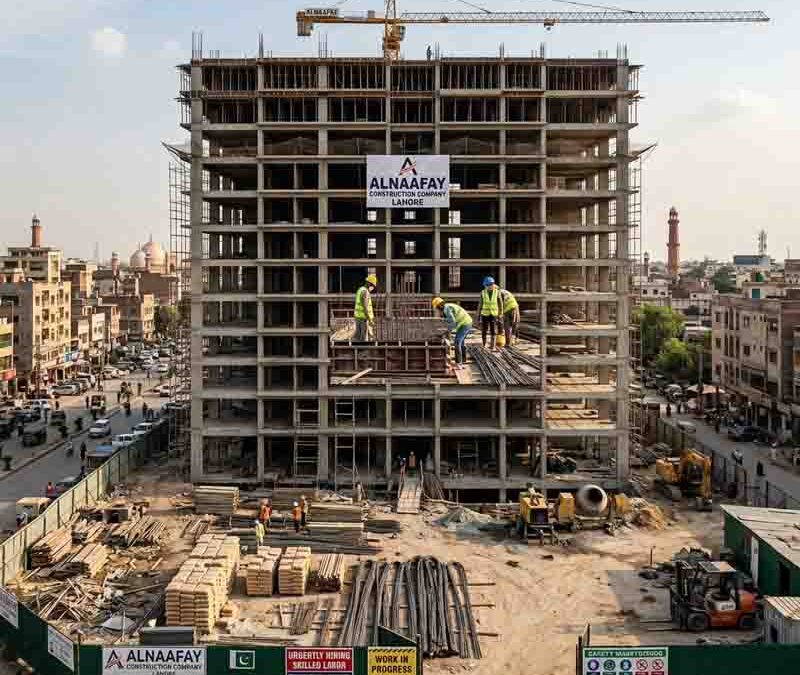
Construction Company Lahore and the Labor Shortage
The construction labor shortage is not exclusively a Western challenge. Rapidly developing cities in South Asia — including Lahore, Pakistan — are experiencing their own version of this crisis, shaped by unique local dynamics.
Lahore is one of Pakistan's most economically vibrant cities, with significant ongoing construction activity across residential, commercial, and infrastructure sectors. Demand for skilled construction workers — including electricians, masons, tile setters, welders, and equipment operators — is high and continuing to grow.
For any construction company in Lahore, the shortage of skilled labor presents a complex set of challenges. On one hand, there is a large population of potential workers. On the other hand, formal vocational training infrastructure has historically been underdeveloped, leaving many workers without the technical qualifications that more sophisticated projects require.
Furthermore, skilled construction workers from Pakistan have historically emigrated to the Gulf Cooperation Council (GCC) countries — including Saudi Arabia, the UAE, and Qatar — in pursuit of higher wages. This "brain drain" of skilled tradespeople further exacerbates the domestic labor shortage in cities like Lahore.
To address these challenges, construction companies in Lahore are increasingly partnering with technical training institutes and vocational centers to develop local talent pipelines. Additionally, some firms are implementing on-site mentorship programs, pairing experienced senior workers with younger apprentices to accelerate skill development.
Government initiatives, including those from Pakistan's National Vocational and Technical Training Commission (NAVTTC), are also working to expand access to skills training. However, more coordinated efforts between the public sector, private construction firms, and educational institutions will be necessary to meaningfully close the skills gap in Lahore's booming construction sector.
The experience of a construction company in Lahore highlights an important truth: the construction labor shortage is a global challenge, even if its specific causes and characteristics vary from one region to the next.
Effective Solutions to the Construction Labor Shortage
Rebuilding the Pipeline Through Vocational Education
Perhaps the most fundamental solution to the construction labor shortage is addressing it at its source — education. Schools, governments, and industry associations must work together to reverse the stigma around trades careers and actively promote construction as a viable, rewarding, and well-compensated professional path.
This means introducing construction and trades awareness programs in secondary schools, restoring shop and vocational courses that many schools eliminated over the past few decades, and showcasing the real earning potential of skilled trades careers. In many markets, an experienced electrician or plumber can out-earn a college graduate — a fact that is not widely communicated to young people making career decisions.
Expanding Apprenticeship Programs
Apprenticeships represent one of the most proven pathways into the construction trades. By pairing on-the-job training with classroom instruction, apprenticeships allow new workers to earn while they learn — making the trades accessible to people who cannot afford to attend school full-time.
Industry associations, unions, and individual construction companies can all play a role in expanding apprenticeship capacity. Moreover, governments can support this expansion through funding, tax incentives for companies that participate in registered apprenticeship programs, and outreach to under-represented populations.
Improving Workforce Diversity and Inclusion
The construction industry has historically been dominated by a relatively narrow demographic — primarily men from specific ethnic backgrounds. Expanding the workforce to include more women, minorities, and immigrants represents a significant opportunity to grow the talent pool.
Research consistently shows that diverse teams perform better and are more innovative. Beyond performance, however, diversity is simply a practical necessity given the scale of the labor gap. Programs specifically designed to recruit, train, and support women and minorities in construction trades have shown promising results in several markets. Consequently, scaling these programs could meaningfully reduce the shortage over time.
Enhancing Working Conditions and Employee Benefits
Attracting and retaining workers in a competitive labor market requires more than just a paycheck. Construction companies that offer comprehensive benefits — including health insurance, retirement plans, paid time off, and mental health support — are better positioned to attract quality candidates and keep them long-term.
Additionally, improving working conditions through better equipment, clearer safety protocols, and more predictable scheduling can make construction careers more appealing. Workers who feel valued, safe, and fairly compensated are far more likely to remain in the industry and encourage others to join.
The Role of Technology in Solving the Construction Workforce Crisis
Technology cannot replace skilled human workers in construction — but it can help the industry do more with fewer people. As a result, the strategic adoption of technology has become a critical component of addressing the construction workforce shortage.
Building Information Modeling (BIM)
Building Information Modeling, or BIM, allows architects, engineers, and construction teams to create detailed digital representations of a project before breaking ground. By identifying potential design conflicts and logistical challenges in advance, BIM reduces rework on the job site — which in turn reduces the labor hours required to complete a project. Therefore, companies that invest in BIM can stretch their available workforce further.
Prefabrication and Modular Construction
Prefabrication involves manufacturing building components — walls, floor panels, mechanical systems, and more — in a controlled factory environment, then assembling them on-site. Because factory production is generally more efficient than site-based construction, prefabrication can dramatically reduce the number of on-site labor hours required for a project.
Modular construction takes this concept even further, with entire rooms or building sections manufactured off-site. Both approaches also offer quality control advantages, since factory conditions are more controlled than a typical job site. Consequently, companies are increasingly exploring prefabrication as a way to combat the effects of the labor shortage.
Construction Robotics and Automation
Robots and automated systems are beginning to take on tasks in construction that were previously performed entirely by human workers. Bricklaying robots, automated concrete pouring systems, autonomous surveying drones, and AI-powered site monitoring tools are all emerging technologies that can supplement human labor.
While these technologies are still maturing and are not yet capable of fully replacing skilled workers, they can handle repetitive, physically demanding, or dangerous tasks — freeing human workers to focus on higher-skill activities. Over time, as these technologies become more affordable and capable, they are likely to play an increasingly important role in addressing the construction labor shortage.
Digital Workforce Management Tools
Modern workforce management software helps construction companies schedule workers more efficiently, track productivity in real time, and identify where additional labor is needed. By optimizing how existing workers are deployed, these tools can improve output without necessarily requiring more workers. Furthermore, better data on workforce utilization helps companies make smarter hiring and training investments.
How Governments Can Help Fix the Construction Labor Shortage
Governments at all levels — local, regional, and national — have both the responsibility and the tools to address the construction worker shortage. Their involvement is particularly important because the issue affects critical public interests, including housing affordability, infrastructure development, and economic growth.
Funding Vocational Training and Trade Education
Direct government investment in vocational training programs is one of the most impactful steps policymakers can take. This includes funding community colleges and trade schools, supporting union apprenticeship programs, and creating public-private partnerships that connect training institutions with employers.
In the United States, programs like the Carl D. Perkins Career and Technical Education Act provide federal funding for vocational education. However, advocates argue that significantly more investment is needed to match the scale of the labor shortage. Similarly, in other countries, expanding public investment in trades training is widely recommended by industry groups.
Reforming Immigration Policies to Support the Skilled Trades
Given the role that immigrant workers have historically played in meeting construction labor demand, immigration policy reform can be a powerful tool for addressing the shortage. Countries like Canada have successfully used point-based immigration systems that prioritize applicants with specific skills — including trades qualifications — that are in high demand domestically.
Expanding visa categories for skilled tradespeople, streamlining the credential recognition process for internationally trained workers, and creating clear pathways to permanent residency for workers who contribute to the construction workforce are all policy measures worth considering.
Incentivizing Industry Investment in Training
Governments can also encourage private-sector investment in workforce development through tax incentives, grants, and matching programs. When companies invest in training their workers, the entire industry benefits — so public support for these investments makes economic sense.
Additionally, government-funded marketing campaigns can help shift public perceptions of construction careers. By showcasing the earning potential, job security, and craftsmanship involved in skilled trades, these campaigns can help attract a new generation of workers.
Supporting Housing and Infrastructure Investment
Ironically, increased government spending on housing and infrastructure — while it creates additional demand for labor — can also help address the labor shortage by creating stable, long-term career opportunities that attract workers to the industry. When construction workers see a reliable pipeline of future projects, they are more likely to commit to long-term careers in the trade.
Moreover, large infrastructure programs often come with provisions for workforce training and apprenticeship participation, which can further expand the labor pool over time.
FAQs
What is the construction labor shortage, and why does it matter?
The construction labor shortage refers to the significant gap between the demand for construction workers and the available supply of qualified workers. It matters because it leads to project delays, higher construction costs, reduced quality, and broader economic impacts. Communities depend on construction activity for housing, infrastructure, and economic development — so a shortage of workers directly affects quality of life.
What are the main causes of the construction labor shortage?
The shortage results from several overlapping factors, including the retirement of baby boomer workers, declining enrollment in vocational and trades training programs, the physical demands of construction work, the lasting impact of the COVID-19 pandemic on labor markets, and changes in immigration policies that have reduced the flow of foreign workers into the industry.
How does the construction labor shortage affect housing affordability?
When labor is scarce, construction costs rise because wages increase as companies compete for a smaller pool of workers. Those higher labor costs are reflected in the final price of homes and commercial buildings. Consequently, the shortage contributes to housing affordability challenges in many markets by making it more expensive to build new homes.
What can construction companies do to address the labor shortage?
Construction companies can take several practical steps, including investing in apprenticeship and training programs, improving working conditions and benefits to attract and retain workers, embracing diversity and inclusion initiatives to expand the talent pool, adopting technologies that improve labor efficiency, and partnering with vocational schools to build a pipeline of future workers.
How is technology helping address the construction workforce shortage?
Technology is helping in several ways. Building Information Modeling (BIM) reduces rework and improves planning efficiency. Prefabrication and modular construction reduce on-site labor requirements. Robotics and automation handle repetitive or dangerous tasks. Digital workforce management tools help companies deploy their existing workers more effectively. Together, these technologies allow the industry to produce more output with the workers currently available.
What role should governments play in solving the construction labor shortage?
Governments can invest in vocational training and trade education, reform immigration policies to attract skilled workers from abroad, provide tax incentives for companies that invest in worker training, and promote construction careers through public awareness campaigns. Additionally, stable government investment in housing and infrastructure creates the long-term demand that encourages workers to pursue and stay in construction careers.
Is the construction labor shortage a global problem?
Yes. While the specifics vary by country and region, the construction worker shortage is a widespread global challenge. Countries including the United States, the United Kingdom, Australia, Canada, Germany, and Pakistan are all experiencing some form of this crisis. As urbanization continues and infrastructure needs grow, addressing the shortage is a pressing priority around the world.
Conclusion
The construction labor shortage is one of the defining challenges of our time. It is not a problem that will resolve itself — and it is not a problem that any single company, government, or initiative can solve alone. Instead, addressing the shortage requires a coordinated, multi-pronged approach that spans education reform, immigration policy, technological innovation, workplace culture change, and sustained public and private investment.
For construction companies, the path forward begins with honest self-assessment. Are you investing in training the next generation of workers? Are your working conditions and compensation packages genuinely competitive? Are you embracing technology to maximize the productivity of your existing team? These are not just strategic questions — they are survival questions in a market defined by scarcity.
For policymakers, the challenge is equally urgent. Infrastructure backlogs, housing shortages, and aging public facilities cannot wait indefinitely for the workforce problem to sort itself out. Bold, targeted investment in vocational training, smarter immigration pathways, and public awareness campaigns are not optional extras — they are essential components of a functioning construction economy.
For young people considering their career options, the construction trades deserve serious consideration. The labor shortage, while a problem for the industry, represents a significant opportunity for individuals. Skilled tradespeople are in high demand, command strong wages, and enjoy job security that many white-collar careers cannot match.
The construction labor shortage is real, it is serious, and it is growing. However, with the right combination of practical solutions, smart policies, and genuine commitment from all stakeholders, it is also solvable. The built environment of tomorrow depends on the decisions we make today — and those decisions start with treating the construction workforce crisis with the urgency it deserves.
