
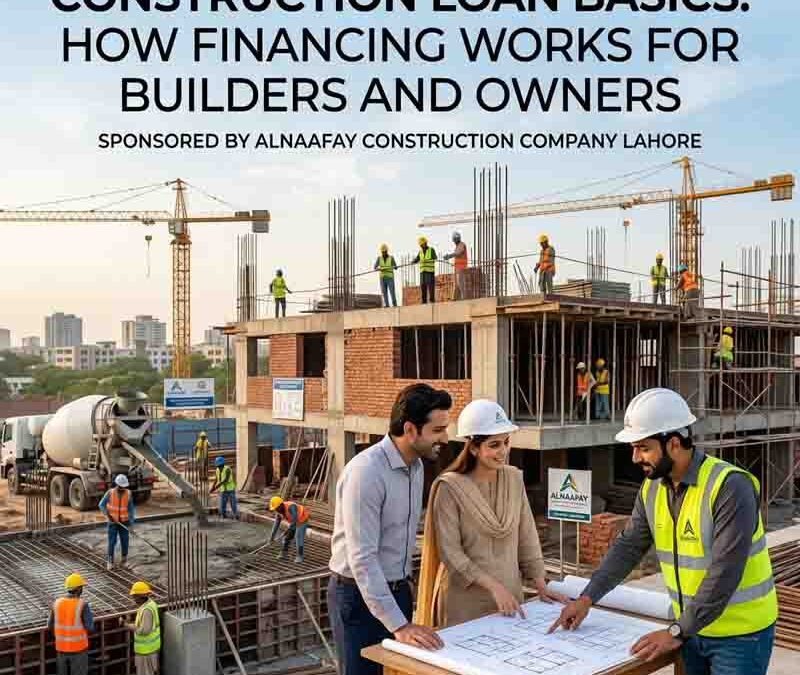
Construction Loan Basics: How Financing Works for Builders and Owners
Building a property from the ground up is one of the most significant financial decisions you can make. Whether you are a homeowner planning your dream home or a builder managing multiple projects, understanding construction loan basics is the first step toward a successful build. This guide breaks down everything you need to know — from how financing works to what lenders expect from you at every stage.
Table of Contents
- What Is a Construction Loan?
- How Construction Loan Financing Works for Builders and Owners
- Types of Construction Loans
- How to Qualify for a Construction Loan
- The Construction Loan Process Step by Step
- Construction Loan Interest Rates and Costs
- Differences Between Construction Loans and Traditional Mortgages
- Risks and Challenges of Construction Financing
- Tips for Builders and Owners to Manage Construction Loans
- Construction Company Lahore
- Frequently Asked Questions
- Conclusion
1. What Is a Construction Loan?
A construction loan is a short-term financing product designed specifically to fund the building of a new property. Unlike a standard mortgage, which helps you purchase a home that already exists, a construction loan covers the cost of creating one from scratch. This includes paying for land, labor, building materials, permits, and contractor fees.
The basics of construction loan financing are straightforward: you borrow money to build, and you repay it — either by converting the loan into a permanent mortgage or by refinancing once the project is complete. Most construction loans run for 12 to 18 months, covering the duration of the build. After that, the borrower transitions into a long-term repayment structure.
Construction loans are available to individual homeowners, professional builders, real estate investors, and small business owners. Each type of borrower faces slightly different requirements, but the core structure of the loan remains consistent across the board.
2. How Construction Loan Financing Works for Builders and Owners
Understanding how construction financing works is essential before you approach a lender. The most important thing to know is that funds are not handed over all at once. Instead, the lender releases money in stages called draws, and each draw is tied to a completed milestone in the construction process.
Here is how the draw process typically works:
- Foundation and site work — approximately 10 to 15% of funds released
- Framing and roof completion — approximately 20 to 25% released
- Rough mechanicals (plumbing, electrical, HVAC) — approximately 15 to 20% released
- Insulation and drywall — approximately 10 to 15% released
- Interior finishes, trim, and fixtures — approximately 15 to 20% released
- Final completion and landscaping — approximately 10 to 15% released
Before each draw is approved, a lender-appointed inspector visits the site to verify that the work has been completed to the required standard. Only after the inspection passes does the next portion of funds get released.
During the construction phase, borrowers make interest-only payments on the amount already drawn — not on the full loan amount. This reduces your monthly costs while the project is underway. Once the build is finished, the loan either converts to a permanent mortgage or is paid off through refinancing.
For builders managing multiple projects at once, this draw structure directly affects cash flow. A slow inspection turnaround means delayed payments to subcontractors, which can slow the entire project down. Choosing a lender who offers fast inspection turnaround — ideally within 24 hours — is a practical way to keep your timeline on track.
3. Types of Construction Loans
Not every borrower has the same needs, and lenders offer several types of construction loan structures to reflect that. Here is a breakdown of the most common options.
Construction-to-Permanent Loan
Also known as a one-time close loan, this option combines the construction phase financing and the permanent mortgage into a single loan. When the build is complete, the loan automatically converts to a traditional mortgage — without requiring a second application or closing. This saves time, money, and paperwork. It is a particularly strong choice for owner-occupants who want a streamlined process.
Construction-Only Loan
This type of loan, sometimes called a two-close loan, covers only the construction phase. Once the project is finished, you apply for a separate permanent mortgage to pay off the construction loan. The advantage here is flexibility — if your credit score improves during the build, or if mortgage rates drop, you have the opportunity to shop for better permanent financing terms. The trade-off is that you pay two sets of closing costs.
Owner-Builder Loan
An owner-builder loan is designed for borrowers who want to act as their own general contractor. These loans come with stricter requirements because lenders view them as higher risk. Most lenders require you to demonstrate prior construction experience, hold a valid contractor license, or produce detailed evidence of project management capability. Without that proof, approval can be difficult to secure.
FHA One-Time Close Construction Loan
Backed by the Federal Housing Administration, this loan combines construction and permanent financing into one package with a lower down payment requirement than conventional loans. It is available for primary residences only and is a strong option for first-time builders who may not have a large cash reserve.
VA Construction-to-Permanent Loan
Available to eligible veterans and active-duty service members, this loan combines construction financing with a permanent VA mortgage. It typically requires no down payment and offers competitive interest rates. As with the FHA option, it is intended for primary residences only.
4. How to Qualify for a Construction Loan
Qualifying for a construction loan requires more preparation than a standard mortgage application. Because the lender is financing a property that does not yet exist, they apply stricter criteria to reduce their risk. Here is what you need to meet before you apply.
Credit Score
Most lenders require a minimum credit score of 680 to approve a construction loan application. Scores between 700 and 739 unlock more competitive interest rates and flexible loan terms. Borrowers with scores of 740 or above typically access the best rates and the highest loan-to-cost ratios. If your score falls below 680, focus on paying down existing debt and addressing any errors on your credit report before applying.
Debt-to-Income Ratio
Lenders prefer a debt-to-income (DTI) ratio at or below 43 to 45 percent. For builders with multiple active projects, this calculation can become complex because each active loan affects your overall debt exposure. You can improve your DTI by paying off outstanding debts or increasing your documented income before submitting your application.
Down Payment
Construction loan basics include understanding that the down payment requirement is considerably higher than for a standard mortgage. For owner-occupied builds, expect to put down 20 to 25 percent of the total project cost. Spec builds and investment properties generally require 25 to 30 percent. If you already own the land, its appraised value can be applied toward your down payment — at current market value, not the original purchase price.
Detailed Construction Plans and Documentation
Lenders need to see complete project documentation before they will release a single dollar. This includes:
- Stamped architectural plans from a licensed architect or engineer
- An itemized construction budget with subcontractor bids
- A project timeline showing critical milestones
- Proof of builder's license and current insurance coverage
- Building permits or evidence that permits are obtainable
Builder Credentials
If you are hiring a general contractor, the lender will verify their license, insurance coverage, and track record of completed projects. Builders with a strong portfolio of successfully finished work close loans faster and secure better terms than those with limited documented experience.
As-Completed Appraisal
Lenders also require an independent appraisal that estimates the market value of the property once construction is finished. If this appraisal comes in lower than your projected value, it can affect the loan amount you are approved for. Work with an experienced local appraiser and provide detailed project specifications to support the highest defensible valuation.
5. The Construction Loan Process Step by Step
The construction loan basics process follows a clear sequence of steps. Knowing each stage in advance allows you to prepare your documents early and move through approval faster.
Step 1 — Pre-Qualification: Contact a lender and provide basic financial information, including your credit score, income, existing debt obligations, and an overview of the project. The lender gives you a preliminary picture of what you can borrow.
Step 2 — Choose Your Rate Structure: Decide whether you want a fixed or variable interest rate for the construction phase. Variable rates are tied to an index like the prime rate and can fluctuate during the build. Fixed rates offer predictability. Discuss the trade-offs with your lender before deciding.
Step 3 — Gather Documentation: Collect all required materials — tax returns, bank statements, construction plans, builder contracts, insurance certificates, and permits. The more complete your submission, the faster your application moves through underwriting.
Step 4 — Submit the Loan Application: File your formal application with the lender. Underwriters will review your financial profile, the project documentation, and the as-completed appraisal. Builders who present organized, complete packages typically receive approval decisions in 15 to 20 business days. Incomplete applications can extend this to 60 to 90 days.
Step 5 — Loan Approval and Terms Review: Once approved, review the draw schedule, interest rate, loan-to-cost ratio, and inspection process with your lender before signing.
Step 6 — Construction Begins and Draws Are Released: As your project hits each milestone, request a draw, schedule an inspection, and receive the next tranche of funds. Keep detailed records at every stage.
Step 7 — Conversion or Payoff: At completion, convert to a permanent mortgage or refinance through a separate lender. Your loan officer should walk you through both options in detail before the construction phase ends.
6. Construction Loan Interest Rates and Costs
Construction loan interest rates are consistently higher than rates on traditional mortgages. In most markets, construction rates run 1 to 2 percentage points above conventional mortgage rates. This premium exists because lenders carry more risk — they are financing an asset that does not yet exist and can be difficult to liquidate if the borrower defaults.
Several factors influence the rate you are offered:
- Credit score: Higher scores unlock lower rates. Borrowers at 740 or above consistently receive the best offers.
- Down payment size: A larger down payment reduces lender risk and often results in a lower rate.
- Loan-to-cost ratio: The lower your loan amount relative to total project cost, the more favorable your terms.
- Project documentation: Well-organized, complete applications signal a lower-risk borrower.
- Lender type: Private lenders may offer faster approvals but often charge higher rates than traditional banks or credit unions.
In addition to interest, budget for closing costs (typically 2 to 5 percent of the loan amount), inspection fees at each draw, and a contingency reserve of 10 to 15 percent of total construction costs. Experienced builders include the contingency reserve in their budgets from day one — because cost overruns are common, and being underfunded mid-project is one of the most serious problems you can face.
During the construction phase, you pay interest only on the amount drawn — not on the full approved loan amount. This structure reduces your monthly financial burden while the project is underway. Once the loan converts to permanent financing, full principal and interest payments begin.
7. Differences Between Construction Loans and Traditional Mortgages
Many borrowers come to the construction loan process assuming it works like a standard mortgage. The two products are fundamentally different in several important ways.
Feature | Construction Loan | Traditional Mortgage |
|---|---|---|
Purpose | Fund new construction | Purchase existing property |
Loan term | 12 to 18 months | 15 to 30 years |
Fund distribution | Released in draws | Paid as a lump sum at closing |
Interest payments | Interest-only on drawn amount | Full principal and interest from month one |
Down payment | 20 to 30 percent | 3 to 5 percent (conventional) |
Interest rate | Higher by 1 to 2 percentage points | Lower — backed by existing collateral |
Approval process | More comprehensive; requires project documentation | Standard income, credit, and appraisal review |
Inspections | Required at each draw milestone | Not required during repayment |
Collateral | Future value of the completed property | The existing property itself |
The approval process for a construction loan is more comprehensive than a standard mortgage, largely because the lender is evaluating the project as much as the borrower. They want to see evidence that the build will be completed on schedule, on budget, and at or above the appraised value. Traditional mortgage underwriters do not carry that same burden.
8. Risks and Challenges of Construction Financing
Understanding construction loan basics means being honest about the risks involved. Construction financing carries more variables than a standard mortgage, and several of those variables are outside your direct control.
Cost Overruns
Material prices can change significantly over a 12 to 18-month build. Labor shortages, supply chain disruptions, and design changes mid-project can push costs well above your initial budget. Without a contingency reserve, cost overruns can halt construction entirely if your loan amount is exhausted.
Construction Delays
Weather, permitting delays, contractor scheduling conflicts, and material backlogs can all extend your timeline. Because construction loans are short-term, a significant delay can push you past your loan maturity date — forcing an extension negotiation with your lender, which often comes with additional fees and potentially a rate adjustment.
Draw Delays and Cash Flow Problems
If your lender's inspection process takes seven to ten business days instead of 24 to 48 hours, your subcontractors wait longer to be paid. Repeated draw delays can damage your relationships with contractors, cause skilled workers to move to other projects, and ultimately slow your timeline further.
Interest Rate Volatility
Many construction loans carry variable interest rates. In a rising rate environment, your monthly interest payments can increase materially during the construction phase. Before signing, ask your lender whether a rate lock is available and what the cost of that protection is.
Incomplete or Inaccurate Documentation
Lenders can and do revoke or delay approval when submitted documentation is incomplete. If your budget understates actual costs, or your timeline is unrealistically optimistic, underwriters will return the application with requests for revision — adding weeks to your approval timeline.
Contractor Issues
A builder who loses their license, becomes insolvent, or abandons the project mid-build creates serious problems for your loan. Verify contractor credentials before signing any agreement, and ensure your lender is notified immediately of any changes to the contracting team.
9. Tips for Builders and Owners to Manage Construction Loans
Managing the construction loan process successfully requires preparation, organization, and proactive communication with your lender. Here are the most practical steps you can take.
Build your credit score to 700 or above before applying. Spend 6 to 12 months before your application paying down revolving debt, making on-time payments, and reviewing your credit report for errors. This single step has the largest impact on the rate you are offered.
Keep your DTI ratio below 45 percent. Pay off smaller balances and avoid taking on new debt in the months before applying. For self-employed builders, work with an accountant to ensure your tax returns accurately reflect your income.
Build a complete documentation package before you submit. Organize stamped plans, itemized budgets, subcontractor bids, permits, and insurance certificates into a single, well-labeled submission. Lenders reward organized applicants with faster decisions.
Include a 10 to 15 percent contingency reserve in your budget. Never submit a budget that assumes everything goes exactly as planned. Contingency reserves protect you against cost overruns without requiring you to return to your lender mid-build.
Ask every lender about inspection turnaround times before you commit. A lender who takes 10 days to inspect each milestone will slow your project more than a slightly higher interest rate. Fast inspections matter for cash flow.
Choose licensed, insured contractors with documented track records. Your lender will verify their credentials regardless. Save time by selecting qualified contractors from the beginning and keeping copies of all licenses and insurance certificates on file.
Communicate proactively with your lender. If a delay is coming, notify your lender before it happens — not after. Lenders are generally more flexible with borrowers who keep them informed than with those who go quiet when problems arise.
Shop at least three lenders before committing. Rates, draw processes, inspection timelines, and loan structures vary significantly between lenders. Comparing multiple offers gives you both negotiating leverage and a clearer picture of the market.
10. Construction Company Lahore
If you are planning a residential or commercial build in Lahore, Pakistan, working with an established local construction company is one of the most important decisions you will make. Lahore's real estate sector has experienced significant growth over the past decade, driven by increasing demand for housing, large-scale infrastructure development, and the expansion of modern commercial zones such as DHA, Bahria Town, and Gulberg.
A reputable construction company in Lahore brings several advantages to your project that directly affect your ability to secure and manage construction financing:
Local regulatory knowledge: Lahore's development authority (LDA) and cantonment boards have specific permitting, zoning, and approval requirements. A local company navigates these processes efficiently, reducing the risk of permitting delays that can extend your project timeline and complicate loan management.
Established supplier networks: Experienced Lahore-based builders maintain long-standing relationships with local material suppliers, which often means better pricing and more reliable delivery schedules. Consistent material availability reduces the risk of mid-project cost overruns.
Documented project track records: If your financing source requires proof of contractor credentials and completed project history — as most construction lenders do — a well-established construction company in Lahore can provide exactly that documentation. Their portfolio of completed builds serves as direct evidence of delivery capability.
Familiarity with local cost benchmarks: An experienced local company provides realistic cost estimates that reflect Lahore's current labor and material pricing. Accurate cost data supports your loan application and makes the as-completed appraisal process more straightforward.
When evaluating a construction company in Lahore, verify their PCATP (Pakistan Council of Architects and Town Planners) affiliations, check for proper business registration, review completed project references, and confirm that they carry liability and workers' compensation coverage. A company that provides clear, itemized construction contracts — with milestones, payment schedules, and defined deliverables — will make your loan draw process significantly smoother.
Regardless of whether your financing comes from a local bank, a development finance institution, or a private lender, the quality and credibility of your construction company in Lahore will influence how quickly your loan is approved and how smoothly your project is funded throughout the build.
11. Frequently Asked Questions
What is the difference between a construction loan and a home equity loan?
A construction loan funds the building of a new property. A home equity loan lets you borrow against the existing equity in a property you already own. The two products serve entirely different purposes and come with different qualification criteria, term lengths, and repayment structures.
Can I use a construction loan to renovate an existing home?
Standard construction loans are typically designed for new builds. However, renovation-specific financing products — such as the FHA 203(k) loan or a construction-to-permanent loan with a renovation component — are available for significant renovation projects. Speak with your lender about which product fits your project scope.
How long does it take to get approved for a construction loan?
Approval timelines vary based on documentation completeness and lender processes. Borrowers who submit complete, well-organized applications are typically approved in 15 to 20 business days. Incomplete submissions can extend the process to 60 to 90 days or longer.
What happens if my construction project goes over budget?
If costs exceed your approved loan amount, you will need to cover the difference with personal funds, negotiate a loan modification with your lender, or secure additional financing. This is why building a 10 to 15 percent contingency reserve into your original budget is one of the most important preparation steps you can take.
Do I make monthly payments during the construction phase?
Yes. During the construction phase, you make interest-only payments on the amount that has been drawn — not on the full loan amount. This keeps your monthly costs lower while the project is underway. Full principal and interest payments begin after the loan converts to permanent financing.
What credit score do I need for a construction loan?
Most lenders require a minimum credit score of 680. However, scores of 700 or above give you access to more competitive interest rates. Scores of 740 or above unlock the best terms available. If your current score falls below 680, focus on reducing your debt and correcting any credit report errors before applying.
What is an as-completed appraisal?
An as-completed appraisal is an independent estimate of your property's market value once construction is finished. Lenders require this before approving a construction loan because they need to verify that the completed property will be worth enough to serve as adequate collateral. If the appraisal comes in lower than expected, it can reduce the loan amount you are approved for.
Can a builder use a construction loan for multiple projects at once?
Yes, builders can hold multiple construction loans simultaneously. However, each active loan is counted against your debt-to-income ratio, which can complicate qualification for additional financing. Builders managing multiple projects benefit from working with lenders who understand the structure of construction businesses and can evaluate their financial situation accordingly.
12. Conclusion
Construction loan basics are not complicated once you understand what lenders are evaluating and why. The draw structure, the documentation requirements, the credit and DTI thresholds, and the draw inspection process all exist for a clear reason: lenders are financing a property that has not been built yet, and they need confidence that you can deliver a completed project on time and on budget.
Whether you are an individual building your first home or a professional builder managing a pipeline of projects, the fundamentals remain the same. Strong credit, detailed documentation, a realistic budget with a contingency reserve, and a credentialed contracting team are the building blocks of every successful construction loan application.
For projects in Lahore, partnering with a reputable, experienced construction company in Lahore gives your financing application the credibility and documentation it needs to move through approval quickly. Local knowledge, established contractor credentials, and a clear track record of completed builds all directly support your ability to access and manage construction financing effectively.
Start by reviewing your financial profile, organizing your project documentation, and reaching out to at least three lenders to compare terms. The more prepared you are before your first conversation with a lender, the faster and more smoothly your construction loan process will move from application to approved.
