
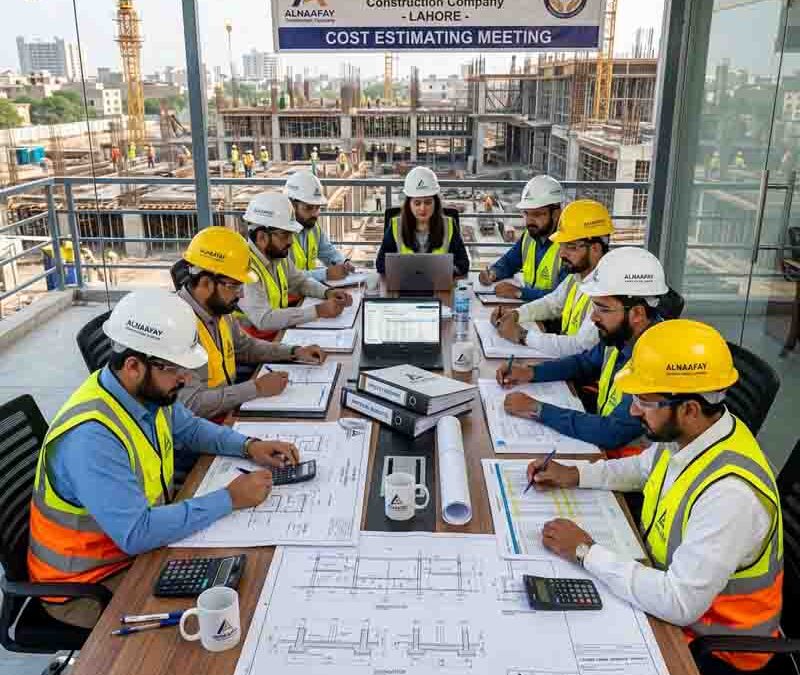
How to Create an Accurate Construction Cost Estimate: A Complete Step-by-Step Guide
Getting a construction cost estimate wrong is not just a minor inconvenience. It can derail an entire project, strain client relationships, and cause serious financial losses. Whether you are building a small residential home or a large commercial complex, the accuracy of your estimate sets the tone for everything that follows.
This guide walks you through exactly how to build a reliable construction cost estimate from the ground up. By the end, you will understand what goes into one, why it matters, which mistakes to avoid, and how professionals—including construction companies in Lahore—approach the process.
Table of Contents
- What Is a Construction Cost Estimate?
- Why an Accurate Construction Cost Estimate Matters
- Key Components of a Construction Cost Estimate
- Step-by-Step Guide to Creating an Accurate Construction Cost Estimate
- Common Mistakes That Make Construction Cost Estimates Inaccurate
- Tools and Methods Used for Construction Cost Estimating
- How a Construction Company in Lahore Approaches Cost Estimation
- Tips for Owners and Contractors to Improve Estimate Accuracy
- Frequently Asked Questions
- Conclusion
1. What Is a Construction Cost Estimate?
A construction cost estimate is a detailed projection of how much a building project will cost to complete. It covers everything from raw materials and labor to equipment, overhead, insurance, and contingency funds. In short, it answers the question every project owner and contractor needs answered before breaking ground: how much is this going to cost?
However, a construction cost estimate is not simply a list of prices. It is a complex, structured process that requires a thorough understanding of project scope, local market rates, construction methods, building codes, and risk factors. The estimate evolves as the project progresses—starting as a rough ballpark in the early stages and becoming increasingly detailed and precise as more information becomes available.
According to the American Society of Professional Estimators, estimates are typically classified across a five-level system, ranging from rough order-of-magnitude estimates (with accuracy margins as wide as ±30%) to highly detailed definitive estimates with variances as small as ±2%. Understanding where your estimate falls within this spectrum is the first step toward producing one that is truly useful.
Essentially, a construction cost estimate revolves around three core activities: quantifying the materials, labor, and equipment needed; selecting materials that align with the project's specifications and budget; and pricing every item based on current market rates.
2. Why an Accurate Construction Cost Estimate Matters
The stakes attached to a construction project budget estimate are high on every side of the equation. For contractors, an inaccurate estimate can mean the difference between winning a profitable bid and walking away from a job that bleeds money. Overestimating pushes clients toward competitors. Underestimating results in financial losses that can be difficult to recover from.
For project owners, a reliable estimate provides the foundation for sound financial decision-making. It helps determine whether a project is feasible, guides conversations with lenders and investors, and sets expectations for the entire build.
Research consistently shows that budget and time overruns are among the top causes of stress for project leaders. According to Runn, budget and time limitations outrank challenges like change management and team development as the leading sources of project leader stress. Furthermore, a study examining construction in developing economies found that cost overruns and delays are widespread problems, often stemming from poor pre-construction planning and inadequate estimation.
The consequences of inaccuracy go beyond financial strain. Missed budgets damage client trust, delay project timelines, create disputes between contractors and subcontractors, and can permanently harm a company's reputation. Therefore, producing an accurate construction cost estimate is not just a professional best practice—it is a business-critical skill.
3. Key Components of a Construction Cost Estimate
Before you can build an accurate estimate, you need to understand what it is made of. A well-structured construction project cost estimate includes two broad categories of costs: direct costs and indirect costs.
Direct Costs
Direct costs are those directly tied to the physical construction of the project. These include:
- Materials: The raw and finished materials required to build the structure, such as concrete, steel, lumber, brick, insulation, and finishes.
- Labor: The wages of all workers involved in on-site construction, from skilled tradespeople to general laborers.
- Equipment: The cost of purchasing, renting, or operating machinery such as cranes, excavators, and concrete mixers.
- Subcontractors: Fees paid to specialized contractors for tasks like electrical work, plumbing, HVAC, and roofing.
- Permits and bonds: Permit fees and surety bonds are also considered direct costs and must be specifically listed in the estimate.
Indirect Costs
Indirect costs are incurred during the project but are not tied to any specific construction task. These fall into two subcategories:
- Main office overhead: This includes estimator salaries, office rent, utilities, legal services, insurance, and equipment depreciation. These are typically calculated as a percentage of the total project cost.
- Job site overhead: These are site-specific costs that support the whole project but are not tied to a single task. Examples include temporary fencing, trailers, barricades, signage, and portable sanitation facilities.
Insurance and Bonds
Including adequate insurance in your construction cost estimate is essential. Common insurance types to factor in include General Liability Insurance, Builder's Risk Insurance (covering damage to the structure during construction), and Professional Liability Insurance. Alongside insurance, bonding costs—such as performance bonds, payment bonds, and bid bonds—must be clearly itemized in the estimate.
Profit Margin and Contingency
Finally, a realistic construction budget estimate must include a profit margin and a contingency allowance. The contingency is a buffer set aside to absorb unforeseen costs. Skipping this step is one of the most common and costly mistakes estimators make.
4. Step-by-Step Guide to Creating an Accurate Construction Cost Estimate
Now that you understand what a construction cost estimate contains, here is how to build one accurately.
Step 1: Define and Capture the Full Scope of Work
The scope of work is the foundation of your entire estimate. In fact, industry research suggests that approximately 80% of the estimating process is spent understanding the project scope—and up to 90% of all errors in a construction cost estimate can be traced back to scope-related issues.
Defining the scope means reviewing all available construction documents, including architectural drawings, engineering plans, and project specifications. These documents tell you exactly what is being built, which materials are specified, and what quality standards must be met.
Equally important is conducting a physical site visit. Walking the project site reveals ground-level realities that documents cannot fully capture—such as access challenges, existing utility lines, soil conditions, and environmental considerations. All of these factors affect cost.
Three common scope-related errors to watch for are omissions (missing items entirely), mismatched units of measurement, and calculation mistakes. Double-checking each of these areas before moving forward is a simple habit that pays dividends.
Step 2: Perform a Material Quantity Takeoff
Once the scope is defined, the next step is a quantity takeoff—sometimes called a material takeoff. This is the process of compiling a complete list of every material, piece of equipment, and labor task required to complete the project.
For smaller or straightforward projects, the takeoff list may be relatively brief. For larger builds or new construction, however, it can be extensive and complex. Several practical tips help ensure accuracy during this stage:
- Group similar materials together to maintain organization and avoid double-counting.
- Use digital tools such as CAD or BIM software to take measurements directly from plans, which reduces human error.
- Follow the order of construction when listing items—start with foundations and work upward systematically.
- Round quantities up slightly to account for waste, breakage, or minor design changes that occur during the build.
- Verify the scale of blueprints before taking measurements, since an incorrect scale can lead to serious quantity errors.
Any mistakes made during the takeoff phase will carry through to every subsequent stage of the estimate. Consequently, this step demands careful, methodical attention.
Step 3: Price All Materials, Labor, and Equipment
After the quantities are established, each item must be assigned a price. This is where a construction cost estimate transforms from a list of quantities into an actual dollar figure.
Pricing can come from multiple sources. These include supplier quotes, subcontractor bids, online cost databases, historical project data, and published cost guides. Using current, project-specific pricing is critical. Generic or outdated data leads to estimates that simply do not reflect the real world.
A useful rule of thumb from RSMeans, one of the most respected sources of construction cost data: using up-to-date and comprehensive cost data is essential. You should have a clear understanding of all costs involved, including labor productivity rates, equipment operating costs, and location-specific pricing factors.
Direct costs—materials, labor, equipment, and subcontractor fees—should be listed line by line. Indirect costs such as overhead and profit margin are then calculated as a percentage of the project total and added at the end.
Step 4: Factor In Contingencies and Risk
After all direct and indirect costs are calculated, a responsible construction project cost estimate includes a contingency allowance. Most industry professionals recommend setting aside between 5% and 15% of the total estimated cost as a contingency, depending on how well-defined the project scope is and the level of risk involved.
Additionally, you should conduct a risk assessment at this stage. Identify potential risks such as weather delays, permitting issues, price volatility in materials, or supply chain disruptions. Each identified risk should inform either the contingency amount or a specific risk mitigation strategy.
Step 5: Validate and Cross-Check the Estimate
The final step is validation. Every well-constructed construction cost estimate must be reviewed before it is submitted or used to make financial decisions.
Validation involves cross-checking your numbers against comparable projects, reviewing subcontractor quotes for reasonableness, and applying common sense. As RSMeans notes, while data is more abundant than ever, there is still no substitute for experienced professional judgment. Ask yourself: do these numbers make sense given the size, location, and complexity of this project?
Ideally, a second qualified estimator should review the estimate independently. Fresh eyes catch errors that the original estimator might overlook. Furthermore, aligning estimates with a standardized framework—such as the CSI MasterFormat divisions, which cover all aspects of a construction project from concrete to mechanical systems—helps ensure nothing is overlooked.
5. Common Mistakes That Make Construction Cost Estimates Inaccurate
Even experienced estimators make mistakes. Understanding the most common pitfalls is the first step toward avoiding them.
Skipping the Site Visit
Failure to visit the project site is one of the most frequently cited causes of inaccurate construction cost estimates. Without seeing the site firsthand, an estimator cannot account for access issues, poor soil conditions, or existing infrastructure that may complicate the build.
Relying on Outdated or Generic Data
Using old pricing data or national averages instead of current, local market rates leads to estimates that are out of step with reality. Material costs and labor rates change rapidly, particularly in volatile markets. Therefore, always verify pricing against current sources before finalizing any estimate.
Underestimating Scope Creep
Scope changes occur on nearly every project. However, many estimators fail to build adequate contingencies for this reality. Analyzing historical data to identify where scope typically expands—and building those allowances into the estimate from the start—is a proactive approach that protects project budgets.
Inaccurate Quantity Takeoffs
A shaky takeoff produces a shaky estimate. Missing a material category, misreading a plan, or failing to account for a design addendum can result in significant cost overruns. Using digital takeoff tools and following a systematic, top-to-bottom approach reduces this risk considerably.
Underestimating Labor Costs
Labor is often the most volatile element of a construction project budget estimate. Failing to account for overtime rates, prevailing wages, union requirements, or realistic productivity curves can throw the entire estimate off. Always use current, location-specific labor data.
Insufficient Contingency Planning
Not reserving adequate contingency funds leaves a project exposed. Unexpected events—from weather delays to sudden material price increases—are not exceptional circumstances. They are a predictable feature of construction. Building in contingency is not pessimism; it is good practice.
Poor Communication with Subcontractors and Suppliers
Estimates built in isolation frequently contain gaps. When subcontractors and suppliers are not consulted early and thoroughly, the resulting numbers may not reflect realistic market pricing. Clear, timely communication with all parties is essential to producing a reliable estimate.
Ignoring Past Project Data
Each completed project is a source of valuable data. Comparing actual project costs to original estimates reveals patterns—where estimates tend to be too low, which materials consistently run over, which subcontractor categories are most unpredictable. Systematically capturing and using this data improves every future estimate.
6. Tools and Methods Used for Construction Cost Estimating
A variety of methods and tools are available to help estimators produce accurate construction cost estimates.
Estimating Methods
- Analogous estimating uses data from similar past projects as a baseline. It is best suited to early-stage estimates when project details are still limited.
- Parametric estimating applies statistical algorithms and historical data to calculate costs based on measurable project parameters, such as square footage.
- Bottom-up estimating is the most detailed approach. It estimates costs at the individual task or activity level, then rolls them up to produce a project-wide total. Consequently, it is the most accurate method, particularly for complex projects.
- Three-point estimating calculates three scenarios—optimistic, pessimistic, and most likely—then uses a weighted formula to arrive at an expected cost that accounts for uncertainty.
- Square footage estimating applies an average cost per square foot, derived from comparable completed projects, to estimate total construction cost. It is quicker than bottom-up estimating but less precise.
- Unit cost estimating breaks the project into its smallest components, assigning a specific cost to each unit of material and labor. RSMeans describes this as the most accurate approach, typically within -5% to +10% of actual costs, when detailed design information is available.
Software and Digital Tools
Modern construction cost estimating software has transformed the estimating process. Cloud-based platforms allow teams to collaborate in real time, maintain version-controlled documents, and generate estimates from digital takeoffs.
Tools like Autodesk Forma Estimate and ProEst provide comprehensive cost databases, automated workflows, and integrated takeoff capabilities. BIM software allows estimators to extract quantities directly from 3D models, reducing manual measurement errors significantly.
Additionally, cloud-based cost management tools provide ongoing visibility into project costs once construction begins, making it easier to track actual spending against the original estimate and flag early warning signs of overruns.
7. How a Construction Company in Lahore Approaches Cost Estimation
Lahore's construction market is dynamic, competitive, and subject to rapid price fluctuations in both materials and labor. For any construction company in Lahore, producing a reliable construction cost estimate requires not only technical skill but also a current understanding of local market conditions.
Reputable construction companies in Lahore typically approach cost estimation in four progressive stages, each building on the last as more project information becomes available.
Stage 1 — Order of Magnitude Estimate: Created during the pre-design phase, this rough estimate assesses whether a project is financially feasible. With an accuracy range of -25% to +50%, it is intended to be directional rather than precise. For example, for a 5-marla house in Lahore, this estimate gives a broad cost range based on plot size and location.
Stage 2 — Schematic Design Estimate: As initial layouts and sketches take shape, a more refined estimate is developed. This estimate incorporates the number of rooms, structural elements, and basic material choices. It carries a margin of error of approximately 15–20% and helps determine whether the project should proceed with the current design or be adjusted.
Stage 3 — Design Development Estimate: This stage produces a more detailed cost projection based on specific drawings and unit costs—for instance, the cost per square foot of flooring or the current rate for steel reinforcement in the Lahore market. With an accuracy margin of roughly 10%, this estimate is reliable enough to support major financial decisions such as securing financing or finalizing contracts.
Stage 4 — Construction Document Estimate: The most precise stage, this estimate is prepared once building plans, specifications, and deliverables are fully finalized. With a margin of error as low as 5%, it functions as the financial blueprint for the construction phase and is used to control spending and prevent budget overruns.
Estimators at construction companies in Lahore typically rely on a combination of historical pricing—drawing from previous projects of similar type and scale—and current average industry pricing, which reflects up-to-date local rates for labor, materials, and equipment. Key cost variables in the Lahore construction market include:
- Current rates for materials such as bricks, cement, sand, steel, and tiles
- Local wage rates for skilled tradespeople including masons, electricians, and plumbers
- Subcontractor fees for specialized tasks such as HVAC and waterproofing
- Equipment rental costs for cranes, concrete mixers, and other machinery
For reference, a leading construction company in Lahore currently estimates grey structure construction at approximately PKR 3,250 per square foot, with a 10-marla grey structure starting at around PKR 1.3 crore—though these figures vary depending on design, location, and material specifications.
Given the volatility of Pakistan's construction market, a responsible construction company in Lahore will always include a contingency allowance in the construction cost estimate and revisit pricing regularly as the project progresses.
8. Tips for Owners and Contractors to Improve Estimate Accuracy
Whether you are a property owner commissioning a build or a contractor putting together a bid, the following practical steps will help you produce or evaluate a more accurate construction cost estimate.
For Property Owners
Verify credentials before you commit. Before accepting an estimate from any construction company, check that the firm holds the relevant licenses, certifications, and a verifiable portfolio of completed projects. A company with a strong track record is more likely to produce reliable estimates.
Request a detailed breakdown. A trustworthy estimate does not arrive as a single lump sum. Ask for a line-by-line breakdown of all costs—materials, labor, equipment, overhead, and contingency. Transparency in the estimate reflects transparency in the build.
Speak to past clients. References from previous clients provide insight into whether the contractor's estimates tend to align with final costs or routinely run over budget.
Understand the estimation stage. Recognize that early-stage estimates carry wider accuracy margins than estimates produced after full design documentation is complete. Asking where your estimate sits within the estimation lifecycle helps set appropriate expectations.
For Contractors and Estimators
Always conduct a site visit. Never price a project without seeing it in person. Site conditions influence cost in ways that no document can fully convey.
Update your cost database regularly. Material and labor rates change. An estimate based on pricing from six months ago may already be significantly out of date, particularly in markets with rapid price movement.
Use a standardized framework. Structuring your estimate around a recognized system—such as the CSI MasterFormat—ensures comprehensive coverage and makes your estimate easier for clients and reviewers to understand.
Invest in quality software. Cloud-based estimating and takeoff tools reduce manual errors, speed up the process, and make it easier to collaborate with project team members and subcontractors.
Review every estimate before submission. Before sending any construction cost estimate to a client, have it reviewed by a second qualified professional. This simple step catches errors that are easy to miss when you have been working on the same document for hours.
Learn from past projects. Keep detailed records of actual project costs and compare them to original estimates after every job. Over time, this data will sharpen your estimating instincts and reduce systematic errors.
9. Frequently Asked Questions
What is the difference between a construction cost estimate and a bid?
A construction cost estimate is an internal projection of what a project is expected to cost. A bid, by contrast, is a formal, often binding offer to complete the project for a specific price. Estimates inform bids, but they are not the same thing.
How accurate should a construction cost estimate be?
Accuracy depends on the stage of the project and the information available. Early-stage rough estimates may carry accuracy margins of ±25–30%. Detailed estimates prepared with complete design documents can achieve accuracy within ±5–10% or better.
Does location affect a construction cost estimate?
Absolutely. Location influences a construction project cost estimate in several significant ways. Local material prices, labor rates, building codes, permit costs, site accessibility, and even climate all affect what it costs to build in a specific place. Consequently, an estimate that works for one city cannot simply be transplanted to another.
Who is responsible for creating a construction cost estimate?
Typically, a dedicated Construction Estimator or Cost Engineer leads the process. That person works closely with architects, engineers, and project managers to define the project scope and compile the estimate. On smaller projects, the contractor or project manager may take on the estimating role directly.
What are direct costs and indirect costs in a construction estimate?
Direct costs are directly tied to the physical work—materials, labor, equipment, and subcontractor fees. Indirect costs support the project but are not linked to a specific task—these include main office overhead, site facilities, and administrative expenses.
How often should a construction cost estimate be updated?
An estimate should be updated whenever there is a significant change in project scope, design, or market conditions. Additionally, as a project progresses through its design phases, estimates should be revised to reflect the increasing level of detail and accuracy that becomes available.
What contingency percentage should I include in a construction cost estimate?
Most industry professionals recommend a contingency of between 5% and 15% of the total estimated cost. The appropriate percentage depends on how well-defined the project scope is, the volatility of local material prices, and the overall level of risk associated with the project.
What is a quantity takeoff, and why does it matter?
A quantity takeoff is the process of calculating the exact quantities of all materials, labor tasks, and equipment needed for a project. It forms the backbone of any construction cost estimate. Errors in the takeoff directly produce errors in the final estimate, which is why accuracy at this stage is so critical.
10. Conclusion
Creating an accurate construction cost estimate is one of the most demanding—and most important—tasks in the entire construction process. It requires a thorough understanding of project scope, local market conditions, material and labor pricing, risk factors, and the many indirect costs that support a build.
The good news is that accuracy is achievable. By following a structured process—defining the scope, performing a meticulous quantity takeoff, applying current pricing, building in contingency, and validating the final numbers—both contractors and project owners can produce estimates they can trust.
Mistakes happen when estimators skip steps, rely on outdated data, or fail to communicate with the right people. Fortunately, each of those pitfalls is avoidable with the right habits, the right tools, and the right level of professional diligence.
Whether you are working with a construction company in Lahore navigating a volatile local market, or a contractor in any other city preparing a competitive bid, the principles are the same. Build your estimate carefully, review it thoroughly, and update it whenever conditions change.
Ready to take the next step? Work with a qualified construction estimator or a trusted construction company that provides transparent, detailed cost estimates—and give your project the financial foundation it deserves.
