
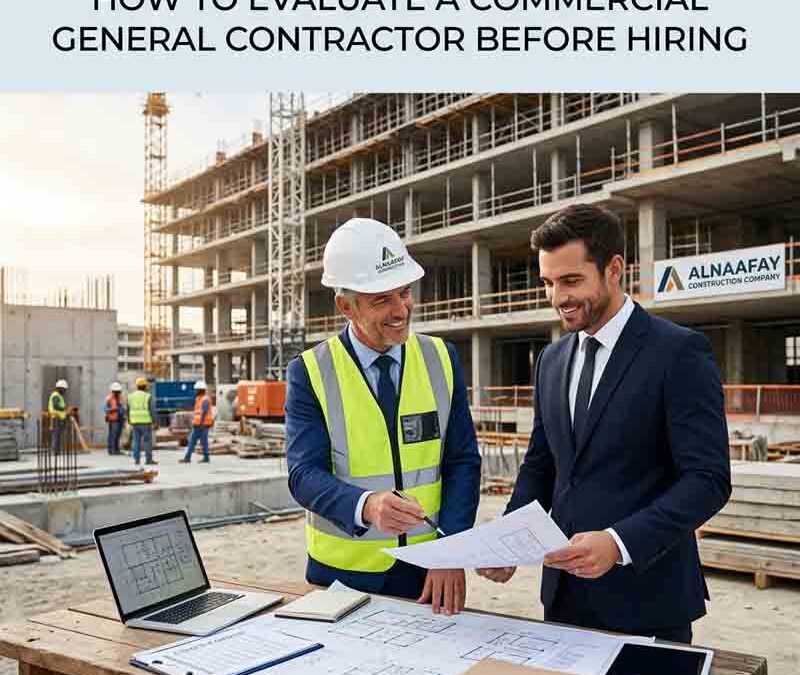
How to Evaluate a Commercial General Contractor Before Hiring
Quick answer: To evaluate a commercial general contractor before hiring, you must verify their active licenses, review their previous experience on similar projects, and check their surety bonding capacity. Furthermore, we recommend conducting reference checks, analyzing their financial stability, and assessing their pre-construction planning capabilities to ensure your project finishes on time and on budget.
Table of Contents
- What exactly is a commercial general contractor?
- Why does evaluating a commercial general contractor matter so much?
- How can you check the previous experience of a commercial general contractor?
- What key credentials and licenses should you look for in a contractor?
- How do you review a commercial general contractor's portfolio effectively?
- What questions should you ask a commercial general contractor before hiring?
- How do you evaluate communication and professionalism during the hiring process?
- What should you understand about bids and construction contract types?
- How do pre-construction services save time and money?
- What red flags should you watch out for when hiring a general contractor?
- How do you make your final decision on a commercial general contractor?
- Ready to move forward with your commercial construction project?
- Frequently Asked Questions (FAQ)
Building a commercial facility requires a significant investment of capital, time, and resources. Before the first shovel hits the dirt, you face dozens of critical decisions about budget, design, materials, schedules, and labor. Therefore, selecting the right partner to lead this process is the most important choice you will make.
We understand that finding the right construction partner feels overwhelming. You want a team that delivers reliable craftsmanship and protects your property for years to come. Consequently, you must know exactly how to evaluate a commercial general contractor before hiring them.
In this comprehensive guide, we provide a step-by-step roadmap for assessing potential contractors. We break down the evaluation process into concrete, actionable steps so you understand exactly what to look for. By following these guidelines, you ensure that your commercial construction project rests in capable, trustworthy hands.
What exactly is a commercial general contractor?
A commercial general contractor serves as the primary manager for a commercial construction project. Specifically, they oversee the entire building process from the initial planning stages through to the final property handover. This role involves coordinating multiple moving parts to ensure the project meets all design specifications, safety regulations, and budget constraints.
We define a commercial general contractor by the specific responsibilities they hold. First, they hire and manage specialized subcontractors, such as electricians, plumbers, and concrete workers. Second, they secure all necessary building permits and schedule local municipal inspections. Third, they manage the supply chain, ensuring that materials arrive on site exactly when needed. Finally, they maintain daily site safety and enforce strict quality control standards.
Because commercial projects involve complex zoning laws and large-scale engineering requirements, commercial contractors possess different skill sets than residential builders. Therefore, you must specifically seek out professionals with dedicated commercial expertise.
Why does evaluating a commercial general contractor matter so much?
Choosing a contractor sets the trajectory for your entire building project. When you know how to evaluate a commercial general contractor before hiring, you actively protect your financial investment. Proper evaluation prevents costly delays, subpar workmanship, and legal liabilities down the road.
We see many property owners rush the hiring process to get their project started quickly. Unfortunately, this approach often leads to severe consequences. For example, hiring an unvetted contractor might result in missed deadlines, which delays your ability to open your business and generate revenue. Furthermore, poor quality control can lead to structural issues that require expensive future repairs.
Thorough evaluation gives you predictability. By verifying a contractor's financial stability and operational capacity, you minimize the risk of the builder abandoning the project mid-construction. Consequently, taking the time to conduct a rigorous assessment provides peace of mind and guarantees a smoother construction experience.
How can you check the previous experience of a commercial general contractor?
Past performance is the single best predictor of future success. Therefore, investigating a builder's track record is a mandatory step when you learn how to evaluate a commercial general contractor before hiring. We do not rely on a contractor's marketing materials alone. Instead, we dig deep into their verified project history.
You must look for specific alignment between their past work and your current needs. If you want to build a medical facility, a contractor who only builds retail spaces lacks the necessary background in healthcare compliance.
We recommend following these specific steps to verify previous experience:
- Request a detailed list of completed projects from the past five years. This list should include project locations, completion dates, and total construction costs.
- Ask for a minimum of three references from past clients who built similar facilities. We advise calling these references directly to ask about their experience.
- Inquire about the contractor's experience with your specific local municipality. Navigating local zoning laws and permit offices requires established local relationships.
- Ask about the specific project managers and superintendents who will work on your site. The company's overall experience matters, but the experience of the actual people running your daily operations matters more.
When calling references, ask concrete questions. Specifically, ask if the project finished on time, if the contractor stayed within the budget, and how they handled unexpected challenges. This direct feedback reveals how the contractor operates under pressure.
What key credentials and licenses should you look for in a contractor?
Proper licensing and insurance protect you from catastrophic financial liability. We never leave anything to chance when it comes to legal compliance. Therefore, you must demand proof of all necessary credentials before signing any agreements.
Every state and municipality enforces different licensing requirements for commercial construction. You must familiarize yourself with your local laws. Next, you must physically verify the contractor's documentation through official government portals.
We require the following credentials as a baseline for any commercial contractor:
- Active General Contractor License: Ensure the license is current, in good standing, and holds the appropriate classification for commercial work. We check state licensing boards to confirm there are no active disciplinary actions.
- General Liability Insurance: This policy covers property damage and bodily injury that might occur during construction. We recommend a minimum coverage of $2 million for commercial projects, though larger builds require higher limits.
- Workers' Compensation Insurance: This coverage protects you if a worker suffers an injury on your property. Without it, the injured worker could sue you directly for medical costs.
- Surety Bonding Capacity: A surety bond acts as a financial guarantee that the contractor will fulfill their contractual obligations. We look for contractors who can easily secure performance and payment bonds from reputable surety companies.
Do not accept expired or incomplete documents. Always request that the contractor's insurance provider sends a Certificate of Insurance directly to you, naming your company as an additional insured party.
How do you review a commercial general contractor's portfolio effectively?
A portfolio offers a visual and factual representation of a contractor's capabilities. However, you must look beyond glossy photographs to understand the true story behind each project. Knowing how to evaluate a commercial general contractor before hiring means analyzing their portfolio for specific technical details.
We examine portfolios to assess the complexity and scale of the contractor's previous work. Specifically, we look for evidence of problem-solving and quality craftsmanship.
When reviewing a portfolio, focus on these critical elements:
- Project Scale Match: Verify that they have successfully completed projects of similar square footage and budget size to yours.
- Material Quality: Look closely at the finishes and structural materials used in their past builds. High-quality materials indicate a commitment to durability.
- Scope of Work: Determine if the contractor handled ground-up construction or just tenant improvements. Ground-up construction requires significantly more site management and foundational expertise.
- Industry Specialization: Note if the portfolio demonstrates a deep understanding of your specific industry requirements, such as specialized HVAC systems for laboratories or heavy-duty electrical loads for manufacturing plants.
If possible, we strongly recommend visiting a completed project in person. Walking through a finished building allows you to inspect the details up close and assess how well the facility has aged since completion.
What questions should you ask a commercial general contractor before hiring?
The interview process gives you a direct look into how a contractor thinks and communicates. We prepare a standardized list of questions for every candidate so we can compare their answers objectively.
Your goal during the interview is to uncover their operational strategies and core business values. We suggest asking the following specific questions:
- Who will be the dedicated project manager on site every day, and what is their specific background?
- How do you handle change orders when a design modification is required?
- What is your standard protocol for maintaining site safety and cleanliness?
- How do you vet and manage your subcontractors to ensure quality work?
- Can you provide a detailed timeline for this project, including major milestones?
- What software or project management tools do you use to keep clients updated?
- How do you handle supply chain delays or material shortages?
Listen closely to how they answer. We look for contractors who provide direct, specific answers rather than vague promises. A reliable contractor will outline exact processes, whereas an unreliable one will simply tell you not to worry.
How do you evaluate communication and professionalism during the hiring process?
Construction projects require constant, clear communication over many months. If a contractor struggles to communicate well during the bidding phase, they will certainly struggle during the high-stress construction phase. Therefore, evaluating their professionalism early on is a vital part of learning how to evaluate a commercial general contractor before hiring.
We pay close attention to response times and the clarity of written documents. A dependable contractor answers emails promptly, shows up on time for meetings, and provides thorough documentation.
You can measure their communication skills by observing these behaviors:
- Do they return your phone calls within twenty-four hours?
- Are their written proposals clear, detailed, and easy to understand?
- Do they listen carefully to your concerns, or do they interrupt and make assumptions?
- Are they willing to explain complex construction terms in plain language?
We want a partner who acts as an advisor. The best contractors anticipate your questions and address them directly before they become major concerns.
What should you understand about bids and construction contract types?
Comparing bids requires more than simply looking at the bottom-line number. Often, the lowest bid represents the highest risk, as it may exclude necessary work or rely on subpar materials. Consequently, we analyze bids line by line to ensure we compare identical scopes of work.
You must also understand the different types of commercial construction contracts available. The contract structure determines how financial risk is shared between you and the builder.
We frequently encounter these three primary contract types:
- Lump Sum (Fixed Price): The contractor agrees to complete the specified work for a single, fixed price. This option provides budget certainty for the owner but requires highly detailed, finalized design plans before signing.
- Cost-Plus: The owner pays for all actual construction costs (materials and labor) plus a predetermined fee or percentage for the contractor's overhead and profit. This structure offers flexibility but less upfront budget certainty.
- Guaranteed Maximum Price (GMP): The contractor provides a ceiling price that the project will not exceed. If costs run higher, the contractor absorbs the loss. If costs are lower, the savings often return to the owner. We frequently recommend this structure for large commercial projects.
We always have legal counsel review any construction contract before signing. Clear contracts prevent disputes by clearly defining payment schedules, change order procedures, and dispute resolution methods.
How do pre-construction services save time and money?
Building anything takes careful planning. Before the first brick is laid, dozens of decisions must be made about budget, design, materials, schedules, and labor. This is where pre-construction services come in. These services lay the groundwork for a project so that, once construction starts, the work moves faster and far less money gets wasted along the way.
We define pre-construction as the planning phase that happens before physical work begins. During this phase, a team studies the project, sets the budget, checks the site, and prepares a clear roadmap. As a result, the actual building stage runs faster and stays on budget.
Many owners skip this step to save a little money upfront. However, this choice often backfires. Without proper planning, projects face delays, surprise costs, and quality problems. In contrast, projects that use pre-construction services finish on schedule and waste far less money.
Faster Project Completion Speed
When the planning is done right, construction moves at speed. The team already knows the schedule, the materials, and the sequence of work. As a result, crews do not stand around waiting for decisions or deliveries. Instead, they keep building.
Consider what happens without planning. A crew finishes one task, then waits days for the next set of drawings. Meanwhile, materials arrive late because nobody ordered them in advance. These gaps add up quickly. With pre-construction services, however, we line up every step beforehand, so the work flows without these costly pauses.
Cost Overruns Avoided Through Early Budgeting
Cost overruns are the nightmare of every building project. A budget creeps upward, and suddenly the owner owes far more than expected. Pre-construction services prevent this through careful, early budgeting.
We build a detailed cost estimate before any work begins. This estimate covers materials, labor, equipment, and a sensible margin for the unexpected. As a result, you know the true cost from the start.
Early budgeting also lets us make smart choices together. For instance, if a certain material pushes the budget too high, we suggest a cheaper option that performs just as well. Changing a design during construction costs many times more than changing it during planning.
Here is how early budgeting protects your money:
- We price the project realistically, so there are no shocking surprises.
- We find ways to cut costs without cutting quality through value engineering.
- We settle the design early, so costly mid-project changes drop sharply.
- We set aside a planned reserve, so genuine surprises do not derail the budget.
Because we identify these risks early, we can plan around them calmly. Evaluating a contractor's pre-construction capabilities is a critical element of how to evaluate a commercial general contractor before hiring.
What red flags should you watch out for when hiring a general contractor?
Even with a thorough evaluation process, you must remain vigilant for warning signs. Recognizing red flags early prevents you from entering into a disastrous partnership. We train our teams to walk away from any contractor who displays these specific behaviors.
A reliable contractor operates with total transparency. Conversely, a problematic contractor relies on high-pressure tactics and vague promises.
We strongly advise you to watch out for the following red flags:
- Unusually Low Bids: If one bid comes in drastically lower than the others, the contractor likely missed essential scope items, plans to use inferior materials, or intends to heavily upcharge you later through change orders.
- Demand for Large Cash Deposits: Professional commercial contractors do not require massive cash payments upfront. Standard practice involves a reasonable mobilization fee, followed by monthly progress payments based on completed work.
- Lack of Permanent Business Address: We verify that the contractor operates out of a legitimate, physical office space. Contractors working solely out of a post office box pose a higher flight risk.
- Refusal to Provide Written Details: If a contractor insists on verbal agreements and refuses to put schedules, material specifications, or warranties in writing, we immediately disqualify them.
- Poor Financial Health: Look for steady or growing revenues. If a contractor shows signs of financial instability, they might use your project funds to pay off previous debts.
We do not compromise on these standards. Catching these red flags during the evaluation phase saves you massive headaches during construction.
How do you make your final decision on a commercial general contractor?
After gathering bids, checking references, and conducting interviews, you must synthesize this data to make a final choice. We use a structured scoring matrix to keep our decisions objective and fact-based.
Do not make your decision based on price alone. Value encompasses quality, reliability, timeline, and risk management.
We recommend evaluating your finalists based on this weighted criteria:
- Experience and Track Record: How closely do their past successes match your current needs?
- Financial and Legal Standing: Are their licenses, bonds, and insurance policies bulletproof?
- Team Competence: Do you trust the specific project manager assigned to your build?
- Pre-Construction Planning: Did they provide a highly detailed, realistic roadmap for the project?
- Communication: Did they communicate clearly, honestly, and professionally throughout the bidding process?
Once you select your preferred contractor, work with your legal team to finalize the construction contract. Ensure every verbal promise made during the interview process is explicitly written into the final document.
Ready to move forward with your commercial construction project?
Evaluating a commercial general contractor requires diligence, patience, and a methodical approach. By following the steps outlined above, you ensure that your project is managed by a competent, financially stable professional. We stand behind this structured evaluation process because we have seen it protect property owners time and time again.
A successful commercial build depends entirely on the strength of the team leading it. Therefore, take the necessary time to verify credentials, call references, analyze bids, and look for red flags. Your thoroughness now will pay massive dividends when your facility opens on time and on budget.
Frequently Asked Questions (FAQ)
What is the most important credential a commercial general contractor must have?
The most important credential is an active, state-issued commercial general contractor license, paired with robust general liability insurance and workers' compensation coverage. These documents prove they are legally authorized to build and financially protected against accidents.
How much should I pay upfront before commercial construction begins?
You should typically pay a mobilization fee of 10% to 20% of the total project cost to cover initial permits and early material orders. We advise against paying large, upfront cash deposits, as standard commercial contracts rely on monthly progress payments tied to specific completion milestones.
How can I verify a commercial general contractor's financial stability?
You can verify a contractor's financial stability by requesting a letter from their surety bonding company stating their current bonding capacity. Additionally, you can ask for a bank reference letter or run a commercial credit report to ensure they pay their suppliers on time.
What is the difference between a lump sum and a GMP contract?
A lump sum contract charges a single fixed price for the entire project, which means the contractor absorbs cost overruns but keeps any savings. A Guaranteed Maximum Price (GMP) contract sets a price ceiling; the contractor covers overages, but any savings below the GMP are typically returned to the property owner.
Why should I pay for pre-construction services?
You should invest in pre-construction services because detailed early planning identifies design conflicts, creates accurate budgets, and prevents expensive mid-project change orders. We find that spending a small amount on planning upfront reliably saves you significant time and money during the actual build.
