
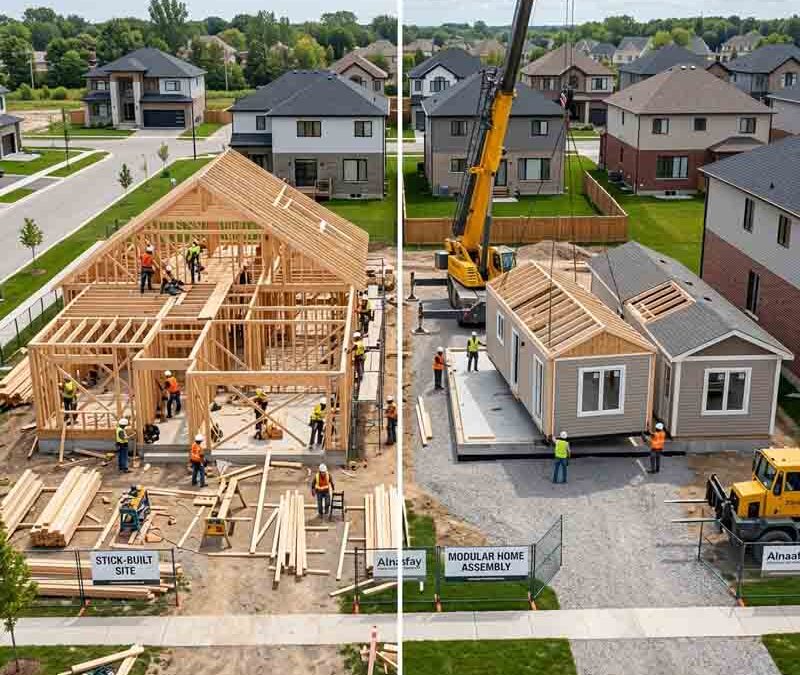
Stick-Built vs. Modular Homes: Which One Is Right for You?
Choosing a home is one of the biggest decisions most people will ever make. Beyond the location, the neighborhood, and the price, the way a home is built plays a major role in how it performs over time. Two of the most common building approaches today are stick-built construction and modular construction. Both have strong followings, but they work very differently, and each one suits a different type of buyer.
This guide breaks down everything you need to know about stick-built vs. modular homes in plain, simple language. Whether you are building from scratch, buying a new home, or just comparing your options, this article will help you make a clear and confident decision.
Table of Contents
- What Are Stick-Built Homes?
- What Are Modular Homes?
- How Each Home Type Is Built
- Stick-Built vs. Modular Homes: Key Benefits and Drawbacks
- Design Flexibility: Modular vs. Stick-Built Homes
- Quality, Speed, and Cost Comparison
- Financing and Resale Value
- Maintenance and Customization
- Material Options for Both Home Types
- Climate Suitability: Which One Works Where?
- Which Country Is Most Famous for Modular and Stick-Built Homes?
- Stick-Built vs. Modular Homes in Lahore
- Practical Buying Advice: How to Choose
- Conclusion
- FAQs
What Are Stick-Built Homes?
A stick-built home is exactly what the name suggests. It is built piece by piece, on the actual land where the house will stand. Workers use lumber, beams, and framing materials — often called "sticks" — to construct the structure from the ground up. This is the most traditional form of home construction used across the world.
Stick-built homes are also called site-built homes or on-site construction homes. Every wall, floor, roof, and room is assembled directly on the property. There is no factory involved. Everything happens outdoors, on location, with a team of skilled tradespeople.
This method has been around for centuries. In fact, most homes you see in older neighborhoods were built this way. The process is familiar to builders, architects, and lenders alike, which gives it a level of trust that newer methods sometimes lack.
What Are Modular Homes?
Modular homes are built in sections — called modules — inside a factory. These sections are manufactured under controlled conditions, then transported to the building site and assembled on a permanent foundation. Once placed, a modular home looks exactly like a traditional home. From the outside, most people cannot tell the difference.
It is important to understand that modular homes are not mobile homes or manufactured homes. Unlike mobile homes, modular homes are permanently placed on a foundation, just like stick-built homes. They follow the same local building codes and must meet the same standards.
The modular approach is newer and more technology-driven. Because the building happens in a factory, weather delays are minimized, waste is reduced, and quality control is much easier to manage.
How Each Home Type Is Built
The Stick-Built Construction Process
Stick-built construction starts with preparing the land and laying the foundation. After that, workers frame the walls using wooden or steel studs. Then the roof structure is added, followed by sheathing, insulation, windows, doors, electrical wiring, plumbing, and finally interior and exterior finishes.
Each stage depends on the one before it. Therefore, the process can take several months. Weather conditions often cause delays. Rain, snow, or extreme heat can slow down progress significantly.
However, the process allows for a high degree of on-site adjustments. If a design changes midway through, builders can often accommodate it. This flexibility is one of the strongest advantages of stick-built construction.
The Modular Construction Process
Modular home construction starts with a detailed design plan, just like a traditional build. After the design is finalized, the factory begins producing the modules. Meanwhile, the foundation is prepared at the building site.
Once the modules are complete, they are transported by truck and craned into place on the foundation. The sections are then joined, sealed, and connected to utilities. The entire on-site phase often takes just a few days to a few weeks, depending on the size of the home.
As a result, the total build time from factory to move-in is usually much faster than stick-built. Additionally, because production happens indoors, weather rarely causes delays.
Stick-Built vs. Modular Homes: Key Benefits and Drawbacks
Benefits of Stick-Built Homes
- Design freedom: Builders can create almost any shape, size, or layout.
- Widespread acceptance: Lenders, appraisers, and buyers are very comfortable with this method.
- Easy modifications: Changes during construction are easier to make on-site.
- Perceived value: Many buyers associate stick-built with higher quality, even if that is not always true.
- Architectural variety: Curved walls, vaulted ceilings, and complex roof lines are much easier to achieve.
Drawbacks of Stick-Built Homes
- Longer build time: On-site construction often takes 6 to 18 months or more.
- Weather exposure: Materials and the structure are exposed to the elements during construction.
- Higher labor costs: Skilled tradespeople working on-site tend to cost more.
- More waste: Site-built construction generates significantly more material waste.
- Harder quality control: Managing quality across a large team on an open site is challenging.
Benefits of Modular Homes
- Faster construction: Factory production speeds things up considerably.
- Consistent quality: Factory environments allow precise control over every step.
- Less waste: Materials are measured and cut with accuracy in a controlled setting.
- Lower cost potential: The efficiency of factory production often reduces total costs.
- Weather protection: Building indoors protects materials from rain, humidity, and extreme temperatures.
Drawbacks of Modular Homes
- Design limitations: Very unusual or complex architectural shapes are harder to achieve.
- Transportation constraints: Modules must fit on trucks, which limits certain dimensions.
- Land requirements: The site must be accessible for large delivery vehicles and cranes.
- Stigma: Some buyers still mistakenly associate modular homes with lower quality.
- Financing gaps: Some lenders treat modular homes differently, though this is changing.
Design Flexibility: Modular vs. Stick-Built Homes
Design flexibility is one of the most common reasons people choose stick-built construction. Because everything is built on-site, there are virtually no limits on what shapes or configurations are possible. Buyers can add curved walls, unusual room layouts, or dramatically high ceilings without major complications.
Modular homes, on the other hand, come with some natural constraints. Since modules must be built in a factory and transported on trucks, very wide spans or extremely irregular shapes may not be practical. Nevertheless, today's modular manufacturers offer a huge variety of floor plans and finishes. Many buyers are surprised at how much design variety is now available in modular construction.
Furthermore, modular builders have become increasingly skilled at combining modules in creative ways. Multi-story homes, L-shaped layouts, open-plan living areas, and luxury finishes are all achievable. The difference between stick-built and modular homes in terms of design is narrowing every year.
Quality, Speed, and Cost Comparison
Quality
Quality depends far more on the builder than on the construction method. However, modular homes often benefit from better quality control because production happens in a factory. Every measurement is precise, every joint is consistent, and supervisors can catch errors immediately.
Stick-built homes vary more widely in quality. A skilled builder with a good team can produce an exceptional home. On the other hand, poor site management can lead to problems that are hard to detect until much later.
Speed
Modular construction is almost always faster. Factory production can happen simultaneously with site preparation. Therefore, the total timeline is compressed. In contrast, stick-built homes must be built stage by stage, and each stage takes time.
Cost
Cost is where the comparison gets nuanced. On average, modular homes cost less per square foot because factory production is more efficient. However, foundation costs, transportation, crane rental, and site preparation can add up. Additionally, custom stick-built homes vary enormously in price depending on materials and location.
For most buyers, modular homes offer better value when cost efficiency is the top priority. Stick-built homes may cost more but offer greater design freedom, which can justify the premium for the right buyer.
Financing and Resale Value
Financing
Stick-built homes are the easiest to finance. Most banks and mortgage lenders are very comfortable with traditional on-site construction. Loans, appraisals, and valuations follow well-established processes.
Modular home financing has improved significantly in recent years. Many lenders now treat modular homes exactly like stick-built homes for mortgage purposes, especially when they are placed on permanent foundations. However, some lenders still apply stricter terms or different appraisal methods, so it pays to shop around.
Resale Value
Stick-built homes generally hold their resale value well. Buyers in the resale market are familiar with them and tend to price them confidently.
Modular homes have historically faced a slight resale value gap, mainly due to stigma rather than actual performance. That gap is closing as more buyers understand that a modular home on a permanent foundation is built to the same codes as a stick-built home. In many markets today, a well-maintained modular home sells at comparable prices.
Maintenance and Customization
Maintenance
Both home types require regular maintenance, including roof inspections, exterior upkeep, HVAC servicing, and plumbing checks. Stick-built homes may develop more settling issues over time due to the natural movement of on-site materials. Modular homes, because they are assembled with factory precision, often show fewer of these issues early on.
However, long-term performance depends mainly on materials used, local climate, and how well the home is maintained. Neither type has a clear advantage here overall.
Customization
Stick-built homes offer more customization flexibility from the start. Buyers can change designs mid-build, add unique features, or adjust layouts without major consequences. Modular homes require most design decisions upfront, before production begins. Once the factory starts building, changes are difficult and costly.
That said, modular manufacturers today offer extensive catalogs of finishes, layouts, and features. Many buyers find that the available options more than meet their needs.
Material Options for Both Home Types
Understanding the materials used in stick-built vs. modular homes helps buyers make smarter long-term decisions.
Wood Framing
Wood framing is the most common structural choice for both stick-built and modular homes. It is lightweight, affordable, widely available, and easy to work with. In stick-built construction, wood framing happens on-site. In modular construction, it is done in a factory under controlled conditions, which often results in more consistent framing.
Steel Framing
Steel framing offers superior strength and resistance to termites, fire, and moisture compared to wood. It is a popular choice in areas with high winds or seismic activity. Both stick-built and modular homes can use light-gauge steel framing. Steel tends to cost more upfront but delivers long-term durability benefits.
Concrete Elements
Concrete is used in foundations for both home types, but it also appears in walls, floors, and roofs in some designs. Insulated concrete forms (ICFs) are increasingly popular for walls in both methods. Concrete provides excellent thermal mass, noise resistance, and durability. Additionally, it performs very well in extreme weather conditions.
Insulation Choices
Insulation is critical for energy efficiency and comfort. Both stick-built and modular homes use a variety of insulation materials, including fiberglass batts, spray foam, rigid foam boards, and mineral wool. Modular homes often achieve better insulation consistency because the installation happens in a factory. Stick-built homes may have gaps or inconsistencies depending on the crew's skill level.
Exterior Cladding
Exterior cladding options include brick veneer, fiber cement siding, vinyl siding, wood cladding, stone veneer, stucco, and metal panels. Both home types support all of these options. However, certain cladding types work better in specific climates, which is discussed in the next section.
Roofing
Common roofing materials include asphalt shingles, metal roofing, clay or concrete tiles, and flat membrane roofing. Both stick-built and modular homes support standard roofing options. Metal roofing is growing in popularity for its longevity, energy efficiency, and ability to handle heavy rain.
Flooring
Flooring choices include hardwood, engineered wood, ceramic tile, porcelain tile, luxury vinyl plank, laminate, and polished concrete. Both construction methods support all standard flooring types. The choice depends more on budget, climate, and personal preference than on how the home was built.
Interior Finishes
Interior finishes include drywall, plaster, cabinetry, countertops, trim, and paint. Both stick-built and modular homes support a wide range of interior finish options. Modular builders typically offer curated packages, whereas stick-built projects allow fully custom selections.
Climate Suitability: Which One Works Where?
Hot Climates
In hot, dry climates, both home types can perform well with the right materials. Thick insulation, reflective roofing, and light-colored exterior cladding help reduce heat gain. Modular homes with factory-applied insulation often achieve more consistent thermal performance. Concrete walls and tile roofing are especially effective in very hot regions.
Cold Climates
Cold climates demand excellent insulation and airtight construction. Modular homes often have an edge here because factory construction allows for precise sealing of gaps and joints. Spray foam insulation, triple-pane windows, and vapor barriers are important in cold regions. Both home types can achieve high energy efficiency when built correctly, but modular construction typically delivers more consistent results.
Humid Areas
Humidity is tough on wood. In very humid climates, moisture management is critical. Steel framing, fiber cement siding, and closed-cell spray foam insulation are smart choices for both home types in humid areas. Modular homes built in well-managed factories are less likely to have moisture trapped in the structure during construction, which reduces the risk of mold.
Rainy Regions
Heavy rainfall requires excellent roofing, drainage systems, and moisture-resistant cladding. Metal roofing, steep roof pitches, and fiber cement or stone cladding perform best. Both construction methods can be adapted for rainy regions, but the quality of on-site workmanship matters greatly in stick-built homes.
Seismic Zones
In earthquake-prone areas, structural integrity is everything. Steel framing and reinforced concrete foundations are strongly recommended. Modular homes can be engineered for seismic resistance, and many factory-built modules are structurally very strong due to the precision of factory assembly. Stick-built homes in seismic zones must follow strict codes and require careful workmanship to meet safety standards.
Which Country Is Most Famous for Modular and Stick-Built Homes?
The United States is the country most commonly associated with both stick-built and modular home construction. Stick-built construction has dominated American residential building for generations, shaped by abundant timber resources, a strong tradition of custom homebuilding, and a large labor market of skilled tradespeople.
At the same time, the United States is a global leader in modular home construction. Companies like Clayton Homes, Champion Homes, and Cavco Industries produce tens of thousands of modular and manufactured homes every year. The modular industry is heavily regulated in the US through HUD codes and state-level building standards, which ensures consistent quality.
Other countries are strong players too. Japan is widely respected for its precision modular construction, with companies like Sekisui House producing high-quality factory-built homes. Sweden and Germany are known for their advanced timber frame and panelized systems. Australia has seen strong growth in modular building for both residential and remote-location projects.
However, the US market remains the largest and most diverse for both stick-built vs. modular homes in terms of volume, variety, and innovation. The sheer scale of American residential construction, combined with a well-developed lending market, makes it the benchmark reference point for this comparison globally.
Stick-Built vs. Modular Homes in Lahore
Lahore is one of Pakistan's most dynamic real estate markets. The city has seen rapid growth in housing demand, with buyers across income levels looking for well-built, affordable, and modern homes. Understanding how stick-built homes vs. modular homes apply in this context is useful for local buyers.
Traditional stick-built construction dominates Lahore's residential landscape. Most homes are built using brick masonry, concrete columns, and reinforced concrete slab construction — a local adaptation of site-built methods. This approach is familiar to builders, contractors, and buyers across the city.
Modular construction is newer to the Lahore market but is gaining interest, particularly for gated communities and fast-delivery projects. Prefabricated elements and factory-made components are increasingly being used in large-scale developments.
Top Societies in Lahore and What to Expect
DHA (Defence Housing Authority) is one of the most established and prestigious housing societies in Lahore. Properties here follow strict construction standards. Traditional site-built construction is the norm, with high-quality materials and detailed architectural planning.
Bahria Town Lahore is a massive, well-planned community with a mix of residential and commercial spaces. The society is known for uniformity and quality control, making it a strong candidate for prefabricated or modular elements in future development phases.
Lake City offers a modern layout with premium amenities. The society is growing rapidly, and buyers looking for well-built homes with modern finishes will find strong options here. Site-built construction is dominant, though newer developments may incorporate prefabricated components.
Valencia Housing Society is a mid-tier option with solid infrastructure. Homes here are traditionally site-built and follow conventional masonry construction, offering good long-term value.
Wapda Town is a well-established society with a large residential community. Construction here follows conventional on-site methods, and the area offers a mature, settled neighborhood feel.
Johar Town is one of Lahore's most popular areas, offering a wide range of housing types. Buyers here will find mostly traditional construction, with newer projects beginning to incorporate modern building techniques.
Model Town is one of Lahore's oldest and most respected housing colonies. Heritage architecture and traditional construction methods dominate. Buyers value the area for its mature tree-lined streets and established community character.
Gulberg is a commercial and residential hub known for upscale living. Properties here tend to be high-end, with premium finishes and custom construction. Stick-built, on-site methods are standard.
Askari Housing is a disciplined, well-maintained community with strong security and uniform standards. Construction quality is consistently high, following site-built methods with strict material and design controls.
Cantt (Cantonment) areas in Lahore maintain some of the strictest building regulations in the city. Traditional construction is mandatory in most parts, and the standards for materials and workmanship are high.
For buyers in Lahore, the choice between stick-built homes vs. modular homes ultimately depends on the society's rules, available contractors, budget, and how quickly you need to move in. Modular options are emerging, but traditional construction remains the dominant and most widely accepted approach in the city.
Practical Buying Advice: How to Choose
Choosing between stick-built and modular homes does not have to be complicated. Instead, consider these clear factors:
Budget
If budget efficiency is your top concern, modular homes often offer better value per square foot. However, do not forget to factor in transportation, foundation, crane costs, and site preparation. On the other hand, stick-built homes can vary enormously in price depending on the builder, location, and design complexity.
Timeline
If you need to move in quickly, modular construction is typically the faster option. Factory production and site preparation happen at the same time, which compresses the overall schedule. Conversely, stick-built construction takes longer, especially when weather delays are involved.
Land
Both home types require a solid, prepared foundation. However, modular homes need accessible roads for large trucks and space for a crane. If your land is remote or difficult to access, stick-built construction may be the only practical choice.
Design Goals
For highly custom, architecturally unique homes, stick-built construction gives you the most flexibility. On the other hand, if a standard floor plan with good finishes works for your needs, a modular home can meet your goals at a lower cost and faster timeline.
Local Regulations
Always check local zoning laws and building codes before committing to either option. Some areas have restrictions on modular homes, while others have no differentiation. Additionally, lender requirements may vary, so confirm financing options early in the process.
Builder Reputation
Regardless of which method you choose, the builder's reputation and track record matter more than anything else. A skilled modular manufacturer with strong reviews will deliver a better home than a careless site builder. Do thorough research, visit completed projects, and ask for references.
Conclusion
The debate around stick-built vs. modular homes comes down to priorities. There is no single right answer for every buyer. Stick-built homes offer unmatched design flexibility, broad market acceptance, and a deep tradition of craftsmanship. Modular homes offer speed, consistency, cost efficiency, and growing design variety.
Both methods can produce beautiful, durable, high-quality homes when done well. The difference between stick-built and modular homes is less about which is better in general and more about which is better for your specific situation. Your budget, your timeline, your land, your design vision, and your local market all play a role.
Take the time to research both options carefully. Talk to builders who specialize in each method. Visit completed homes from both categories. Ask hard questions about cost, materials, energy efficiency, and warranties. Ultimately, a well-informed buyer is always in the best position to make the right call.
FAQs
Q1: Are modular homes as strong as stick-built homes?
Yes. Modular homes are built to meet the same local building codes as stick-built homes. In many cases, factory production results in tighter construction and more consistent structural strength.
Q2: Do modular homes hold their value as well as stick-built homes?
Modular homes on permanent foundations hold their value very well. The resale value gap that existed years ago has narrowed significantly as buyers become more educated about what modular construction actually involves.
Q3: Which is cheaper — a stick-built home or a modular home?
On average, modular homes cost less per square foot due to factory efficiency. However, total costs depend on design complexity, site conditions, location, and finishes. Always get detailed quotes for both options before deciding.
Q4: Can a modular home be customized?
Absolutely. Today's modular manufacturers offer extensive options for floor plans, exterior finishes, interior materials, and features. Most design needs can be met through a good modular builder's catalog.
Q5: How long does it take to build each type of home?
Stick-built homes typically take 6 to 18 months or more, depending on size and complexity. Modular homes can often be completed and ready for occupancy in 3 to 6 months because factory and site work happen simultaneously.
Q6: Is it easier to get a mortgage for a stick-built or modular home?
Stick-built homes are easier to finance through traditional lenders. However, modular home financing has improved greatly, and many lenders now treat permanent-foundation modular homes the same way. Shopping around for lenders familiar with modular construction is a smart move.
Q7: Which is better for hot climates like Lahore?
Both can work well in hot climates with the right materials. Good insulation, reflective roofing, moisture-resistant cladding, and proper ventilation are key for either construction type. Local climate conditions should always guide your material and design choices.
Q8: Are modular homes available in Pakistan?
Modular and prefabricated construction is slowly growing in Pakistan, including in cities like Lahore. However, traditional site-built construction remains dominant across most residential markets in the country.
Q9: What is the main difference between stick-built and modular homes?
The main difference is where they are built. Stick-built homes are constructed entirely on-site. Modular homes are built in sections in a factory and then assembled on a permanent foundation at the building site.
Q10: Which type of home is better for earthquake-prone areas?
Both can be engineered for seismic resistance. Steel framing, reinforced foundations, and proper engineering are essential in earthquake zones regardless of the construction method. Consulting a structural engineer familiar with local seismic codes is strongly recommended.
