
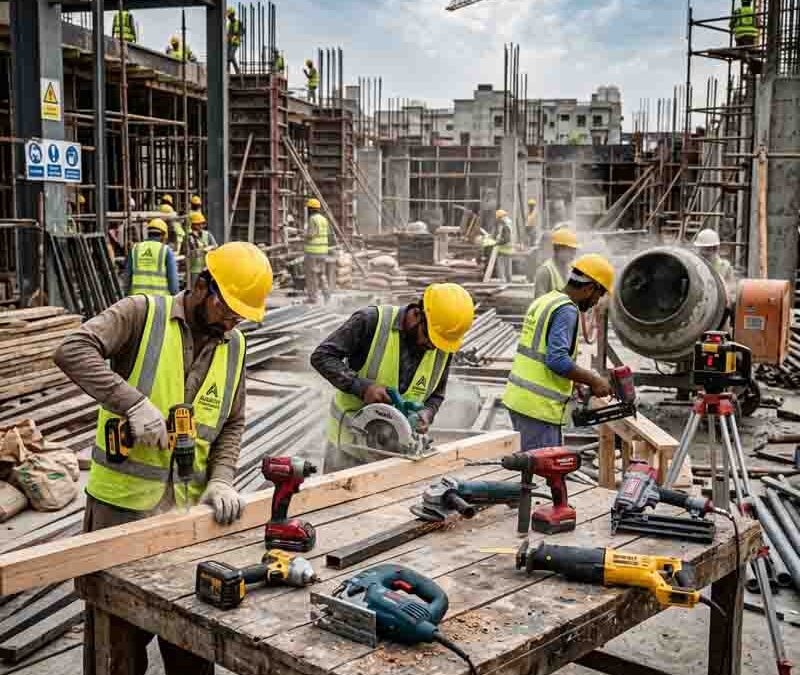
Top 10 Power Tools Every Contractor Should Have on Site
On any busy job site, the difference between finishing early and falling behind often comes down to one thing: the tools in your team's hands. Quality power tools speed up work, raise the standard of every finish, and keep your crew safe while they do it. Because the right kit shapes both your timeline and your reputation, choosing your tools wisely deserves real thought.
This guide walks through the ten power tools that belong on every serious site. Along the way, you will learn what each tool does, why it matters, and how to get the most from it. Whether you run a small crew or a large Construction Company Lahore, this list will help you build a kit that handles almost any task. So let us dig into the tools that turn plans into finished buildings.
Table of Contents
- Introduction
- Why Power Tools Matter for a Construction Company in Lahore
- Tool 1: Circular Saw
- Tool 2: Drill/Driver
- Tool 3: Angle Grinder
- Tool 4: Reciprocating Saw
- Tool 5: Jigsaw
- Tool 6: Nail Gun / Framing Nailer
- Tool 7: Power Sander
- Tool 8: Rotary Hammer Drill
- Tool 9: Plate Compactor
- Tool 10: Concrete Mixer
- Frequently Asked Questions (FAQs)
- Conclusion
Why Power Tools Matter for a Construction Company in Lahore
Before we explore individual tools, let us understand why this kit deserves your investment. Power tools are not just conveniences; they are the engines that drive every modern project. To see their true value, consider how deeply they shape your speed, quality, and profit.
They Save Time on Every Task
Time is money on a job site, and power tools save plenty of both. A task that takes an hour with hand tools often takes minutes with the right powered equipment. As those minutes add up across a whole project, they translate into faster completion and lower labor costs. For a busy Construction Company Lahore juggling several jobs at once, that saved time can mean the difference between meeting a deadline and missing it.
They Improve Quality and Consistency
Beyond speed, power tools deliver cleaner, more precise results than hands alone ever could. Straight cuts, even finishes, and tightly driven fasteners all become far easier with the right equipment. Because consistency builds trust, that higher quality protects your reputation with every client you serve. Therefore, smart builders treat good tools as a direct investment in their brand.
They Keep Crews Safer
Safety matters on every site, and well-maintained power tools support it in real ways. Modern tools come with guards, brakes, and ergonomic designs that reduce strain and accidents. Tired workers using poor hand tools, by contrast, face higher risks of injury and fatigue. As a result, a careful Construction Company Lahore views quality equipment as part of its safety strategy, not just its toolkit.
They Reflect a Healthy, Growing Industry
The demand for skilled building work keeps climbing, and the tools sector mirrors that growth. The global power tools market sits at roughly $43.8 billion and is expected to grow at about 3.7% each year through 2029, according to the Freedonia Group. Meanwhile, Pakistan's construction sector accounts for around 2.53% of national GDP and employs 7.61% of the working labor force, per the Board of Investment. With Fitch Solutions projecting the industry's value at Rs. 2,705.5 billion by 2028, the appetite for serious equipment shows no sign of slowing.
Now that the case is clear, let us turn to the tools themselves.
Tool 1: Circular Saw
First on the list is a tool no site should be without: the circular saw. This versatile cutter handles a huge range of materials, which makes it one of the most-used tools in any crew's arsenal. Once you understand what it can do, you will see why it earns the top spot.
What It Does
A circular saw uses a fast-spinning, toothed blade to slice through material in straight, clean lines. While it excels at quick cuts in lumber, it can also tackle metal and masonry once you fit the correct blade. You can choose a handheld version for mobility or mount a stationary unit into a table for repeated, precise cuts. Because of this range, it adapts to framing, decking, and countless other tasks.
Why You Need It
Speed and versatility make the circular saw indispensable on any site. Rather than struggling through boards by hand, your crew can rip and crosscut in seconds. Moreover, swapping blades lets one tool serve many purposes, which keeps your kit lighter and your budget leaner. For these reasons, a well-equipped Construction Company Lahore treats the circular saw as a foundational purchase.
Pro Tip
To get clean, safe cuts, always match the blade to the material and keep it sharp. A dull blade forces the motor to work harder, which slows the cut and raises the risk of kickback. Therefore, inspect and replace your blades regularly to protect both your work and your team.
Tool 2: Drill/Driver
Next comes perhaps the most versatile tool in existence: the drill/driver. Few tools see as much daily use, and few earn their place in the kit so easily. Let us look at why it belongs in every worker's hands.
What It Does
A drill/driver performs two essential jobs in one compact body. First, it bores clean holes through wood, metal, plastic, and more. Second, it drives screws quickly and firmly into a wide range of materials. Thanks to adjustable speed and torque settings, it handles both delicate and heavy-duty tasks with ease.
Why You Need It
Almost every stage of construction calls for holes or fasteners, which puts the drill in constant demand. Instead of turning screws by hand, your crew can fasten dozens in the time it once took to drive a few. Because the tool is so widely useful, many builders keep several on site at once. Honestly, you can never have too many of these around.
Pro Tip
Whenever possible, choose cordless models from a single battery system. This way, every tool in your kit shares the same batteries and chargers, which simplifies your workflow. As a bonus, sticking to one brand often saves money over time, since you avoid buying duplicate accessories.
Tool 3: Angle Grinder
Third on our list is a true site workhorse: the angle grinder. When you need to cut, grind, or polish tough materials, this tool steps up where others fall short. Understanding its strengths helps you use it safely and well.
What It Does
An angle grinder spins an abrasive disc at high speed to cut, grind, smooth, and polish hard materials. With the right disc, it slices through metal, masonry, tile, and concrete with impressive ease. It also removes rust, strips paint, and cleans up rough welds in seconds. Because so many discs fit a single grinder, one tool covers an enormous range of jobs.
Why You Need It
Hard materials defeat ordinary tools, yet an angle grinder cuts through them without complaint. From trimming rebar to smoothing a rough edge, it handles the tough finishing work that every project eventually demands. Furthermore, its compact size lets workers reach tight spots that larger machines cannot. For this versatility, a practical Construction Company Lahore keeps at least one grinder ready at all times.
Pro Tip
Always wear eye and ear protection when running an angle grinder, since it throws sparks and debris. In addition, let the tool reach full speed before it touches the material, and never remove the guard. These simple habits keep both the operator and the work safe.
Tool 4: Reciprocating Saw
Fourth comes the demolition specialist: the reciprocating saw. When a project calls for tearing out rather than building up, few tools work faster. Let us explore where this rugged saw truly shines.
What It Does
A reciprocating saw drives its blade back and forth in a fast push-pull motion to cut through almost anything. It chews through wood, metal, PVC, plaster, and even embedded nails without missing a beat. Because the saw does the back-and-forth work for you, it removes the strain of manual sawing entirely. This makes it ideal for rough, demanding cuts where speed matters more than polish.
Why You Need It
Remodeling and demolition jobs depend on a tool that cuts quickly through mixed materials. Rather than switching saws for each substance, your crew can power through wood and metal alike with one machine. As a result, tear-out work that once took hours can finish in a fraction of the time. For renovation-heavy work, a Construction Company Lahore relies on this saw to clear the way fast.
Pro Tip
Keep a variety of blades on hand, since each material cuts best with its own type. A wood blade tears through framing, while a bimetal blade handles nails and pipe. By matching the blade to the task, you cut faster and extend the life of each blade.
Tool 5: Jigsaw
Fifth on our list is the master of curves: the jigsaw. While straight cuts have plenty of tools to choose from, curved and intricate cuts call for this nimble saw. Here is why it deserves a spot in your kit.
What It Does
A jigsaw uses a thin, narrow blade that moves up and down to cut along curved and detailed lines. It shapes circles, arcs, and custom patterns that a circular saw simply cannot manage. Beyond curves, it also handles straight cuts, plunge cuts, and bevels with the right setup. Affordable and compact, it takes up almost no room in your toolbox.
Why You Need It
Detailed work appears in nearly every project, from cutting sink openings to shaping decorative trim. Without a jigsaw, those precise curves become slow, frustrating, and often imprecise. With one, your crew shapes complex pieces quickly and cleanly. Because it covers so many fine cutting tasks, a versatile Construction Company Lahore keeps a jigsaw within easy reach.
Pro Tip
For smooth curves, let the blade do the work and avoid forcing the tool through the cut. Pushing too hard can bend the thin blade and ruin the line. Instead, guide the saw gently and let its speed carry it through the material.
Tool 6: Nail Gun / Framing Nailer
Sixth comes a tool that transformed the speed of building work: the nail gun. For framing and fastening at scale, nothing beats the pace of a quality nailer. Let us see why it became a job-site staple.
What It Does
A nail gun, or framing nailer, drives nails into material with a single squeeze of the trigger. It fastens structural lumber far faster than a hammer ever could, often setting a nail in a fraction of a second. Builders rely on it for wall framing, roof trusses, floor joists, and roof decking. Because it works so quickly, it keeps large framing jobs moving at a steady pace.
Why You Need It
Framing involves driving thousands of nails, and doing that by hand wastes precious time and energy. A framing nailer slashes that effort, letting one worker fasten in minutes what once took hours. On top of speed, it delivers consistent depth and holding power on every nail. For framing-heavy projects, a productive Construction Company Lahore depends on this tool to hit tight deadlines.
Pro Tip
Always treat a nail gun as a serious tool and keep the safety tip engaged until you are ready to fire. Many building codes require full-round-head nails for framing, so check local rules before you load. Following these guidelines protects both your crew and your compliance.
Tool 7: Power Sander
Seventh on our list is the finishing expert: the power sander. When a project moves from rough construction to polished detail, this tool earns its keep. Understanding the types helps you choose the right one.
What It Does
A power sander smooths surfaces quickly by moving sandpaper at high speed against the material. A belt sander uses a continuous loop of sandpaper to remove material fast over large areas. An orbital, or finishing, sander, by contrast, works in small circles to create a smooth, even surface. Together, these styles cover everything from heavy stock removal to delicate final finishing.
Why You Need It
Quality finishes set great work apart, and sanding by hand is slow and uneven. A power sander delivers a flat, professional surface in a fraction of the time. Moreover, it prepares wood and other materials properly for paint, stain, or sealant. Because a clean finish reflects directly on craftsmanship, a detail-focused Construction Company Lahore values this tool highly.
Pro Tip
Start with a coarse grit to remove rough material, then move to finer grits for a smooth finish. Skipping grits often leaves swirl marks that show through the final coat. By working through the grits in order, you achieve a flawless surface every time.
Tool 8: Rotary Hammer Drill
Eighth comes the heavy hitter: the rotary hammer drill. For the toughest masonry and concrete work, ordinary drills simply cannot keep up. Let us look at what sets this powerhouse apart.
What It Does
A rotary hammer drill combines a spinning motion with a strong, pounding hammer action. This dual force lets it bore into concrete, brick, and stone with remarkable speed. Many models also include a chisel mode, which turns the tool into a mini-jackhammer for light demolition. As a result, it tackles jobs that would stop a standard hammer drill cold.
Why You Need It
Construction often means anchoring into concrete, and that work demands serious drilling power. Rather than struggling with an underpowered drill, your crew can sink anchors and holes quickly and cleanly. Furthermore, the chisel function handles small breaking jobs without renting a full jackhammer. For masonry-heavy projects, a well-prepared Construction Company Lahore counts this tool as essential.
Pro Tip
Use specialized masonry bits designed for the impact of a rotary hammer, since standard bits wear out fast. In addition, ease off the pressure and let the hammer action do the work. This approach protects both your bits and the tool's motor.
Tool 9: Plate Compactor
Ninth on our list is the foundation builder: the plate compactor. Before any solid structure rises, the ground beneath it must be firm and stable. This machine makes that stability possible.
What It Does
A plate compactor uses powerful vibrations to press soil, gravel, and asphalt into a dense, stable base. Its heavy steel plate pounds the surface repeatedly, removing air pockets and settling the material. This process creates a firm foundation for driveways, slabs, walkways, and roads. Without proper compaction, surfaces sink and crack over time, which is exactly what this tool prevents.
Why You Need It
Strong structures begin with strong ground, and loose soil undermines everything built above it. A plate compactor delivers the dense, reliable base that lasting work requires. Moreover, it does so far faster and more evenly than manual tamping ever could. Because a solid base protects the whole project, a quality-driven Construction Company Lahore treats compaction as a non-negotiable step.
Pro Tip
For the best results, compact granular material in thin layers rather than one thick pour. Each layer settles more fully when worked separately, which produces a stronger base overall. Therefore, take the time to build up your surface gradually.
Tool 10: Concrete Mixer
Tenth and finally comes a true site essential: the concrete mixer. Concrete forms the backbone of most construction, and mixing it well makes all the difference. Let us close our list with this indispensable machine.
What It Does
A concrete mixer blends cement, sand, aggregate, and water into a smooth, consistent mix. Batch mixers prepare concrete in set portions, while continuous mixers produce a steady, ongoing flow. Both keep the mix uniform, which is vital for strength and durability. By handling the mixing on site, the machine ensures fresh, ready-to-pour concrete exactly when you need it.
Why You Need It
Hand-mixing concrete is slow, exhausting, and often inconsistent, which weakens the final result. A concrete mixer produces large, uniform batches quickly and with far less labor. As a bonus, on-site mixing lets you control quality and avoid the cost of delays in delivery. For foundations, slabs, and structural work, a dependable Construction Company Lahore relies on this machine daily.
Pro Tip
Clean the drum thoroughly after every use, since hardened concrete is extremely difficult to remove later. A quick rinse while the mix is still wet saves hours of scraping down the line. By cleaning promptly, you also extend the working life of the machine.
Frequently Asked Questions (FAQs)
What are the most important power tools for a construction site?
The most important tools cover cutting, drilling, fastening, and finishing. A circular saw, a drill/driver, an angle grinder, and a nail gun form the core of most kits. From there, tools like a rotary hammer drill, a plate compactor, and a concrete mixer handle heavier site work. Together, these tools let a Construction Company Lahore tackle nearly any task with confidence.
Should I buy corded or cordless power tools?
Both options have their place, so the right choice depends on the job. Cordless tools offer freedom of movement and work well in spots without easy power access. Corded tools, on the other hand, deliver steady, unlimited power for heavy, continuous work. Many builders keep a mix of both, choosing corded for demanding tasks and cordless for mobility.
How do I choose quality power tools that last?
Start by buying professional-grade tools from trusted, well-known brands. While these cost more upfront, they last far longer and perform more reliably under heavy use. Beyond the brand, proper care matters just as much, so clean, store, and maintain your tools regularly. By investing in quality and looking after it, a Construction Company Lahore avoids costly, repeated replacements.
How can I keep my power tools in good condition?
Good maintenance keeps tools running for years. Clean each tool after use, allow motors to cool between heavy jobs, and store everything in dry, secure cases. In addition, sharpen blades and bits regularly, and follow the maker's guidance on lubrication. These simple habits protect both your investment and your work.
Are power tools worth the investment for a small contractor?
Absolutely, since the time and quality they deliver pay off quickly. Even a small crew completes more work in less time with the right powered equipment. Better finishes also win repeat clients, which grows the business over time. For these reasons, a growing Construction Company Lahore treats its tool kit as a smart, long-term investment.
Which power tool should a new contractor buy first?
If you can buy only one tool to start, choose a quality drill/driver. It handles both drilling and fastening, which makes it useful at nearly every stage of a project. From there, a circular saw and an angle grinder round out a strong starter kit. With these three tools, a new contractor can handle a surprising range of everyday tasks.
Conclusion
A well-chosen kit of power tools forms the backbone of every successful build. From the circular saw that shapes your framing to the concrete mixer that anchors your foundations, each tool plays a clear and vital role. Together, they save time, raise quality, and keep your crew safe, which protects both your schedule and your reputation. Because these benefits compound across every project, the right tools quickly pay for themselves.
Of course, owning the tools is only half the story. To get the most from them, you must buy quality, match each tool to its task, and maintain your kit with care. With Pakistan's construction sector growing steadily and major projects breaking ground across the country, well-equipped crews hold a real advantage. Every smart tool decision strengthens your ability to win and finish work.
For builders working in Lahore, the right equipment turns ambitious plans into finished structures with confidence. A trusted Construction Company Lahore treats its tool kit as a genuine competitive edge, investing in the gear that delivers speed, precision, and safety on every site. Ready to build smarter and finish stronger? Partner with an experienced local team that brings the right tools, the right skills, and the right plan to your next project, guiding it confidently from the first cut to the final finish.
